B2B Phone Number Finder: 2026 Buyer Guide
Evaluate the right B2B phone number finder for outbound sales. Compare waterfall enrichment, verification, compliance, and CRM integrations.
Article summary
- A raw phone match rate measures data presence. A returned number is not automatically current, reachable, matched to the right person or allowed for every outreach method.
- Judge a phone finder on separate outcomes: valid, reachable, role-matched, compliant and sequence-ready numbers.
- Waterfall enrichment routes a request through several sources by country, but it needs clear provenance, validation rules and a definition of an acceptable match.
- The outreach method changes the compliance question. In the US, autodialed or prerecorded calls and texts to wireless numbers generally need prior express consent.
- Store the evidence with the number in the CRM: source, line type, verification timestamp, lawful basis and suppression status.
Want to go further? Ask
 ChatGPT
 Claude
 Perplexity
 Grok
GrokOn this page
- 01The Hidden Cost of Raw Phone Match Rates
- 02Single Source Databases Versus Waterfall Enrichment
- 03Core Features to Evaluate in Enrichment Platforms
- 04Navigating Telecom Compliance and Verification Rules
- 05High Impact Use Cases for Outbound Teams
- 06Integrating Phone Data into Sales Engagement Workflows
- 07Selecting the Right B2B Phone Number Finder
The most popular advice about a B2B phone number finder is also the least useful: choose the provider with the highest phone match rate. A returned number isn't automatically a reachable person, a current employee, a direct line, or a number a sales team may lawfully use for every outreach method.
RevOps leaders should evaluate phone discovery as a chain of states. A number can be syntactically valid, assigned to a carrier, associated with a company, matched to a person, recently verified, suppressed from outreach, or approved for a particular calling method. Pipeline impact comes from the number that survives those checks, not from the number that merely appears in an export.
The SDR dials the matched mobile from last quarter's export.
The person who picks up:

The Hidden Cost of Raw Phone Match Rates
A raw match rate measures data presence, not commercial usefulness. A switchboard can confirm that a company has a telephone line, but it may send an SDR to reception. A shared office number can be active while offering no reliable path to the target executive. A personal mobile can connect a buyer and still create privacy, consent, or reputational risk if the workflow treats it like a generic business asset.
The distinction matters because mobile connectivity is now embedded in global communications. The GSMA Mobile Economy 2025 report states that 4.7 billion people, or 58% of the world's population, used mobile internet by the end of 2024. It also records more than 2 billion global 5G connections at the end of 2024, while smartphones represented approximately 80% of mobile connections in 2024. Those figures establish the addressable importance of mobile communication, but they don't prove that any individual discovered number belongs to the intended contact.
A stronger evaluation asks whether a number is role-matched, current, reachable, and permissible to use. That can produce a lower raw return than a directory that reports every plausible match. Commercially, however, removing stale, shared, or restricted records can protect SDR time and make connect reporting more credible.
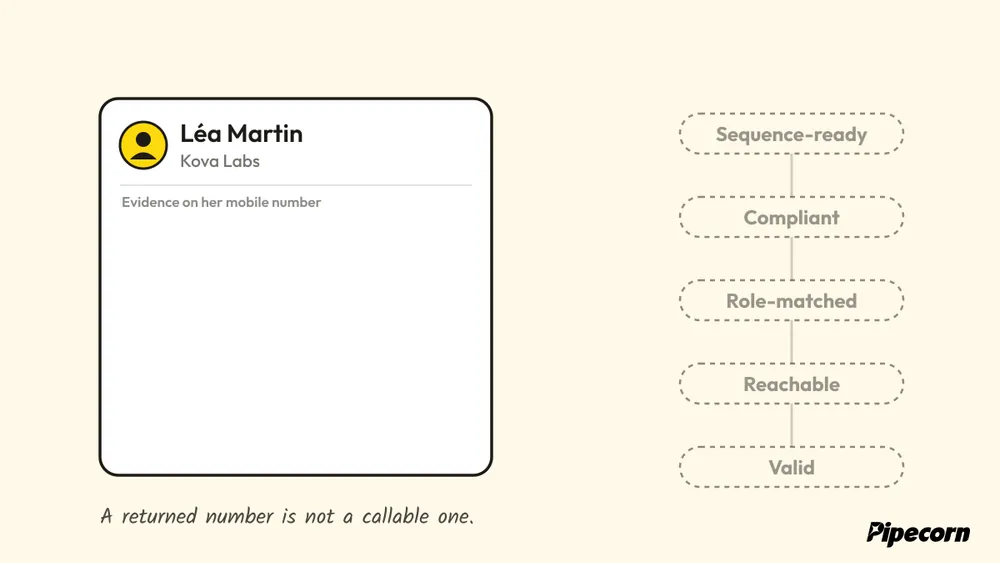
Practical rule: A phone finder should report separate outcomes for valid, reachable, role-matched, compliant, and sequence-ready numbers.
From lookup tool to governance layer
This is why data verification shouldn't be reduced to a green checkmark. Verification needs provenance, a timestamp, confidence, line type, and a disposition such as mobile, landline, VoIP, unreachable, or opt-out. The business association should be stored separately from the caller-ID identity used in an outbound system.
The Federal Communications Commission explains that STIR/SHAKEN digitally signs and validates caller-ID information across IP networks, giving downstream carriers authentication information that can influence whether a call is blocked or labeled. A number that passes a directory lookup can still be reassigned, inaccurately owned, or presented in a way that damages caller reputation.
The contrarian conclusion is straightforward. More accurate discovery can increase exposure when it surfaces personal mobiles without establishing lawful use. A mature sales operation therefore optimizes for actionable contacts, not maximum contact volume. The relevant metric is the share of records that reach the intended person through an approved workflow and produce a meaningful sales conversation.
Single Source Databases Versus Waterfall Enrichment
A single-source database is easy to understand. It stores contact records, applies its own matching logic, and returns a result when its dataset contains one. That model can work for narrow markets and occasional lookups, but it inherits every blind spot in the underlying source. Regional coverage, industry representation, mobile availability, and refresh practices can vary substantially across providers.
A waterfall model treats discovery as an orchestration problem. The system sends a request through a sequence of sources, applies validation rules to each response, and stops when it receives an acceptable result. The architecture is useful when no individual source has dependable coverage across every country and contact category.
Why country routing matters
Numbering plans are national systems, and portability weakens the shortcuts that older enrichment logic often relies on. A prefix may indicate an original allocation, but it can't reliably establish the current carrier after a number moves between networks. Ofcom publishes separate numbering and porting-code data, which illustrates why carrier and line-type attributes should be refreshed instead of inferred from prefixes alone.
Normalization is the first technical gate. The authoritative Google libphonenumber project is designed to parse, format, and validate international telephone numbers using country-specific numbering metadata, and it supports the international E.164 representation, which uses a leading plus sign followed by the country code and national number. That format creates consistency, but syntactic validity still doesn't establish activity, ownership, or consent.
A practical pipeline should therefore:
- Normalize: Convert submitted values to E.164 where the country context is known.
- Validate: Apply the correct national numbering rules.
- Classify: Distinguish mobile, landline, VoIP, shared, and unknown line types.
- Verify: Check current carrier or portability data where available, then test reachability or ownership through an appropriate provider.
- Timestamp: Store when each result was checked and which source produced it.
- Route: Select providers by country, market coverage, and record type rather than using one global default.
The engineering trade-off
Waterfall enrichment isn't automatically better because it calls more sources. Poor routing can waste credits, return conflicting records, or conceal which provider supplied the result. The system needs deterministic rules, clear provenance, and a definition of an acceptable match.
GTM engineers evaluating a web data API should apply the same standard. The integration must make it possible to preserve source data, verification events, country context, and disposition rather than returning an unqualified phone string.
For Pipecorn workflows, the relevant waterfall enrichment architecture is a model for provider routing, not a substitute for governance. A provider may return a number, but the consuming CRM still needs fields that show whether the result is a mobile, whether the person-company relationship remains credible, and whether the record can enter a particular sequence.
Core Features to Evaluate in Enrichment Platforms
Basic lookup tools optimize for speed at the point of search. Enterprise-grade enrichment platforms have to support selection, verification, delivery, and control across the full sales process. The difference becomes visible when a team processes a large account list, works across several countries, or needs to recheck records before activation.
The feature comparison below separates convenience from operating value.
Enrichment Feature Evaluation Matrix
| Feature Category | Basic Tool | Advanced Waterfall Platform |
|---|---|---|
| Source model | One database or one lookup path | Multiple providers routed in sequence |
| Geographic coverage | Coverage depends on a central dataset | Country-aware routing adapts to local availability |
| Validation | Format or database status | Format, line type, carrier, ownership confidence, and timestamp |
| Freshness | Periodic or unclear refresh | Recheck logic for selected records and changed contact status |
| Targeting | Search filters applied after collection | ICP cleaning before credits are spent |
| Delivery | CSV export or manual transfer | API, webhooks, CRM sync, and sequence delivery |
| Credit control | Broad usage rules | Metered verification with routing and cost controls |
| Disposition | Valid or invalid | Mobile, landline, VoIP, unreachable, suppressed, or sequence-ready |
| Operations | Rep-led list handling | Scheduled workflows and auditable enrichment events |
Real-time sourcing matters when the target list changes quickly. Static data can remain useful as a starting point, but the platform should identify when a record needs another check. Job-change tracking and new-hire alerts are valuable because the person-company relationship is part of ownership confidence, not an optional enrichment field.
Questions for the buying committee
A sales leader should ask vendors to demonstrate the full path from source record to dialer. A polished browser extension can still fail if it can't preserve verification evidence or synchronize suppression decisions with the CRM.
- Source transparency: Can the platform identify the provider, retrieval time, country context, and confidence associated with each number?
- Targeting controls: Can AI-based cleaning remove contacts that fail role, seniority, location, or company criteria before phone credits are used?
- Integration depth: Can the system deliver to HubSpot, Salesforce, or Pipedrive, then pass approved records to Outreach, Salesloft, or another engagement platform?
- Credit behavior: Does the vendor explain when credits are consumed, whether failed or invalid results are excluded, and how unused credits are handled?
- Routing logic: Can RevOps teams select country-specific providers or configure custom routing when a market requires specialist coverage?
- Change management: Can the workflow detect job changes, carrier changes, repeated failures, opt-outs, and other events that should remove a record from active sequences?
The lead enrichment tools market includes products optimized for different jobs, from manual prospecting to API-based delivery. The buying decision should follow the operating model. A small team performing occasional lookups may value simplicity, while a global outbound organization needs evidence, routing, suppression, and repeatable delivery.
The strongest platform isn't the one with the largest database claim. It's the one that makes the quality state visible before a number reaches an SDR.
Navigating Telecom Compliance and Verification Rules
A discovered mobile number doesn't grant blanket permission to call, text, autodial, or use an artificial or prerecorded voice. The outreach method changes the compliance question, and the answer also depends on jurisdiction, line type, consent history, suppression status, and the organization's role in the communication.
The autodialer, about to call a wireless number
with no documented prior express consent:

In the United States, the FCC generally requires prior express consent for autodialed or prerecorded calls and texts to wireless numbers. When telemarketing uses prerecorded or artificial voices, written consent, caller identification, and an opt-out mechanism may apply. An established business relationship alone doesn't authorize telemarketing robocalls to a wireless number, as explained in the FCC guidance on unwanted robocalls and texts.
Build the decision around outreach method
A manual live call, an autodialed call, an SMS message, and an AI voice call shouldn't share one boolean field called “phone verified.” Each needs a permitted-use decision.
| Outreach method | Operational question |
|---|---|
| Human live call | Is the number current, owned by the intended contact, and screened against applicable suppression rules? |
| Autodialed wireless call | Is the required prior express consent documented for this number and purpose? |
| Telemarketing text | Is written or otherwise required consent available, and can the recipient opt out? |
| Prerecorded or artificial voice | Does the record contain the specific consent and identification evidence required for the campaign? |
| Any method | Is the source, timestamp, lawful basis, suppression status, and opt-out history auditable? |
For sellers and telemarketers covered by the FTC's Telemarketing Sales Rule, the National Do Not Call Registry must be accessed and listed numbers must be removed from calling lists at least every 31 days, with civil penalties reaching $53,088 per violation, according to the FTC compliance guidance. A registry check should be dated and enforced before a record enters a sequence, including after a newly enriched number is added.
European workflows require a separate legal-basis assessment. The European Data Protection Board's legitimate-interest guidelines describe a three-part test involving a legitimate interest, necessity, and a balance that doesn't override the individual's rights and freedoms. Marketing databases also need updating, and organizations must stop advertising to people who object to direct marketing.
Operational controls before activation
A compliance-first phone workflow should store the following fields:
- Provenance: Where the number came from and when it was obtained.
- Ownership confidence: Why the number is associated with the person and employer.
- Line type: Whether it is mobile, landline, VoIP, or another category.
- Consent and lawful basis: What outreach is permitted and what evidence supports it.
- Suppression status: Registry checks, internal do-not-contact decisions, and objections.
- Audit event: The verification and screening history that supports the activation decision.
Teams comparing providers can use resources that compare phone validation services, but format validation must remain separate from ownership and lawful-use decisions. The phone number verification service concept is operationally complete only when those layers travel with the record into the CRM and engagement system.
High Impact Use Cases for Outbound Teams
The value of verified mobile data appears most clearly when a phone workflow responds to a specific sales event. A static list gives an SDR a contact. A signal-driven process gives the SDR a reason to act, a current relationship to the account, and a controlled route into outreach.
New-hire and job-change outreach
A revenue team tracking job changes can prioritize people who have recently moved into roles relevant to its offer. The enrichment trigger shouldn't be “find every number in the database.” It should be a sequence: detect a role change, confirm the new company and persona fit, enrich the contact, validate the number, check suppression status, and route the record for an approved call.
The SDR, when the job-change alert shows someone
who just moved into a role that fits the offer:

The first outreach can then reference the new operating context rather than relying on a generic introduction. If the person leaves the company, the system should retire the old association and prevent the number from remaining attached to the previous account.
Enterprise multi-threading
An account executive facing an email gatekeeper may need several verified contacts across procurement, operations, finance, and executive sponsorship. Phone discovery helps only when the team distinguishes a direct individual line from a switchboard and records the role relationship clearly.
A disciplined multi-threading workflow enriches only contacts that meet the account plan. It also gives each call a distinct purpose, such as validating a business priority, identifying the process owner, or confirming internal sponsorship. That approach protects the account from repetitive calls to unrelated or shared numbers.
Agency and cross-market prospecting
Outbound agencies often work across markets with different numbering plans, portability practices, and consent expectations. Country-aware routing is therefore more useful than a single global source, particularly when one provider has strong coverage in one market and weak coverage in another.
An agency can separate campaign eligibility from enrichment. Hiring signals, technology changes, and relevant social engagement can identify accounts worth processing, while phone verification determines whether a named contact has an actionable route. The resulting report should show valid, reachable, role-matched, compliant, and conversion-producing contacts as separate stages, so clients don't mistake database volume for campaign quality.
The best use case isn't “find more numbers.” It's “find the right number after a buying signal, then prove that the outreach route is appropriate.”
Integrating Phone Data into Sales Engagement Workflows
A phone number creates no pipeline while it sits in a spreadsheet. RevOps needs a controlled handoff from targeting to enrichment, verification, CRM storage, sequence enrollment, and feedback.
The operating sequence can remain simple:
- Define the eligible audience. Apply company, role, seniority, geography, and campaign rules before spending phone credits.
- Request enrichment selectively. Send only records with a clear sales purpose, and route requests by country or market.
- Store the evidence. Write the number, line type, source, confidence, verification timestamp, lawful-basis metadata, and suppression state to the CRM.
- Apply rejection rules. Exclude invalid, unreachable, opt-out, ambiguous, or stale records from dialer queues.
- Deliver approved contacts. Use an API, webhook, or native CRM integration to place sequence-ready contacts into the correct sales engagement workflow.
- Feed results back. Record failed attempts, carrier or line-type changes, objections, and successful conversations so future enrichment decisions improve.
The lead enrichment API model is appropriate for teams that need programmatic control. API and webhook events should be idempotent, meaning a repeated event doesn't create duplicate contacts or bypass suppression logic. The CRM should also distinguish a newly returned number from a number approved for an active sequence.
Credit governance belongs in the same design. A platform should make clear whether invalid numbers and failed checks consume credits, whether verification is metered separately for emails and mobiles, and whether records are rechecked only when a workflow selects them. Rechecking every stored record may waste budget, while never rechecking allows stale contacts to contaminate the dialer.
A scheduled job can prioritize new-hire alerts, high-fit accounts, and records with old verification timestamps. It should stop before activation when required compliance fields are absent. That control is more valuable than a bulk export because it prevents the CRM from becoming a second ungoverned data warehouse.
Selecting the Right B2B Phone Number Finder
The right platform is an aggregated, compliance-first enrichment system, not necessarily the one advertising the largest contact inventory. A multi-provider architecture can reduce source blind spots, but only if routing, validation, provenance, and suppression controls are visible to the buyer.
The vendor review should cover five areas:
- Coverage architecture: Does the platform use multiple sources, country-aware routing, and fallback logic?
- Verification depth: Does “verified” include format, line type, ownership, freshness, and reachability, or only a database match?
- Compliance readiness: Can the vendor support GDPR and CCPA requirements, provide a Data Processing Agreement, and document relevant controls?
- Workflow delivery: Can data move through API, webhooks, CRM integrations, and sales engagement tools without manual exports?
- Commercial accountability: Are credits spent on actionable results, and can the team measure valid, reachable, role-matched, compliant, and sequence-ready outcomes separately?
SOC 2 Type II, GDPR, and CCPA claims should be verified during procurement rather than accepted as interface badges. The buyer should request applicable documentation, review retention and deletion behavior, and confirm how opt-outs propagate across providers and connected systems.
Teams building internal enrichment infrastructure can also consult this guide for SaaS teams building data products. The same principle applies to vendor selection: data quality is inseparable from the events, controls, and evidence surrounding each returned value.
Pipecorn is one option for teams that need a workspace for ICP-aligned lists, AI-based lead cleaning, waterfall enrichment across more than 100 providers, verified email and mobile delivery, API and webhook workflows, CRM integrations, and sales engagement handoffs. Its fit should be tested against the buyer's own markets, consent process, suppression requirements, and measured sequence outcomes.
A responsible pilot should begin with a representative list and a defined acceptance policy. The team should compare not only returned numbers, but also ownership confidence, current line type, suppression outcomes, usable contacts delivered to the CRM, and conversations generated by the approved workflow. That evidence gives RevOps a defensible total-cost view and prevents a high match rate from masking low-quality or unusable data.
Pipecorn helps outbound teams build ICP-aligned lists, enrich selected contacts through multiple providers, and deliver verified emails and mobile numbers into CRM and sales engagement workflows. Review the Pipecorn workflow with a representative market sample, then measure actionable contacts and compliant conversations rather than raw phone matches.