
7 Best Email Verification Tools in 2026
Compare the best email verification tools for B2B sales by accuracy, methods, pricing, APIs, integrations, and verified-contact workflows.
Article summary
- The best email verification tool depends on where verification sits in the revenue workflow, not on the accuracy badge alone.
- Pipecorn fits teams that need waterfall sourcing, email and mobile verification, signals and CRM delivery in one flow. ZeroBounce and Emailable fit mature hygiene and deliverability programs.
- Bouncer suits predictable, non-expiring credits, Kickbox developer-led API work, NeverBounce ecosystem reach and MillionVerifier budget bulk cleaning.
- Independent benchmarks vary widely with list composition and catch-all domains, so test finalists on a representative sample of your own records.
- Split results into verified, invalid, risky and unknown groups with a written rule for each, and keep SPF, DKIM and DMARC in the same program.
Want to go further? Ask
 ChatGPT
 Claude
 Perplexity
 Grok
GrokOn this page
Accuracy alone doesn't determine the best email verification tool. Sales and RevOps teams also need to compare verification methods, unknown and duplicate billing, API behavior, integration depth, geographic coverage, compliance controls, and how verified contacts reach the CRM or sequencing workflow. A tool that produces a clean CSV may still create manual work for an SDR team, while a strong API may not solve list decay or missing phone data.
The ranking below evaluates tools by the workflow problem they solve. Pipecorn leads for teams that need waterfall sourcing, email and phone verification, enrichment signals, and outbound delivery in one operating flow. ZeroBounce and Emailable are stronger fits for mature hygiene and deliverability programs. Bouncer emphasizes predictable credits, Kickbox developer-facing verification, NeverBounce ecosystem connectivity, and MillionVerifier cost-sensitive bulk cleaning. Vendor-published capabilities are separated from editorial recommendations, and independent benchmarks are treated as evidence rather than accepting headline accuracy claims.
A verifier's homepage: "99.6% accuracy, guaranteed."
The buyer, before testing a single record:

1. Pipecorn
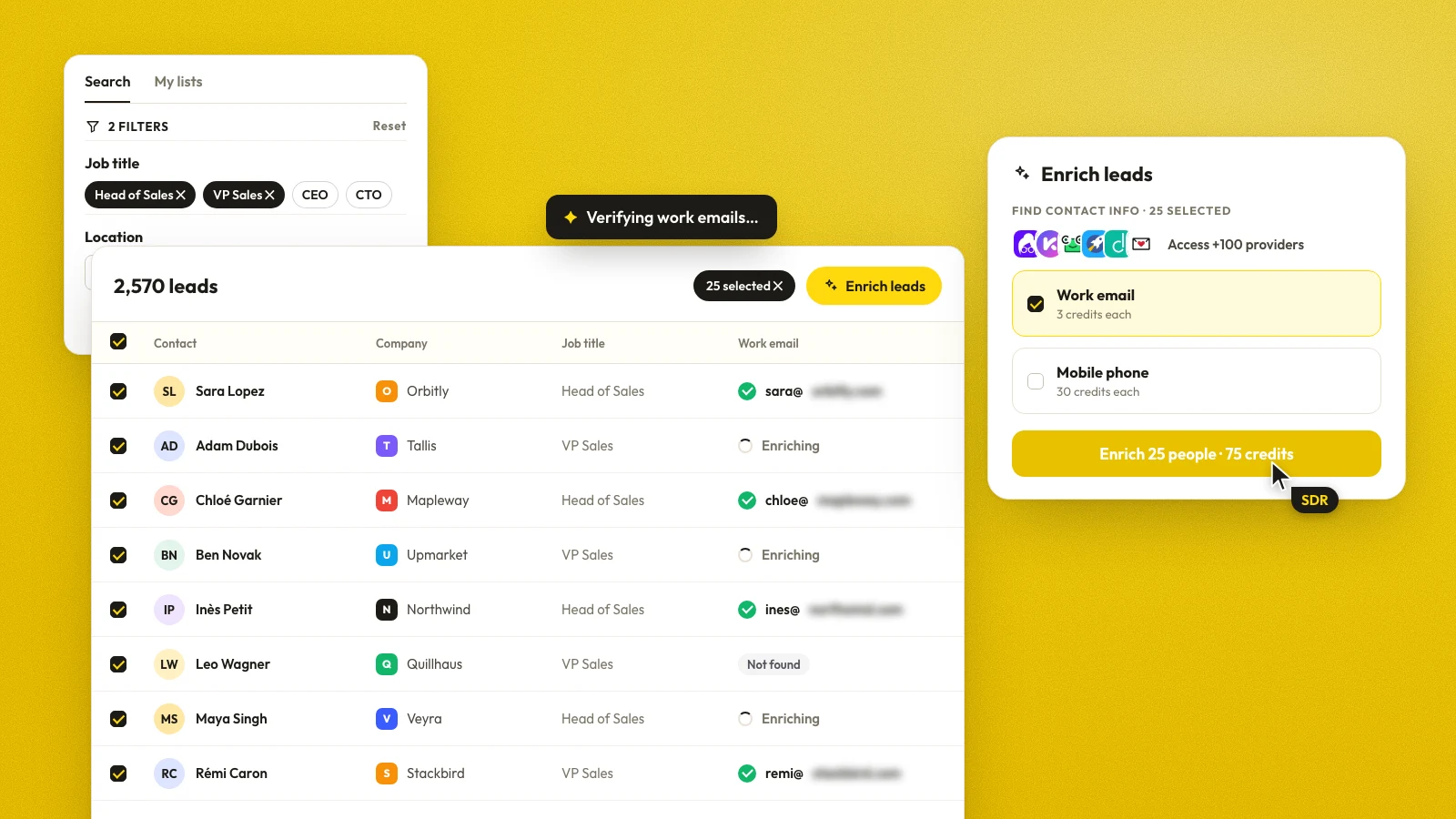
Pipecorn is the strongest fit when email verification is only one stage in a broader outbound workflow. Its Waterfall Enrichment platform routes lookups across 100+ data providers and 50+ countries, selecting providers by country and using multiple sources rather than relying on a single database. That design addresses a problem single-source verification tools can't solve: an address can be valid, yet absent from the first provider a sales team checks.
The platform combines real-time sourcing, clean and refresh of existing records, job-change and hiring signals, and email and mobile verification. Pipecorn says credits are charged only for contacts that pass verification, which makes the billing model more relevant to outbound teams than a simple price per lookup. Regional coverage can still vary by provider, so teams should test representative domains before committing budget.
Practical rule: A verification result has more value when it arrives with a prioritized contact, current company context, and a defined CRM handoff.
For programmatic GTM workflows, Pipecorn exposes API and MCP endpoints, webhooks, and integrations with HubSpot, Salesforce, Pipedrive, Outreach, Salesloft, and lemlist. The MCP server exposes a verify_email tool for real-time verification, so an agent or a RevOps workflow can check an address before it reaches the CRM. The platform also supports credit rollover, tiered rate limits, custom provider routing on higher plans, and enterprise controls including SOC 2 Type II, GDPR, CCPA, and DPA options, according to Pipecorn's published product information.
The trade-off is operational planning. Custom routing, priority support, higher API limits, and dedicated onboarding sit behind higher tiers, while credit metering requires careful forecasting. Teams wanting only an occasional CSV cleanup may find the broader system unnecessary. Teams building a repeatable prospecting-to-sequence workflow should read the Waterfall Enrichment guide before selecting a standalone verifier.
2. ZeroBounce
ZeroBounce is a practical choice for teams that want mature bulk hygiene with deliverability diagnostics in the same account. Its published product positioning includes a 99.6% accuracy claim presented as guaranteed, pay-as-you-go credits, the ZeroBounce ONE subscription, credit rollover, and no charge for unknown results. Those are vendor claims and should be tested against the team's own B2B domains, particularly where catch-all behavior is common.
The tool supports bulk file processing and a real-time API. ZeroBounce also advertises activity scoring, inbox placement tests, and DMARC and blacklist monitoring, so a deliverability team can investigate more than whether an address responds to validation. Finder and scoring features consume additional credits, however, and that can make total usage cost higher than the verification line item suggests.
A La Growth Machine benchmark of 12 services on 47,000 emails over 90 days measured NeverBounce at 99.1%, Clearout at 98.4%, and ZeroBounce at 96.5% against actual bounce data. Scored with unknown results counted as failures, the same tools land far lower, which is why catch-all handling matters on B2B domains. That gap supports a controlled sample test rather than a purchase decision based on a guarantee alone. Independent benchmark results provide useful context for that evaluation.
Unknown results shouldn't be forced into either the send or suppress bucket. They need a documented workflow.
ZeroBounce suits RevOps teams that need transparent billing options, documented integrations, and deliverability tooling beyond basic validation. Its main limitation is that catch-all addresses still require risk-based handling. Teams connecting verification to a broader enrichment and CRM process can compare its API requirements with Pipecorn's email verification API workflow. The ZeroBounce platform remains the more focused choice when list cleaning is the central requirement.
3. Bouncer
Bouncer earns its place for teams that care about predictable credit economics. Its published model uses pay-as-you-go credits that never expire, and it doesn't charge for duplicate or unknown results. That policy matters when a RevOps team repeatedly validates overlapping exports from a CRM, enrichment platform, and event list. The team pays for usable verification work rather than repeatedly paying for the same unresolved records.
Bouncer also offers a real-time API and Bouncer Shield, a form-level validation option for stopping poor-quality addresses at signup. Its deliverability kit adds seed and inbox testing, although those capabilities can increase total spend when a team needs more than basic verification. Bouncer's public compliance guidance identifies SOC 2 Type I as complete and Type II as in progress, a distinction enterprise procurement teams should include in vendor review.
Independent 2026 testing found substantial variance among verification tools. In a 15-tool test on 3,000 real business emails, Hunter recorded 70.00% overall accuracy, followed by Clearout at 68.37% and Kickbox at 67.53%. The broader lesson isn't that these figures define every provider, but that results depend heavily on the list composition and test conditions. The benchmark methodology and results support testing Bouncer on the actual ICP before scaling.
Bouncer is especially suitable when credits need to remain available between campaigns and when billing rules must stay easy to explain. It is less suitable for teams that need enrichment, phone discovery, job-change signals, or automated delivery into sales engagement tools from the same workspace.
For implementation guidance, teams can use this email verification process to define syntax, domain, mailbox, unknown, and suppression handling before connecting a verifier to the CRM.
4. Emailable
Emailable fits organizations that treat compliance, signup capture, and risk classification as one verification problem. The company publishes SOC 2 Type II compliance, GDPR and CCPA positioning, a public Trust Center, SSO and two-factor authentication options, and a Deliverability Guarantee. These are published vendor claims, so procurement teams should still review the current Trust Center, data processing terms, and retention controls.
The product returns verification states alongside a 0 to 100 Email Quality Score. That extra score gives teams a way to separate clearly deliverable contacts from addresses requiring review, rather than sending every non-invalid result directly to a sequence. Emailable supports bulk verification, API access, and an embeddable widget, which makes it relevant to both marketing databases and product signup forms.
Unknown and duplicate credits are credited back, while credits don't expire. The trade-off is entry cost for smaller operators, since the published pay-as-you-go minimum is 5,000 credits. Inbox placement and blacklist monitoring are available as additional capabilities and consume separate credits, so teams should calculate the full operating cost if deliverability monitoring is part of the requirement.
A 2026 catch-all benchmark across 10,000 addresses at 251 catch-all domains found that real contacts identified ranged from 4% to 98.2% depending on the tool, and seven of the fourteen tests left at least 94% of the records unresolved. The result makes catch-all policy more important than a single accuracy badge. The catch-all benchmark supports routing uncertain records into a review, enrichment, or second-pass workflow.
A catch-all domain accepts mail for every address.
The verifier, asked whether this one person really exists:

Emailable is a strong shortlist candidate for enterprise forms and compliance-led teams. It isn't the natural choice for an SDR organization that also needs waterfall sourcing, mobile numbers, intent signals, and automated sequence delivery.
5. Kickbox
Kickbox is designed for teams that need verification data inside developer-managed workflows. Its real-time API returns granular fields such as accept_all, role, disposable, did_you_mean, and score, giving engineers more control than a single valid or invalid field. Bulk verification and point-of-capture form validation extend the same logic to uploaded lists and signup flows.
The developer experience is the main editorial reason to consider Kickbox. Published product materials emphasize SDKs, straightforward documentation, and deliverability tools such as seed and inbox testing. Those features can reduce the translation work between a verification vendor and an engineering-owned lead intake system. The trade-off is that catch-all addresses may be classified as risky or unknown, so RevOps needs a clear policy before those records enter an outbound sequence.
Kickbox also publishes pay-as-you-go flexibility and low entry points, but public pricing can be clearer on review sites than on the official homepage. Pricing should therefore be confirmed directly with Kickbox before procurement, especially where API volume, deliverability add-ons, or support requirements affect the commercial model.
SPF, DKIM, and DMARC remain separate from address verification. SPF authorizes sending servers, DKIM signs messages, and DMARC defines how receiving systems handle authentication failures, including monitoring, quarantine, or rejection. GoDaddy's authentication explanation describes how the three protocols work together.
A valid mailbox doesn't guarantee inbox placement. The sender domain still needs aligned authentication and a credible sending history.
The SDR: "Every address came back valid, let's send."
The sender domain with no SPF, DKIM or DMARC:

Kickbox is a good fit for GTM engineers building validation into forms, applications, or internal services. Teams wanting CRM sync, waterfall enrichment, and verified phone discovery need a broader platform rather than a developer-oriented email verifier alone. The data verification guide gives RevOps teams a useful framework for connecting result fields to downstream record decisions.
6. NeverBounce
NeverBounce is a sensible option for established teams that value ecosystem reach and repeatable list cleaning. Its published product capabilities include a REST API, a JavaScript widget, bulk verification, and integrations across Zapier, marketing automation platforms, and CRMs. That connectivity can matter more than a marginal difference in validation results when a company already has operational systems built around those integrations.
The platform's documentation also acknowledges the limits of SMTP validation and catch-all addresses. That positioning is useful for B2B teams because a receiving server can accept mail for a domain without proving that a specific person's mailbox exists. NeverBounce can therefore support a cautious policy that separates deliverable, risky, and unresolved records instead of pretending that every result has equal confidence.
The second 2026 benchmark cited earlier measured NeverBounce at 99.1% against actual bounce data from its test dataset. Because that statistic comes from a separate benchmark rather than a universal guarantee, it should guide a sample comparison, not replace one. Domain mix, corporate security policies, and sending practices can change the outcome. Teams evaluating the product should read its official verification platform information and test live records from the intended ICP.
NeverBounce is strongest when the workflow begins with a list and ends with a cleaned file or an existing marketing database. Its less accessible official pricing page means procurement teams may need direct confirmation rather than relying on public review references. Teams also shouldn't assume that ecosystem integrations eliminate the need for CRM rules, suppression logic, or bounce monitoring.
A broader data validation techniques guide can help teams define those rules before an integration starts moving records automatically.
7. MillionVerifier
MillionVerifier competes for budget-led bulk cleaning. Its published offering includes bulk list verification, a real-time API, daily auto-clean integrations with major ESPs and CRMs, 40+ integrations, non-expiring credits, and 100 free trial credits. That combination lets a small outbound team test the workflow before paying for a larger recurring program.
The product's strongest use case is a team that already owns its prospect data and needs an inexpensive recurring cleaning layer. MillionVerifier publishes low high-volume pricing and simple pay-as-you-go options, which can appeal to agencies and SDR teams processing large exports. The team should still validate results on representative samples because aggressive marketing claims don't reveal how a verifier handles the team's particular domains, catch-alls, and role addresses.
Independent research shows why that test matters. One 2025 deliverability survey found that only 23.6% of businesses verify lists before every campaign, while 40.2% verify monthly and 7.4% never verify. The deliverability survey connects verification frequency with operational discipline, not just a one-time database cleanup.
MillionVerifier may be less suitable for enterprise programs that require deep support SLAs, extensive documentation, or a broad compliance review. Those requirements can outweigh a lower list price. Teams should also define how daily auto-clean updates affect CRM ownership, suppression fields, and active sequences before enabling automatic changes.
For cost-sensitive bulk operations, the best decision isn't always the lowest credit price. It is the tool that produces acceptable deliverability outcomes without creating manual review, duplicate billing, or downstream data repair.
Top 7 Email Verification Tools Comparison
| Solution | Implementation complexity | Resource requirements | Expected outcomes | Ideal use cases | Key advantages |
|---|---|---|---|---|---|
| Waterfall Enrichment: Email & Phone Finder (Pipecorn) | High, API-first with multi-vendor routing and integrations | Moderate–High, credits for verified results, developer time for integrations, enterprise tier for custom routing | Verified emails and mobiles from several providers; fewer bounces; faster list building | Outbound sales teams, programmatic workflows, enterprises needing broad global coverage | Aggregates 100+ providers, country-aware routing, pay-for-verified model, CRM/webhook delivery, compliance controls |
| ZeroBounce | Low–Moderate, real-time API and bulk processing | Pay-as-you-go or subscription credits; add-ons increase usage | High validation accuracy (~99.6% claimed); reduced bounce and clearer list hygiene | Teams needing bulk cleaning plus deliverability diagnostics | Transparent pricing, unknowns free, bundled deliverability tools (inbox tests, DMARC/blacklist) |
| Bouncer | Low, simple API and on-form validation (Bouncer Shield) | PAYG credits that never expire; minimal dev effort for form integration | Cost-efficient verification with predictable billing | Cost-conscious teams and point-of-capture validation on web forms | Clear pricing tiers, no charge for unknowns/duplicates, on-form real-time validation |
| Emailable | Moderate, bulk/API/widget with enterprise compliance | Higher minimums (e.g., 5,000 credits); deliverability add-ons use extra credits | Enterprise-grade compliance and quality scoring; deliverability guarantee claimed | Enterprises needing SOC 2 compliance, quality scoring, and embeddable widgets | SOC 2 Type II, 0–100 quality score, transparent trust posture, bulk + widget support |
| Kickbox | Low, developer-friendly API and SDKs | Flexible PAYG pricing; easy dev integration | Granular verification results and actionable reason codes | Marketing/engineering stacks and developer-led integrations | Detailed result fields (role, disposable, accept_all), strong docs and SDKs |
| NeverBounce | Low, REST API and JavaScript widget, wide integrations | PAYG with many ecosystem connectors (Zapier, CRMs) | Stable bulk cleaning with practical guidance on SMTP/catch-all limits | Teams needing broad integrations and partner ecosystem support | Extensive integrations, practical documentation, established market presence |
| MillionVerifier | Low, straightforward bulk and API offering | Very low-cost credits, free trial, credits never expire | Fast, low-cost bulk cleaning suitable for high volumes | Budget-sensitive teams and quick proof-of-concept testing | Extremely competitive high-volume pricing, non-expiring credits, quick trial credits |
Choose the Verifier That Fits Your Revenue Workflow
The right choice depends on where verification sits in the revenue process. Pipecorn is the strongest option when verified emails need to become qualified outbound contacts, not just rows in a cleaned spreadsheet. Its waterfall sourcing across 100+ providers, phone discovery, real-time verification, job-change and hiring signals, API and MCP endpoints, webhooks, CRM integrations, and sales-engagement delivery support a continuous prospecting workflow. Credit metering and rollover help with planning, while custom routing and higher limits are available on higher tiers.
ZeroBounce and Emailable are better fits for mature hygiene programs that also need deliverability diagnostics, compliance controls, or form-level validation. ZeroBounce combines verification with activity scoring, inbox placement, and authentication monitoring. Emailable adds a quality score, enterprise compliance posture, and embeddable validation. Both require teams to evaluate the cost of add-ons and the handling of unknown or catch-all records.
Bouncer suits teams that prioritize predictable, non-expiring credits and no billing for duplicates or unknowns. Kickbox is the more natural choice for developers who need granular API fields, SDKs, and clear result codes. NeverBounce makes sense for organizations that value established ecosystem connectivity and bulk list operations. MillionVerifier belongs on the shortlist for budget-led bulk cleaning, provided the team validates results on its own sample and accepts lighter enterprise support expectations.
Before scaling, every SDR, RevOps, or GTM team should run a representative list through the finalists. The sample should include the domains, countries, role addresses, catch-alls, and data sources found in actual campaigns. Results should be split into verified, invalid, risky, and unknown groups, with a documented rule for each group.
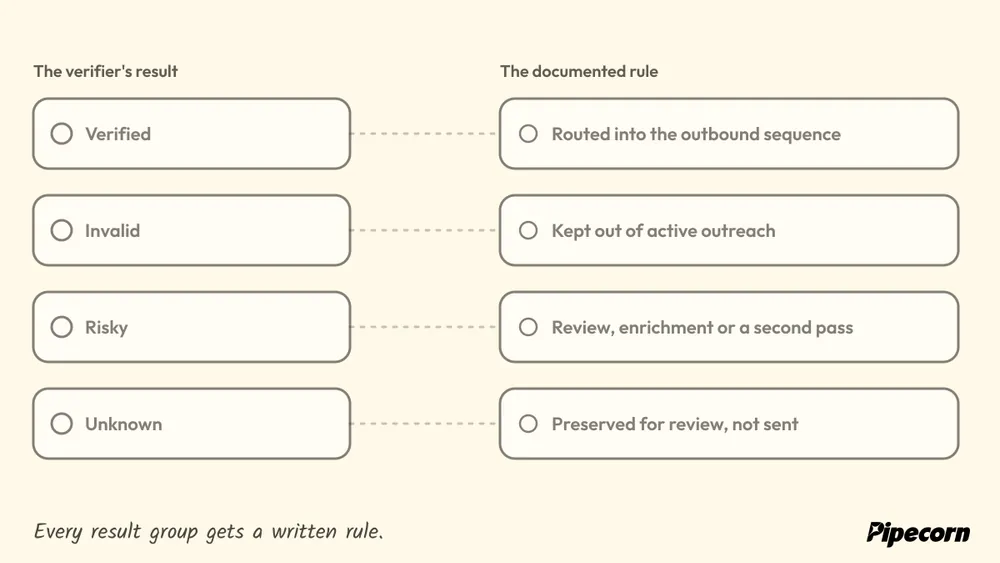
The operational handoff matters as much as the verifier. A CRM or sequencing rule should prevent invalid records from entering active outreach, preserve unknowns for review, and record the verification timestamp and provider result. After launch, the team should monitor bounce outcomes and compare them with the verifier's classifications before expanding volume.
- Build the sample. Include the domains, countries, role addresses, catch-alls and data sources found in actual campaigns.
- Run every finalist. Put the same representative list through each tool on the shortlist.
- Split the results. Group records as verified, invalid, risky and unknown, with a documented rule for each group.
- Set the CRM rule. Keep invalid records out of active outreach, preserve unknowns for review, and store the verification timestamp and provider result.
- Watch the bounces. Compare bounce outcomes with each verifier's classifications before expanding volume.
Authentication must remain part of the same program. Google states that senders must set up DKIM and or SPF and DMARC, while Microsoft explains that DMARC defines handling for messages that fail SPF or DKIM. Microsoft's email authentication guidance confirms why a clean list can't compensate for weak sender identity. Teams should publish SPF and DKIM records, align DMARC, review reports, and tighten policy as confidence grows. DMARC's overview explains the progression from monitoring to quarantine and rejection.
Pipecorn is the practical choice when sales and RevOps teams want to source, verify, enrich, and route qualified contacts without stitching together separate point solutions.
Pipecorn combines waterfall sourcing across 100+ providers with email and mobile verification, AI cleaning, signals, APIs, webhooks, CRM sync, and sales-engagement delivery. Sales and RevOps teams can use Pipecorn to test representative prospect lists, remove uncertain records from active sequences, and route verified contacts into a repeatable outbound workflow.