Effective Subject Lines for Sales Emails: B2B Examples
Write effective subject lines for sales emails using real buyer signals, honest examples and reply-based tests. Choose a pattern for your next send.

On this page
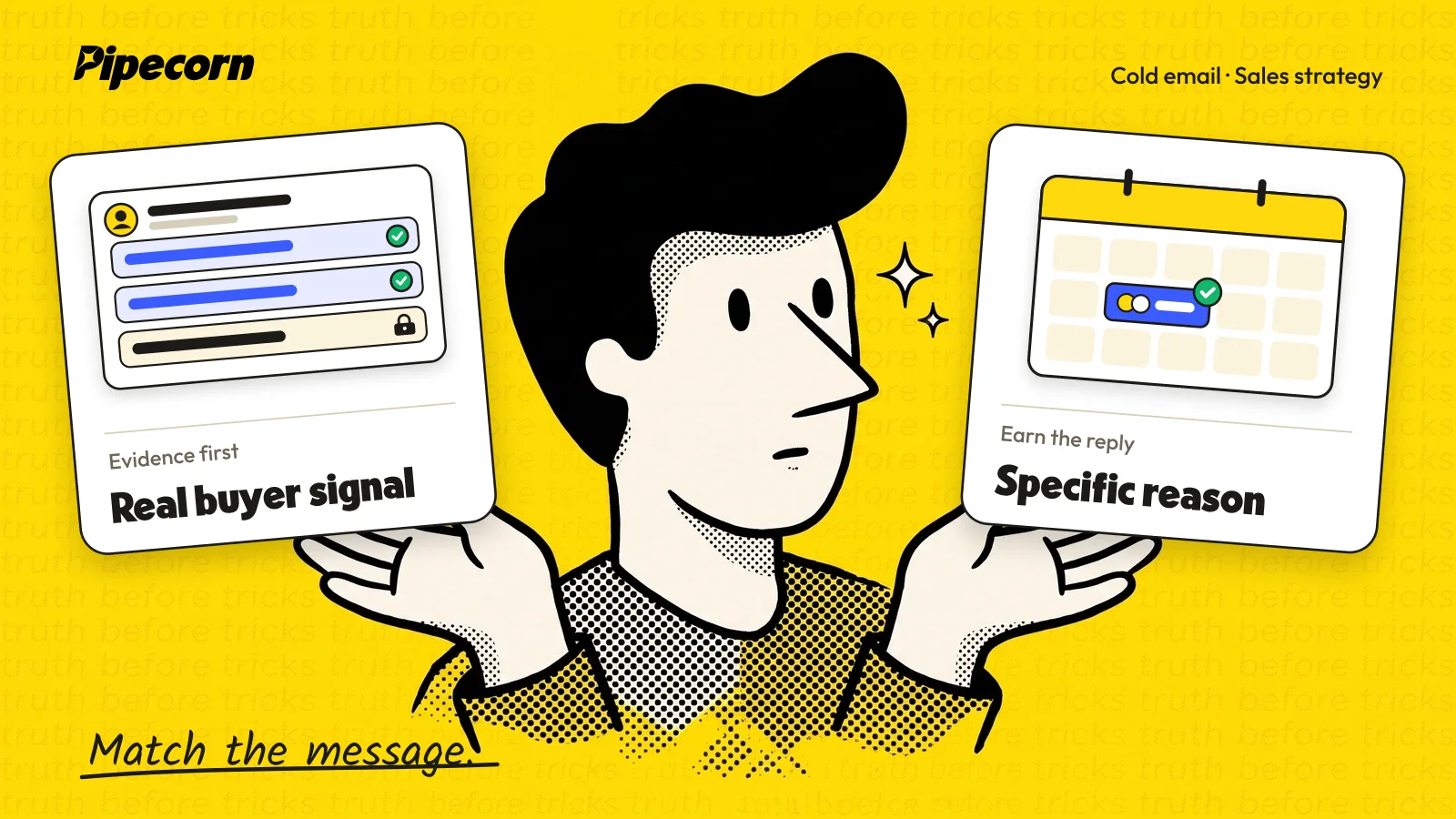
Effective B2B sales email subject lines give the right buyer a specific, truthful reason to read. Start with a fact you can verify, connect it to a relevant question, and make the opening sentence deliver on that promise. "SDR hiring plans" can work as a starting point when the company is actually hiring SDRs. "Your call-list process" is a safer hypothesis when you know the role but have no buying signal.
This guide covers B2B prospecting and follow-up emails, not ecommerce promotions or newsletters. There is no universal winning phrase or guaranteed open rate. The examples below are writing patterns to adapt and test, not campaign results. Their value is the decision behind each one: when to use it, what to check, and when to leave it out.
Choose a subject line from the facts you have
Before writing, separate an observation from an assumption. A public job opening is an observation. "They must be unhappy with their prospecting data" is an assumption. A useful sales email can explore that possibility without pretending it is established.
| What you know | The safe approach |
|---|---|
| A relevant hiring announcement | Name the hiring context. Ask about the process it might affect. |
| A former contact has moved roles | Reconnect around the real relationship. Verify the new role first. |
| Only the buyer's role and company fit | Ask a specific role-relevant question. Do not invent an event. |
| A real call, reply or promised resource | Name that exact topic and deliver the agreed next step. |
| An uncertain identity or outdated employer | Repair the record before writing or sending. |
This choice belongs inside your outbound sales strategy: the account, buyer, reason to contact and offer should fit together before you test wording. A clever subject cannot make an irrelevant list relevant.
Ten B2B sales email subject lines to adapt
Each example assumes a B2B sales context. Replace the topic with something true about your audience, keep the important words near the beginning, and preview the result on the devices your team uses. Do not squeeze a meaningful subject into an arbitrary word limit.
1. "SDR hiring plans"
Use when: the company has a current, relevant SDR opening. This names an observable event without claiming to know the team's internal problems.
Check first: the job is still open and belongs to the right business. In the body, explain how your offer relates to onboarding, account coverage or list preparation. Hiring alone does not prove budget, urgency or dissatisfaction.
2. "Prospecting at your new team"
Use when: a contact you genuinely know has joined another company and prospecting is relevant to the new role.
Check first: their employer, title and your actual relationship. Reconnect without implying the new company has the same needs as the old one. Job-change tracking can help identify moves to review; a detected move is a reason to investigate, not proof of purchase intent.
3. "Your call-list process"
Use when: you sell to sales or RevOps leaders but have no verified event to reference. The line opens a role-specific question rather than inventing a pain point.
Check first: the recipient plausibly owns this process. Ask how contacts become ready for reps, rather than announcing that their current database is broken. If you cannot explain the relevance in the first sentence, narrow the audience.
4. "Compare phone coverage?"
Use when: you can offer a real comparison on a relevant sample and the buyer is responsible for contact-data quality.
Check first: your team can actually deliver the comparison you propose. Define what would be checked in the body. Do not imply a known improvement, guaranteed connect rate or named competitor weakness without evidence.
5. "A contact-data checklist"
Use when: you have a concise resource that directly helps the recipient's work.
Check first: the resource exists, is accessible, and matches the promise. Give the useful content or clearly offer it. A checklist should not turn into an unexpected compulsory demo, and a generic company brochure should not be labeled a tailored audit.
6. "Following the introduction"
Use when: a real introduction has been made and the recipient can recognize it. A known person's name may be more specific if using it is appropriate.
Check first: the introduction actually happened. A shared LinkedIn connection is not a referral. In the first line, explain the connection accurately; never claim that someone recommended you when they did not.
7. "The export workflow we discussed"
Use when: a real conversation covered that workflow and this email delivers the next step.
Check first: the topic and promise in the call notes. A missed call or a voicemail does not justify "we discussed." Name the resource, answer or task the buyer expects instead of sending a generic "just following up."
8. "One more detail on contact routing"
Use when: an earlier outreach message addressed contact routing and you now have one genuinely useful detail to add.
Check first: the new information earns the follow-up. Do not pretend there was a two-way conversation if the recipient never replied. Continuing a real email thread is different from typing a fake reply prefix into a new subject.
9. "Still reviewing data quality?"
Use when: the buyer previously confirmed that this was a project or priority, and the agreed follow-up timing has arrived.
Check first: the previous conversation and any request not to contact them. "Still" implies prior knowledge; remove it if that knowledge does not exist. Let the recipient tell you that the project has stopped rather than manufacturing a deadline.
10. "Who owns contact enrichment?"
Use when: the account fits your offer but ownership is genuinely unclear. Explain briefly why you thought this recipient might know.
Check first: that your research has not already answered the question. Use this sparingly, not as an excuse to email every person at an account. If you know the responsible team, a direct, relevant message is the more respectful route.
Make the first sentence keep the promise
Write the body before polishing the subject. That makes it harder to promise something the message never delivers. The subject creates an expectation; the opening supplies evidence, explains relevance and leads to a small, answerable question.
Only use this example when you have verified the opening and can help with the process. Notice what it leaves out: no invented growth target, no claim that the company is struggling, no fabricated referral, and no calendar invitation masquerading as an agreed meeting.
Cold email and LinkedIn InMail are different channels. If you are writing inside LinkedIn instead, use the separate InMail subject-line guide rather than assuming email conventions and constraints transfer unchanged.
Personalize only what you can verify
A correct first name is not enough. You also need the right person, current employer and a credible connection between their work and your offer. When a field is missing or unreliable, use a neutral fallback or exclude the record. Do not let a merge field guess for you.
- Identity: confirm the contact belongs to the intended account and role.
- Evidence: record the source and date for the hiring, role change or previous conversation.
- Relevance: explain why the observed fact matters to the offer. Keep inference separate.
- Delivery: review the address, sender setup and applicable outreach requirements.
- Suppression: remove opt-outs and contacts your team should no longer approach.
Use an email-address verification process to investigate address quality, but keep it separate from relevance and permission. Verification does not tell you whether someone wants an email.
Prefer relevant public business context or a real prior exchange. Skip private-life details and creepy "we saw you looking" language. If you would struggle to explain where a detail came from, it is a poor foundation for a first sales conversation.
Replace tricks with specific reasons to read
Google's sender guidelines say subjects and headers should accurately represent the sender and message. They specifically warn against starting with "Re:" or "Fwd:" unless the message is an actual reply or forward. Changing a few supposedly risky words is not a substitute for truthful content, sender authentication and appropriate sending practices.
| Avoid | Use a truthful alternative |
|---|---|
| "Re: our meeting" when none happened | "Question about your call lists" if that is the actual topic. |
| "Urgent: action required" for an unsolicited pitch | "Contact-data review" without a manufactured deadline. |
| "Your colleague recommended us" without a referral | "Who owns contact enrichment?" when you genuinely need direction. |
| "Double your replies" without supporting evidence | "Compare phone coverage?" only if you can provide that comparison. |
For US commercial email, the FTC's CAN-SPAM guide requires subject lines to accurately reflect the message and explains that B2B email is not exempt. That is one requirement, not a complete compliance checklist; check the rules that apply to your recipients and sending operation.
Test replies, not just opens
An open-rate increase is not enough to call a subject line better. Apple explains that Mail Privacy Protection downloads remote content in the background regardless of whether the recipient engages. That limits what a tracking-pixel load tells you about a human reading your message. Google also says it cannot verify third-party open rates.
For a practical sales test, compare similar audiences and change one variable. Define a positive reply before launching: for example, a relevant buyer asking to explore the problem or agreeing to a next step. Keep automatic replies, opt-outs and negative responses in separate categories.
- Audience: one buyer role, comparable accounts and the same evidence requirements.
- Variant: change only the subject, not the offer, sender identity or opening paragraph.
- Assignment: split eligible contacts randomly; avoid exposing the same buyer to both versions.
- Observation: use the same pre-agreed reply window and follow-up policy for both groups.
- Readout: retain delivered counts, positive replies, negative replies, opt-outs and qualified next steps.
- Decision: keep testing if the difference is too small or the evidence too sparse to interpret.
A small campaign may not support a confident winner. Do not keep checking the result until one version briefly leads, then stop. If the subject, audience and offer all change together, report a campaign change rather than attributing the outcome to the subject alone.
If opens look healthy but buyers do not respond, inspect the list, promise-to-body match and ask. If delivery is failing, investigate the sending setup and contact data before rewriting every subject.
Build the list before polishing the line
The useful sequence is simple: identify the right account and person, verify the context, write a specific message, then measure the response. Start with one pattern above and one audience you understand instead of sending ten unrelated variants to a mixed list.
Pipecorn's workspace helps teams build qualified contact lists and prepare contact data for their sales workflow. It is the upstream data step, not a promise that a phrase will convert or an email will reach the inbox. Explore the Pipecorn workspace if your team needs a cleaner starting point before writing the next sequence.