How to Find Business Phone Numbers: 2026 Guide
Learn how to find business phone numbers that connect. Discover waterfall enrichment, verification tips, and CRM workflows.

On this page
- 01Table of Contents
- 02Why Most Business Phone Numbers Are Not Worth Dialing
- 03Core Methods for Sourcing Business Phone Numbers
- 04Waterfall Enrichment Across Multiple Data Providers
- 05Verification Best Practices to Ensure Connect Quality
- 06Legal and Compliance Considerations for Phone Outreach
- 07Integrating Verified Numbers into CRM and Engagement Tools
- 08Troubleshooting Common Phone Data Pipeline Failures
The popular advice on how to find business phone numbers is incomplete. It tells you to search LinkedIn, check a company website, or buy a large contact database. Those methods can produce records, but a record isn't automatically a number worth dialing.
A usable business number needs to be current, assigned, reachable, and connected to the right person. A number may still appear in a database even after the contact changes jobs, the line is disconnected, or the call routes to a general switchboard. The practical workflow is therefore less about collecting the largest list and more about sourcing, validating, prioritizing, and refreshing numbers before your team spends time calling them.
Table of Contents
- Why Most Business Phone Numbers Are Not Worth Dialing
- Core Methods for Sourcing Business Phone Numbers
- Waterfall Enrichment Across Multiple Data Providers
- Verification Best Practices to Ensure Connect Quality
- Legal and Compliance Considerations for Phone Outreach
- Integrating Verified Numbers into CRM and Engagement Tools
- Troubleshooting Common Phone Data Pipeline Failures
Why Most Business Phone Numbers Are Not Worth Dialing
Finding a business phone number and finding a callable direct dial are different tasks. A database can show that a number exists, but it may not confirm whether the number still belongs to the intended decision-maker. It may also be a company main line, a recycled mobile number, or an old record copied from another database.
Provider performance varies sharply. Reported phone-data accuracy ranges from 63% to 91%, while coverage ranges from 26% to 92%, according to the 2025 phone data benchmark report. Those figures make raw coverage a poor substitute for connect quality. A provider can return more records while producing fewer conversations if those records are stale or misattributed.

Coverage isn't the same as usability
A number deserves a place in a calling queue only after it passes several practical questions:
- Is it assigned? Carrier or HLR-style checks can indicate whether the number is active on a network.
- Is it direct? A switchboard may reach the company but not the person your rep needs.
- Is it correctly matched? The number should belong to the named contact, not merely the same employer.
- Is it recent? A previously valid number can become useless after a job change or organizational move.
The distinction matters because an outbound team pays for more than data access. Reps spend time preparing accounts, dialing, leaving messages, and recording outcomes. A list with impressive coverage but weak assignment and identity checks can create the appearance of productivity while lowering the number of meaningful conversations.
Practical rule: Measure phone-data quality by connects and correct-person conversations, not by how many records a vendor can display.
A verification-first process also changes list management. Instead of treating enrichment as a one-time event, teams should record when each number was sourced, which provider returned it, what checks it passed, and when it needs another review. That turns phone data into an operational asset with a freshness policy rather than a static spreadsheet.
Core Methods for Sourcing Business Phone Numbers
The best source depends on the list you're building. A narrow account-based campaign needs depth and identity accuracy. Territory prospecting needs broader coverage, but it still benefits from a clear validation step before numbers reach a dialer.
Start with the most relevant public context
A company website is often the quickest route to a main line, department number, or location-specific contact. Check the contact page, leadership pages, press materials, partner pages, and downloadable documents. Websites are useful for confirming that a company operates in a market, but they rarely provide a personal mobile number for a specific buyer.
LinkedIn helps with persona and employment context. A profile can confirm the person's role, employer, location, and recent job history before you attempt enrichment. Manual research works for a small, carefully selected account list. Browser-based workflows can help representatives reveal contact details from Sales Navigator and related pages, including the Sales Navigator phone-number workflow, but teams should still validate every returned number.
Public directories have a longer history than digital prospecting. The first known telephone directory was issued on 21 February 1878 in New Haven, Connecticut, and listed 50 individuals, businesses, and other offices with telephones, as documented in the history of the telephone directory. Published business listings such as Yellow Pages later made phone discovery a standardized public-reference task.

Use data platforms for scale, not blind trust
Dedicated B2B data platforms earn their place when you need to enrich many contacts, apply consistent filters, or connect results directly to a CRM. They can reduce manual searching, but a single vendor shouldn't become your only source. Use the platform to produce candidates, then apply assignment, identity, and recency checks before activating outreach.
A practical sourcing sequence looks like this:
- Confirm the account and persona. Match company, role, country, and employment status.
- Collect candidate numbers. Use the website, professional networks, directories, and one or more B2B providers.
- Record provenance. Store the source, collection date, number type, and confidence status.
- Verify before delivery. Exclude numbers that fail connectivity or identity checks.
- Route by campaign need. Send high-confidence direct dials to calling sequences and hold uncertain records for manual review.
For a focused ICP, manual website and profile research may deliver better judgment than bulk enrichment. For a broad territory, API-based sourcing and scheduled enrichment usually create a more repeatable process. The deciding metric is cost per usable number, not cost per raw record.
Waterfall Enrichment Across Multiple Data Providers
A phone number is useful only if it is worth dialing today. Coverage alone does not answer that question. Providers vary by region, company size, industry, and how quickly they replace stale records. One may perform well in North America but return few usable numbers in EMEA. Another may find mobile numbers in APAC while missing smaller companies.
Waterfall enrichment addresses those gaps by sending each prospect through a controlled sequence of providers. The first source returns a candidate, real-time checks assess its quality, and the workflow continues only when the result is empty, invalid, stale, or below the campaign's acceptance standard. The goal is a verified number, not the first number available. Teams building this process can use this waterfall enrichment guide for provider routing to map the sequence before connecting it to outbound tools.
Route by quality, geography, and cost
Reported direct-dial accuracy varies significantly across providers, according to this B2B contact-data benchmark analysis. That variation is why a waterfall can produce more usable records than a single database, even when each source has gaps.
Set the routing policy before purchasing deeper credits:
- Provider order: Start with the source most likely to perform for the contact's country, industry, and company size.
- Acceptance rules: Require valid formatting, a current assignment signal, and a reasonable person-to-number match.
- Credit controls: Use cheaper or higher-probability sources before paying for deeper enrichment.
- Stop conditions: Stop after finding a verified direct dial, not merely after finding any number.
- No-result handling: Send unresolved records to manual research, email-first outreach, or a later refresh.
Geographic routing should be explicit. A provider that performs well in North America may produce weaker results in EMEA or APAC. Country-aware selection can account for local availability, numbering conventions, carrier signals, and regional privacy requirements. Real-time verification should run after each lookup, so weak candidates do not consume the next enrichment step or enter a rep's queue.

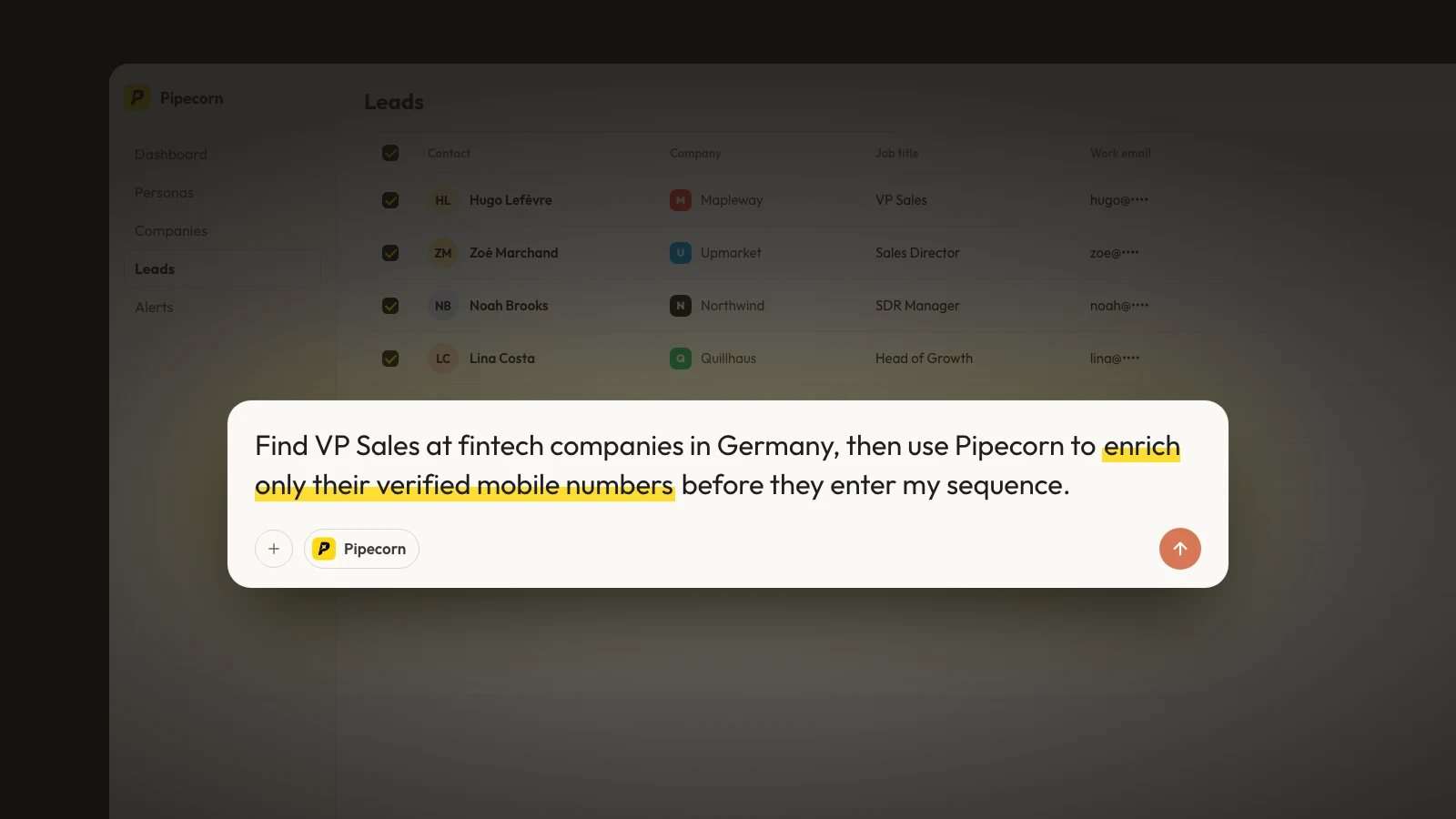
Record why each provider was queried, what it returned, and why the workflow stopped. That audit trail lets RevOps compare yield by region, identify failing vendors, and adjust routing based on connect results rather than coverage claims. Pipecorn is one example of a platform that aggregates 100+ providers, supports country-based vendor routing, and delivers verified contact data through outbound workflows. Treat those capabilities as infrastructure, while keeping your own acceptance criteria.
A visual walkthrough can help teams understand how cascading lookups fit together:
Verification Best Practices to Ensure Connect Quality
A number can look valid and still waste a rep's call. Verification should decide which records are ready today, which need another check, and which should leave the queue.
Start with normalization. Convert each number into a consistent international format, remove obvious formatting errors, and label mobile, landline, company, and switchboard numbers separately. Formatting does not establish reachability, yet inconsistent values can fail downstream checks or create duplicate CRM records.
Run checks before the first dial
Use carrier or HLR-style verification where available to identify assignment and network type. Match that result against the person and company. A live number assigned to the wrong individual remains a failed enrichment result.
Apply this entry-time checklist:
- Validate format: Confirm country code, numbering structure, and number type.
- Check connectivity: Review assignment and reachability signals before routing the record to a rep.
- Confirm identity: Compare the phone record with the contact's employer, role, location, and recent employment data.
- Set a review date: Schedule another check according to campaign importance and change signals.

Watch performance after records enter a sequence. A dial-to-connect rate below 15%, or an email bounce rate above 8%, signals that the data needs inspection. Review sourcing dates, provider mix, job-change activity, and sequence configuration before adding more records. The contact-data verification strategies report gives teams a framework for evaluating these verification controls.
Treat freshness as a recurring process
Clean data ages. One industry analysis places annual phone-number change at about 18%, while broader B2B contact data declines by 2.1% per month, or 22.5% annually, according to the report above. A separate B2B contact data accuracy report estimates that records lose about 22% to 25% of accuracy within 12 months without active maintenance, with average accuracy falling to roughly 65% to 68% after 18 months and around 55% after 24 months.
Set rechecks around job changes, company moves, bounced emails, call outcomes, and extended inactivity. Geographic routing also matters because carrier signals, numbering conventions, provider coverage, and verification quality vary by region. When an unusual lookup raises identity concerns, teams can review practical guidance on how to check if you're being catfished. Keep the result, verification time, and review reason in the CRM so future dialing decisions reflect actual connect quality.
Legal and Compliance Considerations for Phone Outreach
A phone number can be accurate, public, and still unsuitable for outreach. Sourcing and calling require separate decisions about lawful processing, purpose, transparency, and objection handling. Connect-rate work must stop at the point where a record lacks the permission or documentation required for its market.
Rules differ by jurisdiction. Teams contacting people in Europe should assess GDPR requirements such as lawful basis, transparency, data minimization, retention, and objection handling. California privacy obligations can affect how personal information is collected, disclosed, and managed. In the United States, telemarketing programs also need controls for TCPA consent, calling restrictions, and opt-outs. The GDPR checklist for tech leaders can turn those obligations into implementation tasks.
Compliance belongs in the phone record, not in a separate policy document. Store the source, collection or verification time, checks completed, intended campaign purpose, applicable jurisdiction, and phone-outreach restriction. Every dialer, engagement sequence, and manual calling process must check the same suppression list before activation.
Use a short operational checklist:
- Honor opt-outs quickly: Suppress the contact across every connected system, not only the tool that received the request.
- Document purpose: Record why the person was selected and which campaign will use the number.
- Limit retention: Remove records when the defined business purpose ends.
- Control access: Give phone data only to users and systems that need it.
- Review vendors: Confirm processing terms, security controls, and data-protection responsibilities before records are synced.
Vendor capabilities, including SOC 2 Type II certification, GDPR and CCPA support, and data-processing agreements, can reduce implementation work. They do not transfer legal responsibility away from your company. A verified number still needs the right consent status, suppression result, and regional routing rule before it reaches a rep.
Apply geographic rules before enrichment and again before activation. The same provider, number type, or calling cadence may produce different compliance risks across markets. If provenance, consent status, or suppression screening is missing, keep the record out of the active sequence until the gap is resolved.
Integrating Verified Numbers into CRM and Engagement Tools
A verified number only improves connect rates when the CRM preserves its context and sends it to the right workflow. Digits alone cannot tell a rep whether the record is a direct mobile, a switchboard, or a number that needs another verification check.
Set the CRM schema before connecting a provider. In HubSpot, Salesforce, or Pipedrive, give separate fields to direct mobile, direct landline, company line, switchboard, verification status, verification date, source provider, country, and suppression status. Keep the raw provider response out of rep-facing fields, while retaining enough metadata to audit a failed call or compare provider performance.
The handoff should be staged rather than pushed directly into a sequence. Match company and contact identifiers first, then map country codes, phone types, source dates, and verification states explicitly. A controlled test sample will expose field-mapping errors before bulk delivery.
Use activation rules to keep unverified records out of Outreach, Salesloft, or lemlist. Prioritize enrichment for high-value accounts, skip repeated lookups on unchanged records, and create refresh tasks from job-change alerts, bounced email, or failed call outcomes. Queue API requests and handle rate-limit failures so records are not dropped when a plan reaches its limit.
Deduplication needs its own control. If two workflows enrich the same contact at nearly the same time, field-level update rules must decide which result remains. Preserve the winning source and verification time so later users can judge whether the number is still worth dialing.
Pipecorn documents CRM and sales-tool integrations for HubSpot, Salesforce, Pipedrive, Outreach, Salesloft, lemlist, APIs, and webhooks. The calling layer also affects routing and reporting, so compare top phone systems for businesses when selecting tools with recording, analytics, or CRM-connected calling. Geographic routing should remain visible in the workflow, because a verified number still needs the correct country and phone-type treatment before activation.
Troubleshooting Common Phone Data Pipeline Failures
Low connects with high apparent coverage usually means the team is measuring the wrong layer. Check whether the dialer is using the verified field, whether country codes survived the sync, and whether the sequence is calling switchboards as if they were direct dials.
If one geography fails while another performs normally, inspect provider routing before blaming the entire enrichment workflow. Confirm the country-specific provider order, available credits, numbering normalization, and carrier-check response. A regional gap often points to routing logic rather than a universal data problem.
Duplicate records usually come from weak matching rules or inconsistent contact identifiers. Audit the CRM mapping, then compare company domain, person identity, and existing phone fields before allowing a new record. If the provider returns no usable number, don't fill the field with an unverified switchboard. Route the contact to email-first outreach, manual research, or a later refresh.
Job changes create another common failure. When a prospect leaves the target company, suppress the old company-person relationship, update the employment record, and re-enrich only after confirming the new account fits your ICP. When calls connect to a receptionist instead of the intended contact, classify the number correctly and keep it available for account research, but don't count it as a direct-dial success.
Pipecorn helps outbound teams source verified emails and mobile numbers through waterfall enrichment, country-aware provider routing, verification, and CRM or sales-engagement delivery. Visit Pipecorn to evaluate a phone-finding workflow built around reachable contacts, scheduled refreshes, and cleaner handoffs to your calling team.