
Lead Generation with AI: A Practical GTM Playbook
Learn how lead generation with AI works across list building, enrichment, scoring, and outreach — with workflows, risks, and implementation steps
Article summary
- Lead generation with AI works when AI is applied at each funnel stage, with a human decision point where risk rises, and measured on pipeline rather than activity.
- AI touches five places: list building, enrichment, intent and prioritization, personalization, and handoffs. Each has its own failure mode and metric.
- Waterfall enrichment tests several providers instead of trusting one database, but it still needs targeting rules, validation, deduplication and confidence checks.
- Predictive scoring only helps with enough historical outcome data. Teams with thin data should start with transparent rules and record the reason for every score.
- Disclosure, data governance, human review, deliverability monitoring and auditability belong inside the workflow, not in a policy document.
Want to go further? Ask
 ChatGPT
 Claude
 Perplexity
 Grok
GrokOn this page
- 01Why AI Became Standard in B2B Lead Generation
- 02Where AI Fits Across the Lead Generation Funnel
- 03List Building and Enrichment Coverage
- 04Intent Signals and Lead Prioritization
- 05Personalization and Outreach Automation That Still Converts
- 06Risks, Compliance, and Buyer Trust
- 07Building Your AI Lead Generation Workflow
An SDR team starts Monday with a clean ICP, a fresh account list, and a familiar problem. By Wednesday, representatives are still stitching together company records, checking whether contacts have changed jobs, and deciding who deserves a call first. By Friday, the team has spent more time preparing outreach than having conversations.
That's the practical case for lead generation with AI. AI can reduce manual research, improve list coverage, identify timely buying signals, and help sales teams route attention toward stronger opportunities. It can also amplify bad data, generate irrelevant messages, and create compliance exposure at a scale that manual processes rarely reach.
The right operating model isn't “let AI run outbound.” It's to apply AI at each funnel stage, define a human decision point where risk rises, and measure whether the workflow produces better pipeline rather than merely more activity.
The vendor demo: "AI books meetings while you sleep."
The SDR team on Friday, still fixing company records by hand:

Why AI Became Standard in B2B Lead Generation
A sales team can spend its best selling hours confirming job titles, repairing account records, and preparing CRM fields before a single prospecting conversation begins. SDR targets continue rising while this administrative work absorbs attention that should go to qualified buyers.
AI gained a permanent role because it can handle parts of that preparation at scale. It can identify missing information, compare accounts against targeting rules, organize research, and prepare outreach inputs. It can also repeat inaccurate data, produce generic messaging, and spread compliance problems across a campaign. Adoption alone does not prove that a workflow produces pipeline.
ZoomInfo's 2025 survey of more than 1,000 go-to-market professionals reported that 45% of sellers used AI at least once a week. The same source summarized findings that 56% of sales professionals used AI daily and 87% of companies viewed AI as a top business priority for 2025. Those figures show that AI has moved from isolated testing into regular commercial operations, not that every implementation improves revenue.
The shift from tools to operating layers
The workflow now extends beyond drafting email. Teams apply AI to forecasting, lead scoring, pipeline analysis, lead qualification, and prospect outreach. The practical guide to AI sales tools offers useful background, but the buying decision should start with a funnel constraint rather than a tool category.
A seller may still approve the account, review the message, make the call, and handle objections. AI can prepare that work by matching people to account criteria, finding changes that static databases miss, and organizing evidence for a prioritization decision. Human review remains necessary when the system cannot verify a contact, infer intent reliably, or support a claim in the message.
The practical question is therefore where AI improves a measurable bottleneck. Incomplete contact coverage calls for better identity resolution and enrichment. Strong coverage with weak prioritization calls for clearer scoring and routing. Outreach that earns little response needs message relevance and quality controls, not just more automation.
This funnel-stage view also keeps buyer trust and compliance in the operating design. A system that creates more records but lowers data quality or sends unsupported claims has increased activity, not performance.
Where AI Fits Across the Lead Generation Funnel
AI affects lead generation in five distinct places. Each stage has a different failure mode, so a vendor that performs well in one area may be weak in another.
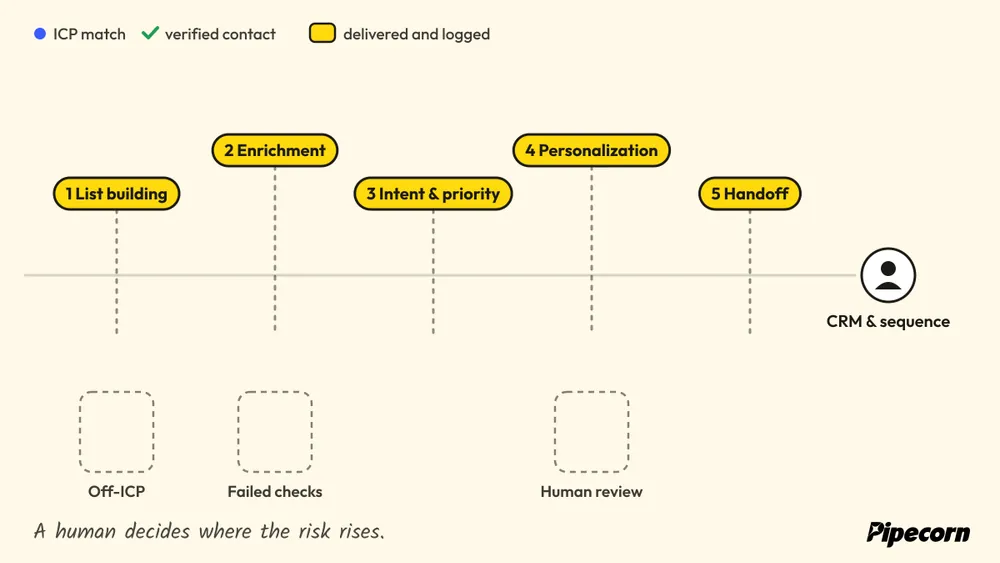
Core idea: AI should reduce uncertainty at the point where a human seller makes a decision, not simply increase the number of records entering the system.
Five operating points
List building uses identity resolution and structured filters to find accounts and people who match an ICP. The system may normalize titles, connect a person to a company, and remove records that don't meet territory or persona rules.
Enrichment fills gaps across firmographic, contact, technographic, and role data. Multi-source systems test several paths rather than assuming one provider has every email address or mobile number.
Intent and prioritization combine fit with behavior. A job change, hiring event, technology change, or relevant engagement can move an otherwise static record higher in the queue.
Personalization turns verified research into a message angle. Useful AI references a real business context and connects it to a relevant problem. It doesn't merely insert a first name into a template.
Handoffs and automation move qualified records into the CRM or sales engagement system, apply routing logic, and create tasks or sequences. Here, workflow design matters most because duplicate records and bad field mappings can spread quickly.
| Funnel stage | What AI does | Problem solved | Metric to watch |
|---|---|---|---|
| List building | Matches accounts and personas to ICP criteria | Broad or inconsistent targeting | ICP acceptance rate |
| Enrichment | Resolves identities and fills contact fields | Missing or stale data | Verified contact coverage |
| Intent and prioritization | Weights fit and time-sensitive signals | Reps calling in arbitrary order | Qualified meetings by priority band |
| Personalization | Summarizes relevant context and drafts variants | Generic outreach | Positive replies by message type |
| Handoffs | Routes records and triggers workflow actions | Manual exports and delayed follow-up | Duplicate and routing-error rate |
The distinction between proactive prospecting and passive lead collection also matters. Teams planning a proactive buyer outreach process need a clear trigger, an accountable owner, and a reason the contact should hear from the company now.
A platform can claim “AI prospecting” while handling only one row in this table. Operators should ask which stage it improves, what data it consumes, and what happens when confidence is low. Sales intelligence tools are easier to compare when every product is evaluated against the same funnel-stage criteria.
List Building and Enrichment Coverage
A single data provider is convenient, but convenience can hide coverage risk. No single database holds every email address and mobile number in every region, so a single-source workflow leaves blind spots in email and mobile discovery that stay invisible until the team measures them against another source.
A single-source workflow asks one database to know the market, maintain current job information, and provide usable contact details across every region. A waterfall workflow asks multiple providers in sequence, then cleans and validates the result before export.
Single source versus waterfall enrichment
| Approach | Strength | Typical weakness | Best fit |
|---|---|---|---|
| Single provider | Simple setup and predictable workflow | Coverage gaps become invisible | Narrow markets with reliable local data |
| Waterfall enrichment | Tests several identity-resolution paths | More routing and credit governance | Broad ICPs, fragmented markets, global territories |
| Manual research | Flexible for unusual accounts | Slow, inconsistent, and hard to scale | Strategic named accounts |
| Static database export | Fast initial list creation | Decays as people and companies change | Short-lived campaigns with verification controls |
Waterfall enrichment doesn't mean accepting every returned record. The system should apply targeting rules first, validate contact fields, suppress duplicates, and reject records that fail confidence checks. That sequence protects deliverability and prevents SDRs from spending time on contacts who were never a valid fit.
Coverage has a financial effect even when a team doesn't calculate it perfectly. More usable records can improve the number of verified contacts available per account, reduce wasted sends, and lower the number of records required to create a live conversation.
Routing by territory and recency
Provider performance can differ by country, industry, and persona. A routing policy that sends every lookup to the same source may perform well in one territory and poorly in another. Real-time sourcing also helps with newly appointed leaders and smaller companies that static databases may update slowly.
Pipecorn provides one example of this model, with waterfall enrichment across 100+ sources, data cleaning, verification, and routing by country across more than 50 countries. Its waterfall enrichment guide is relevant for teams comparing source coverage, validation rules, and export controls rather than counting database records alone.
Intent Signals and Lead Prioritization
Finding a contact is only half the problem. The harder operating question is who should receive attention first when several hundred accounts match the ICP.
Static fit data answers “could this company buy?” Intent signals help answer “why might this company be worth contacting now?” Useful triggers include a new hire, a job change, hiring activity, a technology-stack change, or relevant social engagement. These signals become valuable when they connect to a defined sales hypothesis, not when they merely increase a lead's score.
How predictive scoring works
A rules-based model might award points for a senior title, a target industry, or a company size. A predictive model can combine those firmographic attributes with behavioral signals and historical conversion patterns, then re-rank records as new information arrives.
A 2025 benchmark compilation cites a 3.5× lift in lead-to-opportunity conversion for AI-scored leads compared with rules-based models, from a Q2 2023 analyst evaluation of AI decisioning platforms. That figure is reported in AI-augmented B2B lead generation benchmarks, and it shouldn't be treated as a forecast for every team. The mechanism is more important than the headline. Predictive scoring can prioritize probability rather than relying on fixed points.
The same compilation applies that lift only when at least 12 months of historical CRM data are available for training, and notes that teams with fewer than 500 closed-won records per year lack sufficient training data. Teams with thin or unreliable outcome data should start with transparent rules and use AI recommendations as a decision aid.
Separate signal from noise
A signal deserves promotion when it changes the outreach reason. A job change can identify a new decision-maker. Hiring for a relevant function can indicate an active initiative. A technology change can matter when the company is adopting a system that interacts with the seller's offer.
Signals become noise when they have no timing, role, or account context. An SDR manager should be able to explain why a lead entered the priority queue in one sentence. If the explanation is only “the model scored it highly,” the workflow isn't ready for a pipeline review.
Teams can use lead prioritization methods to define score bands, escalation rules, and feedback loops. The scoring system should also record the reason for each recommendation, so sales can challenge false positives and improve the next ranking.
Personalization and Outreach Automation That Still Converts
AI helps outreach when it compresses research without removing judgment. It fails when the team uses automation to compensate for weak targeting, unverifiable claims, or an unclear reason to contact the buyer.
A practical workflow starts with a defined ICP in a workspace. The team then applies cleaning rules against industry, geography, company, persona, and exclusion rules. Verified contacts move into the CRM and sales engagement tools such as Outreach or Salesloft according to a schedule, with the original source and validation status preserved.
A controlled outbound sequence
Define the reason to reach out. The account should match the ICP and have a plausible business context. A title alone isn't a reason.
Collect evidence. AI can summarize a hiring event, product change, public statement, or relevant company detail. If the system can't verify the detail, it should omit it rather than inventing relevance.
Draft variants, not volume. The seller can test different angles, subject lines, and asks while keeping the value proposition consistent. Short, specific messages generally create less friction than long generated pitches.
Review the uncertain records. Human review belongs on records with weak identity matches, unclear roles, unusual claims, or sensitive industries. High-confidence records can follow a lighter approval path.
Deliver and log. CRM and sequencing systems should receive the contact, source, score reason, suppression status, and campaign context. A message without traceability creates measurement problems later.
The workflow mechanics matter more than the model label. Salesforce-based reporting summarized by ZoomInfo's artificial intelligence statistics says AI-powered prospecting tools cut manual research time by 50% per account. That benchmark describes research time, not pipeline impact. Teams still need to test whether saved time becomes conversations and opportunities.
The AI draft congratulated a prospect on someone else's promotion.
The SDR, reading the reply:

Fully hands-off sending creates avoidable risk. AI can misread an outdated page, confuse two people with similar names, or turn a weak signal into an awkward pitch. Automation should handle repetitive movement between systems while SDRs retain control over claims, audience fit, and higher-risk messages.
Risks, Compliance, and Buyer Trust
More automation doesn't automatically create more pipeline. It can create more complaints, more incorrect messages, and more records that require remediation.
Legal: "Which of these messages did AI write, and who approved them?"
The team that switched on hands-off sending:

The EU AI Act entered into force on 1 August 2024, and its rules on general-purpose AI took effect in August 2025, according to the European Commission's AI Act page. Coverage of AI lead generation risks and compliance trends reads its transparency obligations as requiring disclosure of AI-generated outreach in many cases, a point for Legal to confirm for each use.
Buyer expectations are also moving faster than many outbound playbooks. The same coverage cites an IAPP figure: 47% of multinational B2B marketing teams have pulled at least one AI prospecting tool from EU operations pending legal review. It also reports that disclosed AI outreach outperformed undisclosed AI outreach on reply rates by 8 points among buyers who had been burned by a prior AI message.
Guardrails that belong in the workflow
Disclosure policy: Legal and RevOps teams should decide when AI assistance requires disclosure, which jurisdictions apply, and whether the message can be sent without human approval.
Data governance: Every provider should be assessed for lawful sourcing, retention, processing roles, and contractual protections. Vendor review should include data-processing agreements and the company's internal access controls.
Human review points: Require approval for low-confidence research, sensitive sectors, regulated territories, and messages making claims about a prospect's business.
Deliverability monitoring: Track bounces, complaints, unsubscribes, and suppression-list enforcement. A clean contact record is not permission to send unlimited messages.
Auditability: Keep the source, decision reason, model output, reviewer, and final message available for investigation. A team can't defend a workflow it can't reconstruct.
Buyer trust is an operating constraint, not a brand exercise. SOC 2 compliance guidance can help teams frame vendor diligence, but certification alone doesn't decide whether a prospecting use case is appropriate. The company still needs policies that connect data handling, disclosure, consent, and human accountability.
Building Your AI Lead Generation Workflow
Implementation should begin with the bottleneck that costs the team the most time or creates the most leakage. A Sales VP, SDR leader, or RevOps owner can use a phased decision process:
Audit the current system. Measure source coverage, duplicate rates, verification failures, manual research time, CRM sync errors, and the cost of each point solution. Separate license cost from credits, implementation work, and ongoing administration.
Pilot one ICP segment. Choose a segment with enough volume to produce feedback but narrow enough for clean evaluation. Test enrichment and prioritization before introducing autonomous outreach.
Define control rules. Document who can enter a sequence, which fields must be verified, what happens when confidence is low, and when a human must approve the record.
Measure downstream outcomes. Compare priority bands, positive replies, qualified meetings, opportunity creation, data rejection, and compliance exceptions. Efficiency alone isn't sufficient.
Consolidate or stitch point solutions
Consolidation can make sense when the team has overlapping data vendors, inconsistent field ownership, and repeated exports between systems. A unified platform may reduce handoff friction, but credit metering, geographic coverage, API limits, CRM integration depth, and audit controls still need scrutiny.
Point solutions can make sense when the business has unusual data requirements, a mature warehouse, or a specialized scoring model that a general platform can't support. The trade-off is operational complexity. Every additional system creates another place for duplicate records, stale credentials, conflicting write rules, and unclear ownership.
A vendor shortlist should require evidence of SOC 2 Type II, GDPR, and CCPA compliance, along with practical answers about data processing, retention, verification, integrations, and human review. A small team may prioritize simplicity. A global RevOps organization may prioritize routing control, APIs, regional governance, and observability.
Pipecorn offers ICP list building, data cleaning, waterfall enrichment across 100+ providers, verified email and mobile sourcing, and automated delivery into CRMs and sales engagement tools. Teams evaluating coverage gaps in their outbound workflow can visit Pipecorn to assess whether a consolidated data and handoff process fits their operating model.