Phone Number Verification Service Guide for Outbound Sales
Choose the right phone number verification service for outbound sales. Compare HLR, carrier lookups, SMS OTP, pricing, and integration patterns.

On this page
- 01Table of Contents
- 02The Cost of a Bad Mobile Number in Outbound
- 03What a Phone Number Verification Service Does
- 04Verification Methods Compared
- 05Metrics That Prove Verification Is Working
- 06Integration Patterns for Sales Stacks
- 07Compliance Privacy and Continuous Re-Verification
- 08Decision Checklist and Implementation Roadmap
Your team already knows the feeling. A list looked clean in Salesforce on Monday, the reps started dialing on Tuesday, and by Wednesday half the mobile numbers were either dead, recycled, or landing in voicemail with no chance of a live conversation. The rep burns time, the sequence keeps firing, and the CRM gets a little dirtier every day.
A phone number verification service is the gate between bad data and real conversations. Used properly, it doesn't just tell you whether a number looks fine. It tells you whether that number is still worth paying SDRs to call, whether it should go into an outbound sequence, and whether it needs to be re-checked before the next campaign.
Table of Contents
- The Cost of a Bad Mobile Number in Outbound
- What a Phone Number Verification Service Does
- Verification Methods Compared
- Metrics That Prove Verification Is Working
- Integration Patterns for Sales Stacks
- Compliance Privacy and Continuous Re-Verification
- Decision Checklist and Implementation Roadmap
The Cost of a Bad Mobile Number in Outbound
A rep dials a mobile number from last quarter's event list. The call goes nowhere useful. The next one does the same, then the next. By lunch, that rep has burned a chunk of the day on numbers that were never going to answer, and the sequence still treats those contacts like viable opportunities.
That is the cost of weak phone data. You lose rep attention, your connect rates fall, and the CRM fills with stale mobile numbers. Sales teams often respond by buying more lists or stacking more sequences, but the fix starts upstream. The number needs to be checked before outreach begins.
A phone number verification service sits between sourcing and live conversations. It decides whether a lead should enter dialing, stay quarantined, or get re-checked before the next touch. Sales ops should treat it as part of the outbound operating system, not as a one-time enrichment task.
The market reflects that need. The global phone number verification market was valued at $1.8 billion in 2025 and is projected to reach $7.9 billion by 2034, with North America at 38.5% revenue share and the services segment at 62.5% in 2025 (MarketIntelo). Outbound teams are also using verification at scale. Experian reported 61.8+ million phone validation requests globally in the past 12 months, drawing on roughly 1,500 telecommunications providers across 200+ countries and territories (Experian EDQ).
That growth fits the broader push toward tighter outbound data hygiene. If teams are already validating at that level, the core decision is not whether verification matters. It is how deep to verify, how often to re-check, and how cleanly the process fits the stack. A light pass saves money up front. A deeper check reduces bounce risk and keeps bad mobile numbers out of the CRM longer.
Practical rule: if a mobile number is not verified before it hits the dialer, outbound is running a rejection queue.
If you are evaluating the tooling layer around this, the best adjacent resource is AI outbound sales tools, because verification only pays off when it is connected to list building, routing, sequencing, and ongoing CRM cleanup.
What a Phone Number Verification Service Does
A lot of vendors use the word “verification” too loosely. That creates bad buying decisions, because a number can be valid, active, and still not belong to the person your rep is trying to reach. Sales ops needs a layered model, not a marketing label.

Layer One Format and country code checks
Start with the basics. A proper service should normalize numbers to E.164, confirm the country code, and reject obvious typos. That sounds boring, but it catches the mistakes that poison list quality before a single call is placed.
Format checks are cheap and fast, but they only tell you the number is structured correctly. They do not tell you whether the line is live, whether it's mobile, or whether it belongs to a disposable range. For outbound, that means format validation is necessary, but nowhere near enough.
Layer Two Activity and carrier checks
The next layer is activity and carrier context. A service can look up whether a number maps to a mobile, landline, or VoIP line, and in some cases whether it has been ported or recycled. That matters because outbound performance changes depending on the line type you're calling and the country you're calling into.
The architecture behind stronger carrier-based verification is usually split-flow. The client starts the verification request, then the backend exchanges the token or device credential with the carrier. That keeps secrets server-side and avoids putting carrier credentials in the app. The Open Gateway and CAMARA flow is frontend-initiated and backend-completed, and Android's TS.43-based flow uses a carrier-issued credential that only the aggregator can decrypt before returning the verified MSISDN (Open Gateway and TS.43 whitepaper).
Live network identity is a stronger test than a static database hit. A number that passed yesterday can still be a bad call target today, which is why country-aware re-checks belong in the workflow, not just in the intake form.
Layer Three Ownership proof
Ownership proof is the highest bar, and it is where people overstate what a phone number service can do. SMS or voice OTP can confirm that someone currently controls the device or line, but it doesn't prove long-term identity. It proves momentary access.
That difference matters for lead quality and fraud prevention. A valid number, an active number, and a number owned by your prospect are three different things. If you don't separate them in your process, you'll mix clean leads with shared lines, temporary numbers, and recycled records that look fine on paper but fail in practice.
Use format checks to clean the list, carrier and line-type checks to improve routing, and OTP only when you need proof of control for a high-trust action. For the workflow side, this guide to waterfall enrichment shows how to layer checks without turning every record into an expensive lookup chain.
Verification Methods Compared
The sales mistake is buying one method and pretending it covers every use case. It doesn't. Each method catches a different kind of bad data, and each one misses something important.

HLR lookup
HLR lookup checks whether a SIM is currently registered on a home network. It's useful for spotting dead or unreachable numbers quickly, and it's usually one of the fastest ways to reduce obvious bounces. What it won't do is tell you who owns the number or whether the contact is the right person.
Carrier or line-type lookup
Carrier data and line-type ID tell you whether the number is mobile, landline, VoIP, or a temporary range. For outbound, that's operationally useful because routing a mobile call like a landline call is a waste, and calling a VoIP number like a direct dial can drag down answer quality.
SMS OTP
SMS OTP is about control, not just validity. If you need to know whether the person on the other end can receive a one-time code, OTP is the right method. That's why it belongs in sign-up or high-trust workflows, not as the default method for every prospect in a sales list.
AI and heuristic checks
Heuristic systems combine delivery history, recency, country-specific patterns, and other signals to flag suspect records. They're useful for prioritization, especially when you're working at scale and need to decide which numbers deserve another pass. They don't replace carrier-level verification, but they can reduce waste before the dialer ever sees the contact.

Here's the practical readout for a VP of Sales.
| Method | What it checks | Speed | Best fit for outbound |
|---|---|---|---|
| HLR lookup | Current network presence | Fast | Clearing dead numbers early |
| Carrier lookup | Line type and carrier context | Fast to moderate | Routing and prioritization |
| SMS OTP | Control of the device or line | Moderate | Sign-up and trusted actions |
| AI or heuristic checks | Delivery patterns and risk signals | Fast | Ranking and filtering at scale |
The right blend is not a purity test. If your motion is high-volume outbound, pair a fast validation layer with carrier context, then use stronger proof only where the business risk justifies the extra friction. For teams building waterfall logic across providers, the workflow is similar to the approach described in Pipecorn's enrichment guide, where data quality comes from sequencing sources, not trusting one source to do everything.
Metrics That Prove Verification Is Working
If verification is not changing a weekly dashboard, it is just another cost. Sales ops should track a tight set of metrics that connect directly to live conversations, bounce reduction, and CRM hygiene, not vanity cleanliness scores.
The clearest ones are live-answer rate, invalid bounce reduction, time-to-first-touch, and cost per verified contact. Those four show whether the service is improving outbound economics or just making the database look cleaner.
What to watch first
Live-answer rate is the metric leadership should care about first because it shows whether the list can produce real conversations. Carrier context helps here because it flags line-type issues and keeps reps from wasting calls on numbers that should not be treated the same way.
Invalid bounce reduction shows whether HLR and format validation are removing dead numbers before reps ever see them. That matters because every bounced or dead record creates extra work in sequence management, suppression, and list QA, and those tasks pull operations time away from selling.
Time-to-first-touch matters because speed still wins in outbound. Google's phone verification guidance describes server-side handling of message construction, sending, and code verification, and Firebase's phone number verification can return a signed token in roughly 1 to 3 seconds after consent in supported environments (Google Identity SMS Retriever and verification guidance). That does not mean every sales workflow should use that exact path, but it does show how fast clean verification can be when the system is set up properly.
CFO-friendly filter: if a verification vendor cannot show fewer dead numbers and faster first-touch, you are paying for reassurance, not performance.
Scale matters too, but only if it translates into better execution. The category is already large and active, and the broader point is simple, teams are not inventing this process from scratch, they are deciding how deep the check should go for their outbound motion. For a vendor built around integration depth rather than a single isolated check, the relevant question is how verification fits into the rest of the stack, which is laid out on Pipecorn's integrations page.
A simple weekly dashboard
Use a small dashboard, not a sprawling BI project.
- Live-answer rate: track by segment, country, and source.
- Invalid bounce reduction: track before and after verification.
- Cost per verified contact: divide spend by usable numbers, not raw inputs.
- Time-to-first-touch: measure from ingestion to first call or sequence enrollment.
If those numbers improve together, the service is doing its job. If only list cleanliness improves, you have bought a data hygiene tool, not an outbound performance tool.
Integration Patterns for Sales Stacks
The right integration pattern depends on where the bad number gets caught. Some teams need real-time blocking during list building. Others need CRM cleanup after enrichment. Mature teams need both, plus scheduled re-verification so stale records don't rot in place.
Real-time API checks inside list workflows
This is the cleanest pattern when your team builds lists in a workspace or enrichment layer before pushing records into outreach. The system checks the number as soon as it enters the workflow, then returns a verified, questionable, or blocked status. That keeps bad contacts from ever entering sequences.
If you're using a platform like Pipecorn, that often means building the contact once, routing it through waterfall enrichment, and only then handing the verified record to the next system. Pipecorn's integration layer is laid out at its integrations page, which is the place to evaluate how enrichment and delivery fit your current stack.
Webhooks that update CRM records
Webhooks are the better choice when your CRM is the system of record. HubSpot or Salesforce gets the verification result the moment it's ready, then updates the contact record, lifecycle stage, or suppression status. That reduces manual cleanup and keeps reps from working stale records.
A good webhook flow should push only verified contacts into Outreach or Salesloft sequences. Bad numbers should be quarantined, not deleted outright, because you may want them for deduping, suppression, or later re-checks.
Scheduled re-verification jobs
This is the piece many teams skip, and it's usually the part that saves the most money over time. Numbers change, port, get recycled, or move into line types that don't behave the same way they did last quarter. A scheduled job catches that drift before the next campaign.
Operational standard: treat re-verification like list maintenance, not a special project.
For programmatic teams, tiered rate limits and MCP endpoints matter because workflows shouldn't stall when multiple lists are running at once. If you're architecting it properly, the triggers are simple. New lead enters the system, verify. Number hasn't been touched in a set period, re-check. Carrier or country changes, quarantine and re-route.
Compliance Privacy and Continuous Re-Verification
A single green check doesn't make a number safe forever. It only says the number passed a test at one point in time. That's a weak standard for outbound, especially when numbers port, get recycled, or move between line types.
The compliance question is separate from the data-quality question, but sales leaders need both. GDPR, CCPA, data processing agreements, and local outbound rules affect how you store, use, and refresh phone data. Pipecorn's DPA information is documented at its DPA page, and any vendor in this space should be able to show similar paperwork without hesitation.
What changes in the real world
A number can be valid and still be a poor outbound target. It may be filtered, unreachable under local rules, or no longer suitable for the channel you planned to use. That's why country-aware routing matters, and why continuous verification is more practical than a one-time pass.
If you want a helpful adjacent resource on the sourcing side, find the best scraping API can be useful when your team is building the upstream list, because verification is only as good as the data you feed it.
Continuous re-verification should be a policy, not an exception. Re-check quarterly for active outbound segments, re-check after a bounce spike, and re-check when a country or carrier pattern changes. That keeps your CRM healthier and reduces false positives where a number still exists but no longer deserves a call.
Compliance guardrails to demand
- Documented lawful basis: make sure the vendor supports your outbound legal posture.
- Data processing agreements: keep DPAs available and current.
- Country-aware routing: verify that the system knows where behavior changes by market.
- Retention controls: don't keep bad numbers in active workflows indefinitely.
- Re-verification scheduling: require automated refresh logic, not manual cleanup.
- Suppression handling: bad records should be quarantined with a clear reason code.
The right vendor should help you verify more intelligently, not just faster. If they can't explain how they handle porting, country rules, and stale records, they're selling a point check, not a sales-grade verification system.
Decision Checklist and Implementation Roadmap
Don't buy phone verification as a generic utility. Buy it as part of a sales operating model. Your checklist should be blunt: does it support format, carrier, and ownership layers where needed, does it integrate cleanly with CRM and sequencing tools, and does it give you the compliance evidence your legal team will ask for later?
Pricing should be judged the same way. Credit-metered plans make sense when volume moves around. Tiered subscriptions work when usage is predictable. Pay-per-verified-contact is the cleanest model if you want to align spend with usable data, but only if the definition of “verified” is strict enough. If the vendor offers credit rollover, ask for it. Unused volume shouldn't disappear just because the quarter ended.
A four-phase rollout that won't create chaos
- Pilot one segment. Pick a single ICP slice or region and verify every number before the dialer sees it.
- Measure the right outcomes. Compare live-answer rate, invalid bounce reduction, and cost per verified contact against the baseline.
- Expand the workflow. Add waterfall enrichment, country-aware routing, and CRM webhooks so verified contacts flow cleanly into the right sequences.
- Automate re-checks. Put stale records on a schedule so the CRM doesn't drift back into low-quality territory.
The point isn't to make verification complicated. The point is to make it continuous and operationally useful. If a vendor only sells a one-time pass/fail result, they're solving the easiest part of the problem.
Your next three moves
- Audit your current source-to-sequence path and mark where bad numbers currently slip through.
- Choose one verification standard for mobile contacts and make it the default before dialing.
- Set a re-verification schedule for every segment that stays in play longer than a single campaign.
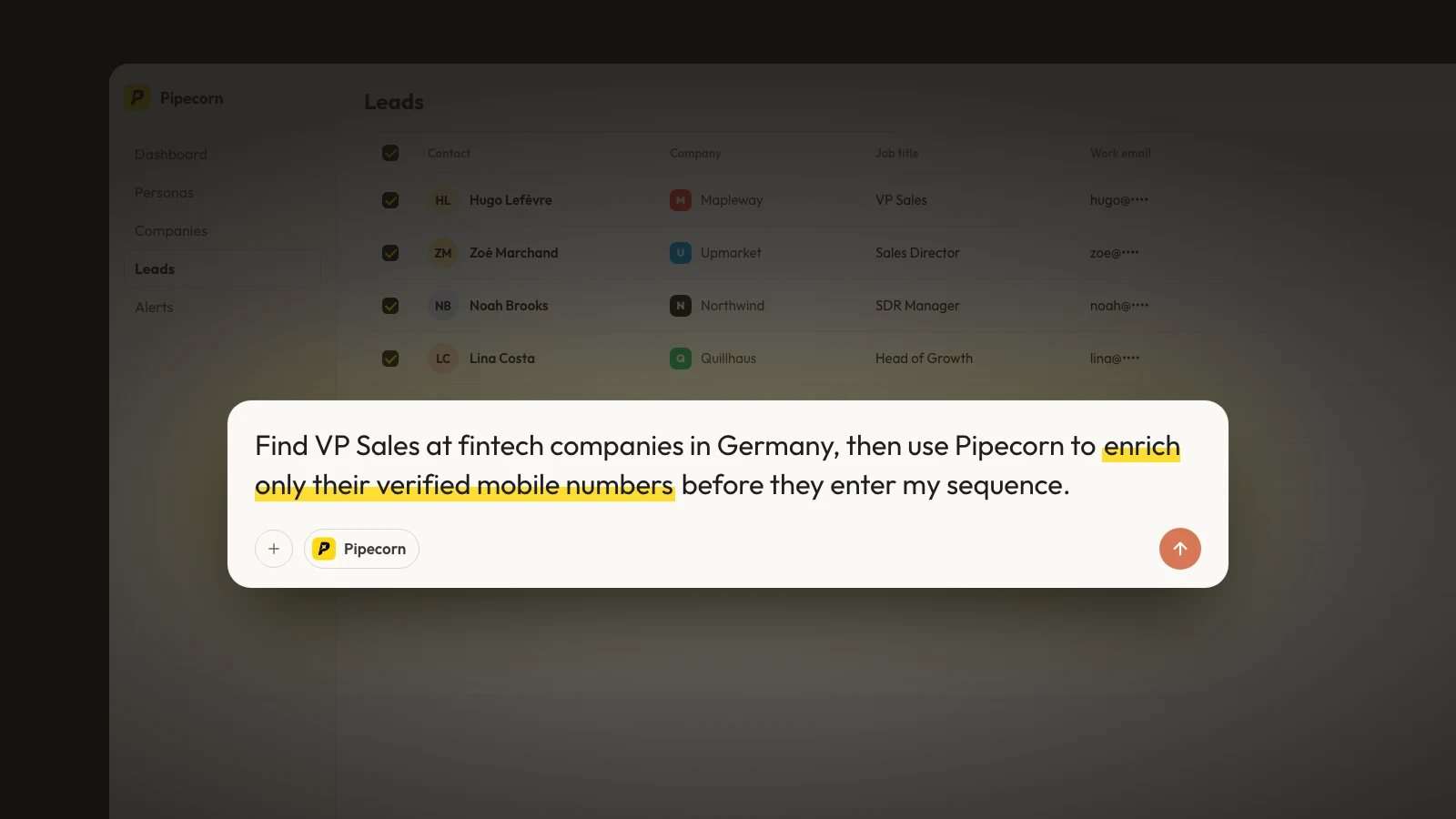
If you're running outbound seriously, Pipecorn can be part of the stack because it aggregates verified emails and mobile numbers, supports waterfall enrichment, and pushes qualified contacts into CRM and sales engagement tools. Visit Pipecorn to see how that workflow can fit into your own outbound process and tighten the gap between sourcing, verification, and live conversations.