
10 Prospect List Building Tools for B2B Sales
Compare 10 prospect list building tools for B2B sales, including targeting, enrichment, integrations, Chrome extensions, pricing, and use cases.

Article summary
- No single prospect list building tool wins everywhere. The right pick depends on where the list breaks, from ICP definition and country coverage to verification, signals and the CRM handoff.
- Contact data goes stale. One 2026 audit of 50.4 million contacts found a database is about 78% accurate after 12 months without re-verification.
- Pipecorn fits teams that need verified multi-source coverage and automated handoffs. ZoomInfo fits enterprise ABM, Apollo self-serve outbound, Cognism European phone data and Clay custom data operations.
- Judge a pilot on usable contacts, not matched ones. Track current role, ICP fit, valid email, reachable phone, duplicates and the records the CRM accepts.
- Set credit controls and a compliance review before rollout. Mobile lookups cost more than emails, and enrichment can create GDPR and CCPA obligations.
Want to go further? Ask
 ChatGPT
 Claude
 Perplexity
 Grok
GrokOn this page
With B2B databases losing 22 to 25% of their accuracy within 12 months, there is no universal best prospect list building tool. Pipecorn is the strongest fit for teams prioritizing verified multi-source coverage and automated CRM or engagement handoffs, while other options win in specific situations such as enterprise ABM, HubSpot-centric enrichment, European phone data, customizable data operations, or transparent self-serve pricing.
The popular advice is to choose the platform with the biggest database. That approach misses the operational problem. A large export still creates work if records are stale, duplicates enter the CRM, phone numbers aren't usable, or sales reps have to move contacts manually between research and engagement tools.
The better decision is to identify where the funnel breaks. Does the team struggle to define an ICP, find enough contacts in a target country, verify emails and mobiles, capture prospects while browsing, monitor job changes, enrich existing CRM records, or route qualified leads into sequences? This comparison evaluates those workflow problems rather than treating every database as interchangeable.
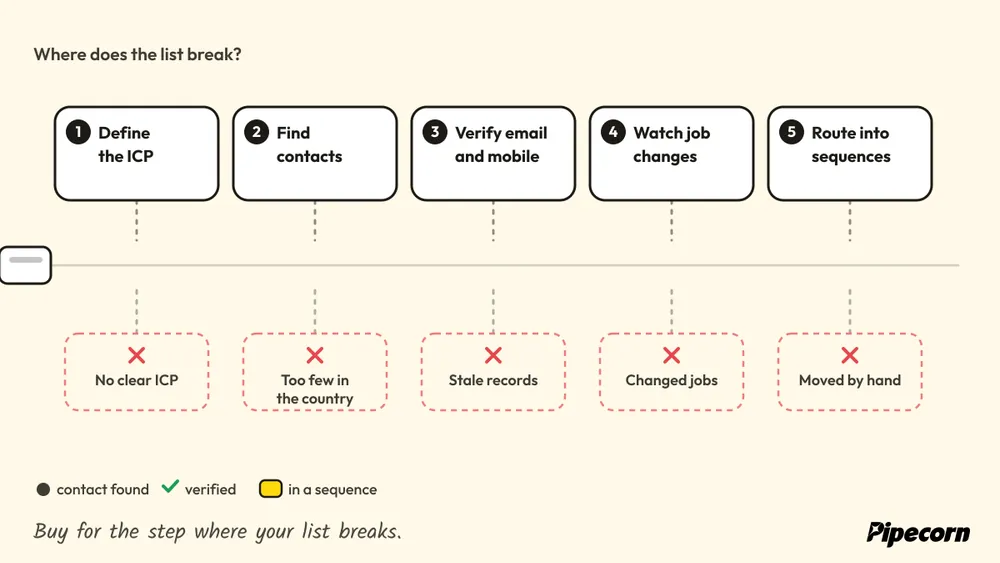
The assessment covers workspace and ICP controls, source coverage, verification, enrichment orchestration, browser capture, signals, integrations, pricing models, implementation effort, and fit for SDR, BDR, RevOps, sales-operations, and GTM teams. Product capabilities and pricing are presented as supplied product information, while recommendations are editorial judgments.
The data-quality issue is structural. One independent 2026 audit covered 50.4 million contacts across 47 industries and 185 countries, finding that a contact set delivered today may be only about 78% accurate after one year without re-verification. That makes continuous sourcing and validation more important than a static list export. The 2026 B2B contact-data accuracy report provides the supporting context.
The SDR, handed the biggest database export on the market,
cleaning it before the first call:

1. Pipecorn
Pipecorn is the strongest overall fit when the central problem is usable contact coverage, not access to another database. The platform builds company and persona lists around an ICP, applies AI-based cleaning and validation, and enriches records through a waterfall that draws on 100+ providers and real-time sources. That design matters for teams working across countries or niches where one database leaves too many fields blank.
The workflow can surface verified work emails and mobile numbers, match uploaded company names, fill missing firmographic fields, and prioritize contacts before delivery. Provider routing can adapt by country, while job-change and new-hire signals help sales teams act on personnel movement instead of waiting for a quarterly list refresh. A Chrome extension reveals contacts as reps browse LinkedIn and company websites.
Best fit for connected outbound workflows
Pipecorn can push prioritized records into HubSpot, Salesforce, Pipedrive, lemlist, Smartlead, HeyReach, and other engagement tools through the interface, API, MCP endpoints, and webhooks. That gives RevOps teams several handoff options, from a rep-led export to a scheduled programmatic workflow.
The commercial model is built around credits. Emails use approximately 3 credits, while mobiles use approximately 30 credits, so phone-first programs need a clear budget model. In the waterfall, Pipecorn bills the provider that delivered a verified result, not the ones that missed, and credits roll over. Plans include Free, Build, Grow, and Scale. The free plan includes 500 exported leads per month and 150 credits with no credit card, and paid plans start at $41 per month billed yearly, according to the Pipecorn pricing page.
Practical rule: Test a representative country and persona segment before committing to a mobile-heavy motion. Email and mobile economics are materially different.
The trade-off is that advanced vendor routing, priority onboarding, and some enterprise support sit on higher tiers. Pipecorn is best for VP and Head of Sales teams, SDR and BDR organizations, outbound agencies, and RevOps operators that want sourcing, verification, signals, and CRM handoff in one operating model. Pipecorn states that it supports SOC 2 Type II, GDPR, and CCPA requirements, with DPAs available.
2. ZoomInfo
ZoomInfo is the better choice when prospect list building sits inside a larger enterprise account-based marketing program. Its product family spans Sales, Marketing, Operations, Talent, and Copilot, so the purchase can cover contact intelligence, account research, data management, hiring use cases, and workflow automation.
The platform's main advantage is depth around US firmographics, organizational structures, buying committees, and intent partnerships. Enterprise SDR teams can use org-chart context to map multiple stakeholders rather than handing one isolated contact to an account executive. Mature CRM and stack integrations also suit organizations with administrators, governance requirements, and several business units.
The enterprise trade-off
ZoomInfo's breadth creates implementation and procurement overhead. Pricing is quote-based, which can make it a difficult fit for a small team that wants to test a narrow segment without a substantial commitment. Mobile accuracy may also vary by segment, particularly when premium mobile add-ons are required.
The right evaluation should compare the included modules, credits, mobile access, intent scope, integration rights, renewal terms, and export rules. A database contract doesn't automatically mean every Sales, Marketing, Operations, or Copilot capability is included.
For RevOps teams deciding between a broad enterprise suite and a waterfall model, this comparison of ZoomInfo waterfall enrichment clarifies why multiple sources can be preferable when the immediate requirement is verified coverage rather than account-intelligence breadth.
ZoomInfo is the most logical shortlist candidate for large ABM programs, complex buying committees, and organizations that can support governance and contract management. It is less compelling when the main need is fast, self-serve list creation with tightly controlled usage costs.
3. Apollo.io
Apollo.io combines a contact and company database with sequencing, a dialer, deal-management functions, AI research, and enrichment. Its main advantage is workflow consolidation: a team can construct an ICP, capture contacts while browsing, enrich records, and move prospects into outreach without assembling separate tools.
The process is direct. A rep searches for an account or persona, reviews the record, enrolls a contact in a sequence, and manages follow-up in one environment. Chrome, Salesforce, and Gmail extensions connect browser research with list building and CRM handoff. Credit-based access to email addresses and mobile numbers can be configured per seat, while self-serve pricing offers a clearer starting point than quote-only enterprise platforms.
Where Apollo fits best
Apollo fits teams addressing tool sprawl around outbound execution. SDR and BDR managers can give reps one workspace for prospect discovery and sequencing. Founders and small sales-ops teams can also start without lengthy procurement.
The trade-off is variable data quality and usage control. Accuracy may differ by segment, while costs can increase with additional seats, contacts, mobile lookups, and outreach activity. Test current employment, email usability, phone coverage, duplicate handling, and sequence handoff against the team's own ICP. Also confirm whether Apollo's workflow covers the team's requirements for enrichment orchestration and signal monitoring, rather than assuming one platform handles every research task.
Teams comparing a broad outbound suite with a verified waterfall should review Pipecorn versus Apollo. Teams comparing options should review which sales data tool is better according to the Yalc analysis. Apollo suits organizations that value self-serve access and native engagement; RevOps should model credit consumption before expanding it across a large SDR organization. Apollo.io remains a practical choice for fast deployment when those conditions fit.
4. Cognism
Cognism is designed for teams where European coverage, phone verification, and compliance posture matter more than a low-friction self-serve purchase. Its Diamond Data program focuses on human and phone-verified mobile numbers, with Diamonds-on-Demand verification for records requiring additional confidence.
The platform supports filters such as “has Diamond mobile,” a Chrome extension for LinkedIn and company websites, and CRM or sales-engagement integrations. Those controls help a phone-led SDR team distinguish between a record with a theoretical number and a record that has passed a stronger verification process.
RevOps, when an SDR is about to dial a mobile number
that was found but never verified:

A useful European data decision
Cognism's fit is strongest when territory includes Europe and the team needs a documented approach to GDPR and do-not-call requirements. A compliance-first workflow can reduce the risk of treating every discovered contact as automatically suitable for outreach, although the buyer still needs an internal legal and suppression process.
Pricing is quote-based and depends on Diamond usage and volume. Diamond hit rates and credit consumption can vary by segment, so the pilot should include the actual countries, industries, seniority levels, and phone requirements used by the sales team.
Cognism is the clearest candidate for Europe-focused sales teams that value phone verification and compliance controls. Cognism alternatives are more relevant when the team needs broader multi-source routing or a different credit model.
5. Lusha
Lusha suits SMB and mid-market teams that want a simple reveal-based workflow. The platform shows whether email and phone fields exist before a rep spends a credit, which makes small-scale prospecting easier to control than an opaque export.
Its Chrome extension supports LinkedIn and website research, while the workspace handles contact reveals, CRM integrations, and sales-engagement connections. A permanent free plan includes 40 credits per month, and published self-serve pricing makes it easier for a manager to run a limited pilot or cancel without an enterprise negotiation.
The right use case for Lusha
Lusha is useful when individual reps build focused lists while researching accounts manually. The do-not-call status shown on phone records adds a practical compliance signal, although it doesn't replace a company's legal review, suppression rules, or provider due diligence.
Mobile revelations consume more credits than emails, and API access is limited to higher tiers. Accuracy and coverage can also vary by region and ICP. A good pilot should measure how many revealed records contain the fields the team needs, how many pass ICP rules, and how many reach the CRM without duplicates.
Lusha is a sensible starting point for lean teams that need a browser-led workflow and predictable self-serve access. Teams needing waterfall enrichment, automated routing, or more extensive orchestration should compare Lusha alternatives before standardizing on it.
6. Clearbit by HubSpot
Clearbit by HubSpot is the smoothest option for teams that already run their revenue process inside HubSpot. Clearbit's company and contact enrichment capabilities now sit within HubSpot's CRM environment, reducing the integration work required to move enriched fields into workflows, segmentation, and reporting.
The product supports real-time and batch enrichment. It also has a mature API and usage guidance for teams managing enrichment at an operational level. That makes it useful for RevOps teams that want firmographic and contact fields updated inside the existing CRM rather than maintained in a separate prospecting workspace.
The integration advantage has limits
HubSpot-native administration is the main reason to choose Clearbit. A team can reduce the number of systems involved, keep field mapping closer to the CRM, and build enrichment into existing lifecycle processes.
The trade-off is dependency. Clearbit is now sold inside HubSpot rather than as a standalone product. Some users also report mixed data freshness and rising costs after the acquisition, so a buyer should test the fields that influence routing, scoring, and segmentation.
Clearbit is an enrichment choice, not necessarily a complete outbound prospecting system. It may fill or update records already known to HubSpot, but teams seeking multi-source contact discovery, mobile verification, job-change alerts, and automated sequence handoffs may need additional tooling. Clearbit is best for HubSpot-centric enrichment, not for organizations trying to remain CRM-agnostic.
7. Clay
Clay is a flexible data-operations workspace for GTM teams. Instead of prescribing one database workflow, it lets RevOps and GTM engineers compose tables and automations across many data integrations, scraping steps, AI research tasks, validation rules, and CRM or sales-engagement destinations.
That flexibility is valuable when the business has unusual ICP logic. A team can combine company filters, persona rules, enrichment, deduplication, AI research, scoring, and scheduled pushes into one controlled workflow. Waterfall logic can also reduce dependence on a single provider, provided the team designs clear stopping rules and monitors the resulting costs.
Control comes with maintenance
Clay's visual builder is powerful, but it isn't a substitute for operational ownership. Someone needs to define which fields are authoritative, handle duplicate records, maintain provider logic, monitor failed steps, and decide whether an AI result is reliable enough for routing or personalization.
Pricing uses fixed-plan and tokenized or usage-based options, depending on the workflow. Heavy AI research and large multi-source runs can make costs less predictable than a simple seat subscription. The team should model cost per qualified, usable record rather than cost per workflow execution.
A 2025 Melissa survey found that 53% of respondents were very confident in prospect and customer data accuracy, while 44% were somewhat confident, yet only 5% selected deduplication among their first automation priorities. The survey is available in Melissa's GTM data-quality research. That gap makes Clay attractive for teams willing to operationalize duplicate control instead of focusing only on contact discovery.
The CRM, after every tool in the stack
imported the same prospect:

Clay is the best fit for configurable RevOps workflows. Teams wanting a more managed path can examine Clay waterfall enrichment alongside the engineering effort required to maintain each approach.
8. Seamless.AI
Real-time contact discovery is the platform's primary workflow. It combines verified emails and cell phones with job-change tracking and Connect, an integrated engagement layer. Reps can find contacts, monitor selected changes, and manage email, calling, and tasks without immediately adopting a separate execution platform. That combination suits SDR and BDR teams that want prospecting and outreach in one system.
The Chrome extension supports browser-led sourcing, while in-app workflows keep discovery inside the platform. Buyer intent and enrichment are available as add-ons. An AI Assistant and API access extend the system for teams that need more automation or a controlled handoff into their existing operations.
A broad suite needs a cost audit
For small outbound groups, the broader suite may reduce the need to coordinate separate prospecting and engagement tools.
Pricing visibility requires closer review. List prices and higher-tier costs are not fully explicit, and API or utilization limits may depend on account terms. Buyers should run a representative usage test and record how credits are consumed by emails, mobile numbers, enrichment, intent, and engagement actions. The relevant comparison is cost per usable contact and completed workflow, not access alone.
Job-change alerts support timely outreach. They can notify a team when a tracked contact changes employer, accepts a new role, or changes title within the same company. An SDR can then reassess the record instead of sending an unchanged sequence. Seamless.AI fits teams seeking combined prospecting and engagement, provided procurement confirms overage rules and API limits in writing.
9. SalesIntel
SalesIntel puts AI and human verification at the center of its data proposition. The platform labels human, email, and machine-verified record types and offers a published accuracy guarantee, giving sales operations teams more context than a single undifferentiated confidence score.
Research-on-Demand is the most distinctive workflow. It can help source net-new or difficult-to-find contacts when a standard database search doesn't produce a usable record. That matters for niche industries, long-tail accounts, and territories where a mass-market database may have broad visibility but weak contact depth.
Reliability is the purchase criterion
SalesIntel also describes 90-day refresh cycles, which gives buyers a defined way to think about record maintenance. Refresh cadence shouldn't be treated as a replacement for internal validation, but it can be easier to govern than an unclear update process.
Pricing is request-only and often annual, so the platform is less suitable for a very small team seeking a casual monthly experiment. Its total database may also be smaller than mass-market competitors in some niches. The evaluation should therefore focus on the exact accounts, roles, and phone fields that matter to the sales motion.
SalesIntel is a strong candidate when connect-rate reliability and difficult contact sourcing justify human support. It also suits teams that want white-glove onboarding at higher tiers. SalesIntel is less compelling when a team values broad self-serve access or needs a low-commitment pilot more than verified record provenance.
10. UpLead
UpLead is a practical option for lean teams that want predictable, credit-based prospecting. One credit represents one contact, with an email and mobile direct dial available when matched.
Its filters cover firmographics, technographics, enrichment, and higher-plan buyer intent. A Chrome extension supports LinkedIn and web prospecting, while bidirectional CRM syncs and sales-engagement integrations reduce manual handoff work. Full API access is available on upper tiers.
A good pilot tool with clear boundaries
UpLead's transparent monthly and annual options make it easy to test with a defined budget. It is particularly suitable for a sales manager who needs to prove contact coverage before requesting a larger data contract.
Credit consumption can accelerate in high-volume programs, especially when teams repeatedly search the same accounts or require mobile direct dials. Database breadth may also trail larger incumbents in niche ICPs. The pilot should track usable contacts, not just matched contacts, and should include duplicates, current roles, email verification, and CRM delivery.
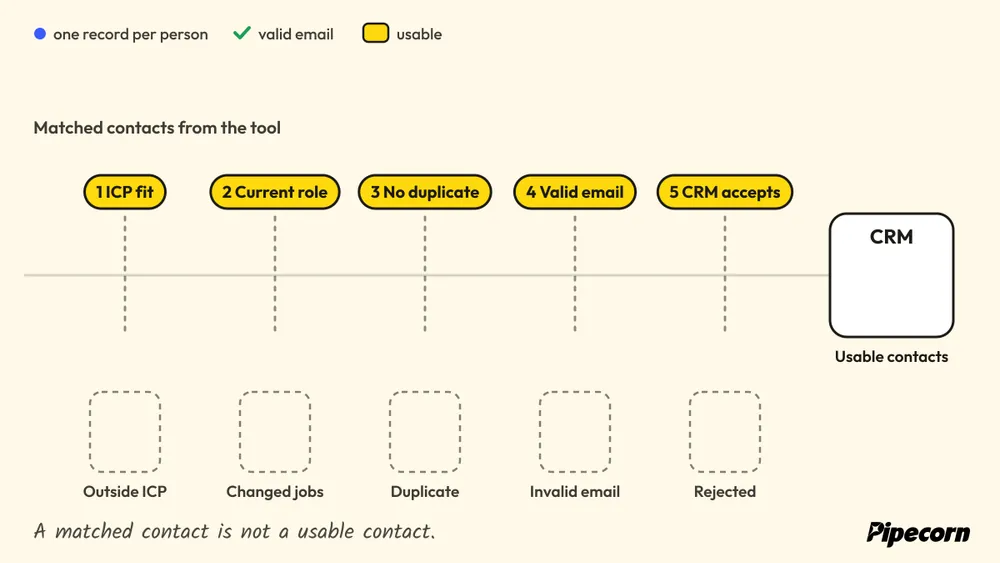
UpLead is a sensible choice for straightforward list creation and controlled experimentation. It is less suitable than Pipecorn or Clay when the requirement is a larger multi-source orchestration layer with country-aware routing, scheduled signals, and complex enrichment logic.
Top 10 Prospect List-Building Tools Comparison
| Product | Core features | Data quality & coverage | Integrations & delivery | Ideal for | Pricing & USP |
|---|---|---|---|---|---|
| Pipecorn (Recommended) | Workspace, AI cleaning, waterfall enrichment (100+ sources), real-time sourcing, job-change alerts, email+mobile verification | High coverage via vendor routing; pay only for verified contacts; SOC2, GDPR & CCPA compliant | HubSpot, Salesforce, Pipedrive, lemlist, Smartlead, HeyReach; API/MCP, webhooks, Chrome extension | VP/Heads of Sales, SDR/BDR, RevOps, outbound agencies | Free + paid tiers (Free, Build, Grow, Scale); credit model (email ≈3, mobile ≈30); credit rollover |
| ZoomInfo | Enterprise sales intelligence, org charts, intent signals, multi-product suite | Deep US firmographics & org mapping; strong intent data; mixed mobile accuracy unless upgraded | Mature CRM & workflow integrations, admin controls, automation | Large SDR teams, ABM programs, enterprise GTM | Quote-based, multi-year deals; best for scale and governance |
| Apollo.io | Contact DB + sequences, dialer, AI research, outreach workflows | Broad database; variable accuracy reported by some segments | Chrome, Salesforce, Gmail extensions; API; integrated sequencing & dialer | Startups & mid-market, self-serve outbound teams | Transparent self-serve pricing, credit model; integrated outreach stack |
| Cognism | Phone-verified "Diamond" mobiles, GDPR controls, European focus | Strong EMEA coverage; human/phone-verified subset ("Diamond") for higher connect rates | Chrome extension, CRM & engagement integrations | Europe-focused teams needing GDPR-aligned prospecting | Quote-based pricing; Diamond data add-on for verified mobiles |
| Lusha | Credit-based reveals, Chrome extension, workspace | Coverage varies by region/ICP; mobiles cost more credits | CRM & SEP integrations, LinkedIn/web reveals via extension | SMBs & mid-market seeking simple per-reveal economics | Published self-serve prices; permanent free plan (monthly credits) |
| Clearbit by HubSpot | Real-time & batch enrichment tightly integrated with HubSpot CRM | HubSpot-centric enrichment; some reports of cost/freshness issues post-acquisition | Deep HubSpot integration, mature API, batch enrichment | Teams fully on HubSpot seeking minimal integration work | Sold inside HubSpot; enrichment priced within HubSpot |
| Clay | Visual workflow builder, multi-source enrichment, AI research & cleaning | Multi-source control; quality depends on chosen connectors & configs | Push to CRMs/SEPs, scheduling, workflow automation | RevOps / GTM engineers building custom data ops workflows | Flexible plans; token/AI costs can vary with heavy usage |
| Seamless.AI | Real-time contact discovery, verified emails & phones, job-change alerts, engagement layer | Real-time verification claims; feature-rich but transparency on limits/pricing varies | Chrome extension, in-app "Connect" engagement, API (tiered) | Teams wanting prospecting + engagement in one platform | Many add-ons; some pricing behind sales |
| SalesIntel | AI + human-verified contacts, Research‑on‑Demand, accuracy guarantee | Higher-confidence data with 90-day refresh cycles; published accuracy guarantees | CRM integrations, Research-on-Demand service, white-glove support | Teams needing reliable connect rates and bespoke research | Quote/request-based pricing; Research‑on‑Demand credits |
| UpLead | Credit = contact (email + dial if available), 95% email verification claim | Predictable credit model; smaller breadth vs largest incumbents | Chrome extension, bi-directional CRM syncs, API on upper tiers | Lean teams wanting predictable spend and easy pilots | Clear credit pricing, monthly/annual options |
Choose the Tool That Fits Your Operating Model
The strongest recommendation depends on the failure point in the team's operating model. Pipecorn is the best overall fit when a sales organization needs verified multi-source coverage, country-aware provider routing, real-time signals, and automated CRM or engagement handoffs. Its waterfall approach addresses the problem that a single database can leave missing or stale records, while its credit model gives RevOps a way to control spend by verified output.
ZoomInfo remains the enterprise ABM choice. Its advantage is account and buying-committee depth, US firmographic coverage, intent partnerships, and administration across a larger sales and marketing stack. It makes more sense when procurement can support quote-based pricing and broader governance than when a small team needs a fast pilot.
Apollo is the practical choice for integrated, self-serve outbound. It combines contact research and engagement in one product, which reduces setup time for startups and mid-market teams. Cognism is the stronger option for European prospecting where phone verification and GDPR-oriented workflows are central. Lusha and UpLead fit lean teams that want transparent or accessible pilots, while Clearbit by HubSpot is the natural choice for HubSpot-native enrichment.
Clay belongs with RevOps and GTM engineering teams that want to design their own data operations. Its flexibility can produce a highly customized workflow, but the organization must own maintenance, duplicate control, provider logic, and usage monitoring. Seamless.AI is suitable for teams that want prospecting and engagement from one vendor, although pricing and utilization terms need careful review. SalesIntel is the better fit when human-verified or hard-to-find contacts justify request-only pricing and a more supported implementation.
| Where the list breaks | Tool the comparison points to |
|---|---|
| Verified multi-source coverage, country-aware routing, signals and CRM handoff | Pipecorn |
| Enterprise ABM, buying-committee depth and US firmographics | ZoomInfo |
| Research and engagement in one self-serve product | Apollo |
| European prospecting with phone verification and GDPR-oriented workflows | Cognism |
| A transparent, accessible pilot for a lean team | Lusha, UpLead |
| Enrichment inside HubSpot | Clearbit by HubSpot |
| Custom data operations owned by RevOps or GTM engineering | Clay |
| Prospecting and engagement from one vendor | Seamless.AI |
| Human-verified or hard-to-find contacts | SalesIntel |
A selection process should follow a short sequence:
- Define the ICP and required fields: Specify account criteria, personas, geography, email and mobile requirements, signals, suppression fields, and the CRM destination.
- Test a representative segment: Use real target companies and roles across the countries and industries that matter, not a vendor-provided sample.
- Measure usable-contact rates: Track current employment, ICP fit, valid email, reachable phone, duplicate rate, and records accepted by the CRM.
- Map CRM and sequence handoffs: Confirm whether the tool supports HubSpot, Salesforce, Pipedrive, Outreach, Salesloft, lemlist, webhooks, API, or the team's actual stack.
- Set credit controls: Establish approval rules for mobile lookups, enrichment depth, AI actions, exports, and recurring refreshes.
- Document compliance review: Confirm data provenance, permitted use, retention limits, deletion support, DPAs, suppression handling, and the lawful basis for enrichment.
The compliance step deserves more attention than most tool comparisons give it. Independent guidance states that appending third-party personal data to CRM records can create GDPR and CCPA obligations. Under GDPR Article 6(1)(f), B2B enrichment commonly relies on legitimate interests, which requires a documented balancing test covering purpose, necessity, and data-subject rights. CCPA also gives California residents the right to opt out of the sale of their personal information. This CRM enrichment compliance guidance recommends checking provenance, permitted use, retention, and deletion support before records enter the CRM.
Freshness should also be measured continuously. A separate 2026 prospecting roundup reported approximately 28% annual contact-data decay, with 67% of contacted prospects showing at least one stale data point. Campaigns using contacts verified within 30 days averaged 6.1% reply rates, compared with 4.2% for older data, according to the sales prospecting statistics roundup. The practical conclusion isn't that one tool guarantees a reply. It is that verification cadence belongs in the operating model, alongside ICP rules and sequence design.
| Measure | Figure | Source |
|---|---|---|
| Accuracy after 12 months without re-verification | About 78% | ELP Data 2026 audit, 50.4 million contacts |
| Accuracy after 18 months | 65 to 68% | ELP Data 2026 audit |
| Accuracy after 24 months | Closer to 55% | ELP Data 2026 audit |
| Annual contact-data decay | 28% | Prospeo sales prospecting statistics |
| Contacted prospects with at least one stale data point | 67% | Prospeo sales prospecting statistics |
| Reply rate, contacts verified within 30 days | 6.1% vs a 4.2% baseline | Prospeo sales prospecting statistics |
Teams should choose the platform that closes the most expensive gap, not the tool with the longest feature list. For many outbound organizations, that means testing Pipecorn against a representative segment, comparing verified and usable records, and measuring whether the CRM handoff removes work from SDRs rather than creating another queue.
Pipecorn combines waterfall sourcing across more than 100 providers, verified work emails and mobile numbers, real-time job-change and hiring signals, and automated delivery into CRM and engagement workflows. Teams can test it against their own target segment, control credit usage, and connect qualified records to the systems already used by sales through Pipecorn.