
Sales Operations Analyst Role, Skills, and Career Path
Learn what a sales operations analyst does, the skills and KPIs they own, and how to build a career in this high-impact revenue role in 2026.

Article summary
- A sales operations analyst is the analytical control layer of revenue operations, between raw rep activity and the revenue decisions leaders make.
- Most of the job is CRM hygiene. Deduplication, validation rules, field mapping and enrichment keep the forecast built on records that can survive a review.
- SQL and CRM administration are the core skills, with BI tools, spreadsheet modeling and a working grasp of APIs and enrichment close behind.
- The KPIs fall into three buckets, pipeline efficiency, revenue health and rep productivity, and the analyst owns the quality of the data behind them.
- Analysts often move on to RevOps manager, sales enablement or GTM engineering once they can own process design instead of only reporting.
Want to go further? Ask
 ChatGPT
 Claude
 Perplexity
 Grok
GrokOn this page
- 01Table of Contents
- 02What a Sales Operations Analyst Actually Does
- 03Core Responsibilities and Daily Workflow
- 04Technical Skills That Separate Good Analysts From Great Ones
- 05Key KPIs the Role Owns and Why Leadership Cares
- 06The Modern Sales Operations Tool Stack
- 07Tactical Playbook for Improving Lead Quality and CRM Hygiene
- 08Hiring Criteria, Career Progression, and Compensation
- 09Putting It All Together This Week
You're in the weekly revenue meeting, and the forecast looks clean until the number doesn't land. Sales says the pipeline is there, managers say reps updated their stages, but the close dates keep slipping and finance doesn't trust the view. That's the moment a sales operations analyst earns the seat at the table, not by building a prettier dashboard, but by finding the data issues, process gaps, and CRM quirks that distort the decision in the first place.
This role sits inside revenue operations as the analytical control layer between raw rep activity and executive revenue decisions. It's where CRM hygiene, dashboards, and process optimization turn into forecast accuracy, quota attainment, and healthier pipeline management. The job has also grown up with the broader adoption of CRM and sales analytics platforms, which made it possible to track metrics like conversion rate, sales cycle length, CAC, CLV, and quota attainment at scale, and that shift is why the role now carries strategic weight instead of just administrative load. A practical overview of adjacent responsibilities and sales ops framing is also useful in MarTech Do on sales operations, especially if you're comparing the function to broader go-to-market work.
The sales leader on Thursday, when Monday's clean forecast
meets the close dates that keep slipping:

Table of Contents
- What a Sales Operations Analyst Actually Does
- Core Responsibilities and Daily Workflow
- Technical Skills That Separate Good Analysts From Great Ones
- Key KPIs the Role Owns and Why Leadership Cares
- The Modern Sales Operations Tool Stack
- Tactical Playbook for Improving Lead Quality and CRM Hygiene
- Hiring Criteria, Career Progression, and Compensation
- Putting It All Together This Week
What a Sales Operations Analyst Actually Does
A sales ops analyst starts with a contradiction. A forecast looks solid on Monday, but by Thursday the same pipeline has duplicate accounts, stale stages, and a few deals that were never real in the first place. The analyst catches the mismatch, traces it back to CRM records and process drift, then pushes a corrected view to sales leadership, RevOps, and finance before the bad number hardens into an executive decision.
That is why the role belongs inside revenue operations, not in a generic admin bucket. It connects sales data, dashboards, CRM hygiene, and process optimization to the numbers leaders rely on, including pipeline health and forecast quality. The analyst partners with sales leadership, RevOps, SDR and BDR managers, and finance, because each group needs the same data to answer a different question.
The boundary of the role
The analyst owns the analytical layer, not every commercial decision. Sales managers still coach reps, finance still owns the P&L, and RevOps may own broader systems architecture. The analyst's value comes from translating raw activity into decision-ready insight, then tightening the rules that keep the next week's data cleaner than the last.
That historical shift matters. Modern sales operations grew alongside CRM and analytics platforms, which made it possible to move from manual spreadsheet reporting to system-level visibility across conversion rate, cycle length, and quota attainment. In practice, that means the analyst is often the first person to see when territory design, lead routing, or stage definitions are about to break the forecast.
For a straightforward companion view on the function, the practical role breakdown in MarTech Do on sales operations is worth reading after you've looked at your own CRM reports. It helps separate the analytical work from the broader go-to-market language people use loosely.
Core Responsibilities and Daily Workflow
Most of the job is unglamorous, and that's exactly why it matters. The daily work is about preventing small data mistakes from snowballing into revenue errors, broken handoffs, and bad territory decisions. If you want to know whether you'd fit, don't ask whether you enjoy slides. Ask whether you enjoy making systems behave.
CRM hygiene comes first
The first responsibility is CRM hygiene and governance. That includes deduplication, validation rules, field mapping, enrichment, and exception handling. Good deduplication isn't just merging two records with the same company name. It means deciding which rep owns the account, which opportunity is current, and whether the duplicate was created by a bad sync, a list import, or an honest rep mistake.
Practical rule: if the record can't survive a forecast review, it isn't clean enough yet.
Finance, opening the forecast and finding the same account
twice, owned by two different reps:

Forecast support and reporting come next
After the system is stable enough to trust, the analyst supports forecast rollups, pipeline reviews, and dashboard maintenance. Stale stages and missing close dates show up fast. The job is to spot those patterns before leadership uses them as evidence of demand strength.
The analyst also feeds territory and quota planning with data. That doesn't mean building comp plans from scratch every week, but it does mean making sure coverage, capacity, and pipeline distribution reflect how the team sells. When a region is overloaded or a segment is under-penetrated, the analyst is often the first one who can prove it.
Process docs and onboarding matter more than people expect
A good analyst also documents how the team is supposed to work. New reps need CRM onboarding that is explicit, not vague. They need to know which fields are mandatory, when to move a stage, how accounts are assigned, and what counts as a valid next step. If that training is weak, reporting gets noisy within days.
Here's the non-obvious part. Much of the job is also about reducing rep friction. The best analysts make systems easier to use without making them less disciplined. The worst ones create rules that look strict on paper and get ignored in practice.
Technical Skills That Separate Good Analysts From Great Ones
The gap between a decent analyst and a great one usually shows up in how reusable their work is. A good analyst can pull a report. A great analyst builds something the business can trust every week without hand-holding. That difference is less about raw intelligence than about how well they think across systems.
| Skill | A good analyst | A great analyst |
|---|---|---|
| Reporting | Can pull a report | Builds something the business can trust every week without hand-holding |
| SQL | Extracts and joins data | Builds reusable logic that other teams can depend on |
| CRM administration | Can patch a process | Designs controls that stop bad records from entering the system |
SQL and CRM administration are the core pair
SQL is the clearest separator. Basic SQL lets you extract and join data. Strong SQL lets you build reusable logic that other teams can depend on, especially when data lives across CRM, enrichment, and reporting layers. If a query has to be rewritten every time a manager asks a follow-up question, it's not mature enough.
CRM administration is the other half. Salesforce and HubSpot are common examples, but the key skill is understanding how objects, flows, validation rules, and lifecycle stages behave in practice. Good admins can patch a process. Great admins design controls that stop bad records from entering the system in the first place.
If your CRM rules only work when everyone remembers them manually, they're not rules. They're suggestions.
A CRM rule that only works when everyone remembers it.
The rep who is supposed to remember it:

BI tools and spreadsheet judgment still matter
Tableau and Power BI matter because leadership wants a view they can scan quickly, but the analyst still needs spreadsheet modeling for ad hoc work, reconciliations, and one-off questions. That sounds old-fashioned until the monthly pipeline review turns into a territory dispute and the quickest way to settle it is a controlled model in Excel or Google Sheets.
The other overlooked skill is translation. A sales leader asks for “better visibility,” but the analyst has to turn that into a measurable question, then decide what data is missing. Analysts who do this well also push back when a request would corrupt data integrity, like forcing reps to fill fields that nobody will use.
Data enrichment and API literacy are becoming baseline
The more integrated the stack becomes, the more valuable data enrichment and API understanding get. An analyst does not need to be a software engineer, but they do need to understand how records move between tools, where sync errors happen, and why validation matters before automation runs. That's especially important when routing, scoring, or territory logic depends on clean inputs.
Key KPIs the Role Owns and Why Leadership Cares
Executives don't care about KPIs because they like acronyms. They care because the numbers tell them whether the commercial system is healthy enough to scale. A sales ops analyst sits right in that measurement loop, and the most useful KPIs fall into three buckets.
| Bucket | KPIs named in this guide | What it tells leadership |
|---|---|---|
| Pipeline efficiency | Conversion rate, sales cycle length | Where opportunities stall and whether the motion leaks at specific stages |
| Revenue health | Quota attainment, forecast accuracy, churn, retention | Whether the team is delivering against the plan |
| Rep productivity | Rep activity patterns, win rate by segment, ramp behavior | Whether the system helps reps or gets in their way |
Pipeline efficiency tells you where deals are slowing
The analyst tracks conversion rate and sales cycle length because those metrics show whether the motion is efficient or leaking at specific stages. Leadership wants to know where opportunities stall, where reps lose momentum, and whether segment-by-segment performance is drifting. The analyst usually controls the reporting integrity and the stage definitions, while only influencing the actual rep behavior that changes the numbers.
Revenue health is where the forecast gets judged
Quota attainment, forecast accuracy, churn, and retention tell leadership whether the team is delivering against the plan. The analyst doesn't own every revenue outcome, but they do own the quality of the input data that determines whether the forecast is believable. If the CRM is full of stale stages and duplicated accounts, the forecast will look more confident than it should.
The same logic applies to AI-driven lead scoring. Bad CRM hygiene degrades AI features because the models only see what the system records. Clean inputs matter more than the label attached to the feature.
A practical outbound benchmark for workflow design lives in this lead sourcing benchmark, especially if your team is trying to compare sourcing quality against outreach expectations.
Rep productivity shows whether the system helps or gets in the way
The analyst also watches indicators like rep activity patterns, win rate by segment, and ramp behavior. These are not vanity measures when they're tied to process quality. If onboarding is weak, ramp slows. If routing is messy, reps waste time. If list quality is poor, outbound teams burn effort on bad contacts.
Leadership rarely asks for more data. It asks for fewer surprises. That's the real job.
The Modern Sales Operations Tool Stack
The modern tool stack is less a pile of apps than a set of bridges. A sales ops analyst usually works across a CRM, an engagement platform, BI layers, and enrichment sources, then makes sure the handoffs between them don't break. The value is in orchestration, not in collecting software logos.
CRM and engagement tools have to stay in sync
Salesforce, HubSpot, and Pipedrive are the usual CRM centers of gravity. On the engagement side, teams often use Outreach, Salesloft, or lemlist. The analyst configures how records move between them, whether through native integrations, webhooks, or API calls, because each sync point can create duplicates, stale fields, or routing errors if it isn't managed carefully.
That's also where watermarking, validation, and ownership logic show up. The analyst decides which fields are trusted, which ones are required, and which changes should trigger a reassignment or alert. In real life, the technical work is less glamorous than the vendor demos, but it's what keeps the outbound machine from drifting.
Enrichment changes the quality of the whole stack
Pipecorn is one example of a lead enrichment layer used in this workflow. It aggregates and waterfalls across 100+ providers, verifies emails and mobile numbers, and pushes qualified contacts into CRMs and sales engagement tools on a schedule. The practical reason analysts care about that kind of system is simple, it reduces the time wasted on stale data and makes outbound inputs more usable before a sequence starts.
For teams that live inside HubSpot, Salesforce, or Pipedrive, the workflow sync matters as much as the source quality. The point is not to add another database. The point is to make CRM records, engagement lists, and source data line up consistently.
If you want a concrete reference for CRM syncing logic, the CRM sync workflow is a useful lens on how enrichment and CRM updates connect operationally.
Choose tools for control, not novelty
The best stack is the one the analyst can govern. If a tool can't be audited, if sync rules can't be explained, or if enrichment quality can't be verified, it creates more work than it saves. Good tools reduce manual intervention. Bad tools just move the cleanup to a different tab.
Tactical Playbook for Improving Lead Quality and CRM Hygiene
Lead quality starts before the record enters the CRM. If the analyst waits until a rep complains about bad contacts, the bad data has already done damage in routing, sequencing, and reporting. The better play is to design the filters and controls up front, then keep tightening them as the team learns what converts.
Start with ICP filters and verified contact data
The first step is to define ICP filters in the enrichment workspace, then keep them consistent. Industry, company profile, and persona rules should be explicit, not tribal knowledge. Once the list is shaped, only verified emails and mobile numbers should flow into sequences, because bad contacts waste rep time and contaminate downstream metrics.
For outbound teams, job-change alerts are especially useful when they trigger reassignment fast. If a target contact moved roles, the analyst should surface the replacement or suppress the stale entry before the sequence keeps firing. Country-based routing also matters because find rates vary by region, and the workflow should adapt to where data can be verified most reliably.
Protect the CRM with routine controls
Deduplication should run on a schedule, not as a rescue mission. Required-field validation prevents incomplete records from becoming permanent fixtures, and stage hygiene audits catch deals that were advanced just to satisfy a manager. Quarterly cleanup sprints help, but they only work if the daily rules already keep the CRM from rotting in between.
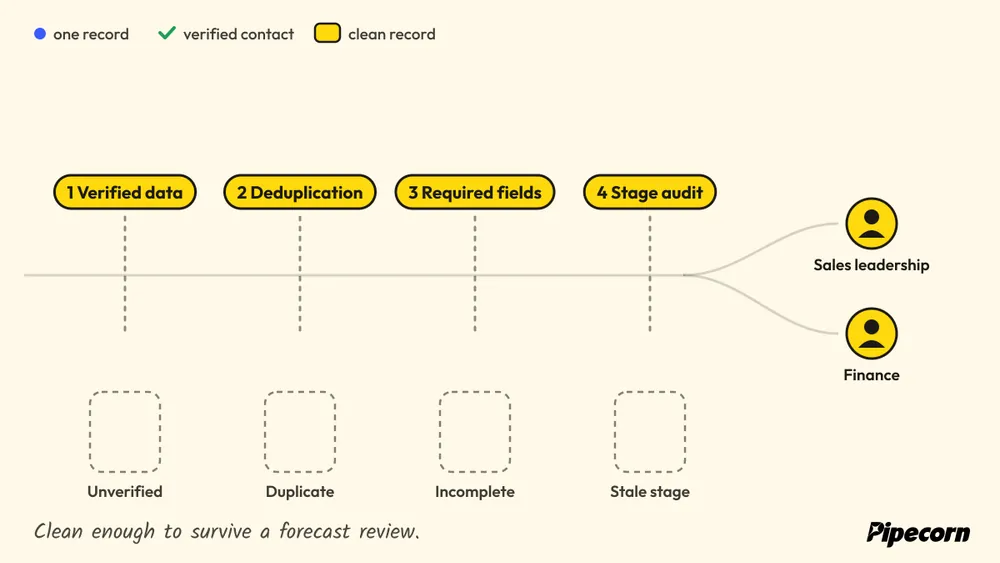
If you need a practical reference point for waterfall sourcing and validation logic, the waterfall enrichment guide is a useful operational companion. It's the kind of material that helps an analyst think about source order, verification, and handoff design instead of just list size.
The same logic applies to outbound infrastructure like email warmup. If the sending environment is weak, even good lead data underperforms because the messages don't arrive where they should.
Clean CRM data isn't a reporting luxury. It's the foundation that keeps routing, scoring, and forecasting believable.
Hiring Criteria, Career Progression, and Compensation
Hiring managers usually screen for three things in a sales ops analyst candidate. First, do they understand the business problem behind the data. Second, can they work across CRM, reporting, and process controls without getting lost in the tooling. Third, can they communicate clearly enough that sales leaders trust the output. A dashboard portfolio matters, but only if it shows judgment.
What good resumes actually signal
SQL projects, CRM admin exposure, and dashboard work are strong signals because they prove the candidate can handle structured data and commercial workflows. A bachelor's degree is commonly expected, and industry guidance also points to 3 to 5 years of sales experience before moving into the role, which makes sense because the analyst needs to understand how sellers behave inside the system. The broader tooling and workflow expectation is also consistent with hands-on CRM, BI, and process experience rather than pure analytics theory.
Compensation reflects the role's strategic weight
Salary benchmarks show how much the role has matured. Coursera cites a U.S. median total salary of $104,000 for the role, while the broader operations research analyst occupation has a median annual pay of $91,290 according to the U.S. Bureau of Labor Statistics. Apollo reports $60,000 to $80,000 base pay and $70,000 to $90,000 total compensation at the entry level, rising to $110,000 to $140,000 base and $125,000 to $160,000 total compensation at the senior level.
Career paths usually split by leverage
Analysts often move toward RevOps manager, sales enablement, or GTM engineering once they can own process design instead of only reporting. The transition point is usually when they can explain system behavior, not just query it. Senior analysts tend to be the ones who can challenge a broken routing rule, redesign a forecast input, or onboard a new team without creating chaos.
Red flags are easy to spot in interviews. A candidate who only talks about dashboards, but not data governance, usually struggles once the CRM gets messy. A candidate who can explain process trade-offs, stakeholder pressure, and the cost of bad inputs is much more likely to succeed.
Putting It All Together This Week
If you're already in the seat, ship one CRM hygiene improvement, one reporting cleanup, and one process rule that reduces manual fixes. That might mean tightening validation on a required field, reconciling duplicate accounts, or making one pipeline view more trustworthy for managers. The goal is to leave the system cleaner on Friday than it was on Monday.
If you're job hunting, build three proof points. Show a dashboard that ties a business question to a clean metric, a SQL or spreadsheet example that reconciles messy data, and a short write-up of a workflow you improved. Hiring managers want evidence that you can protect the data before you explain it.
If you're hiring, test for process thinking, not just tool familiarity. Ask how the candidate would handle duplicate ownership, stale stages, or a broken handoff between CRM and engagement tools. The best answers will show judgment, not just software names.
The central takeaway is simple. Sales operations analyst is no longer a back-office reporting role. It's the analytical control layer of revenue operations, and the people who treat it that way will compound their impact, and their compensation, faster than the ones who only chase dashboards.
A CTA for Pipecorn.