Outbound Sales Strategy: A Practical Playbook for 2026
Build a winning outbound sales strategy in 2026. Learn ICP design, waterfall enrichment, multi-channel cadences, KPIs, and compliance from real practitioners.

On this page
If you're staring at a dashboard full of sends, a CRM full of stale contacts, and a CRO asking why pipeline hasn't moved, you already know the problem isn't just “more outbound.” The issue is usually a broken operating system, weak data, weak timing, or a cadence that stops before the buyer ever replies. In 2026, the outbound sales strategy that wins is the one that treats data, signals, and sequencing as one loop, because the math is unforgiving. Benchmarking puts cold email open rates around 15–25%, reply rates around 1–5%, and deal conversion at 0.2–2% (industry benchmark), so a team can't afford to optimize one layer and ignore the rest.
Table of Contents
- The Outbound Sales Motion in 2026
- Defining the ICP and Signal Stack
- Sourcing and Verifying Lead Data
- Designing Multi-Channel Cadences
- Wiring It Into CRM and Sales Engagement Tools
- Metrics That Predict Pipeline Quality
- Personalization, Compliance, and Scaling
The Outbound Sales Motion in 2026
A RevOps lead taking over outbound in 2026 usually inherits the same pattern. SDRs are sending a lot of email, replies are thinning out, the CRM has half-clean records, and the CRO still wants to know why pipeline is flat while activity keeps climbing. That problem is not only copy, and it is not only tooling. It is the operating model.

A useful outbound sales strategy ties three layers together. The data foundation gives the team reliable account and contact coverage. Signal-based prioritization sorts accounts by fit and timing, so reps work the ones with a real chance of movement first. The multi-channel cadence sequences email, LinkedIn, and phone into one motion instead of treating each channel as its own campaign.
The system only works when the layers match
Better copy does not rescue a bad list. More software does not help if every account sits in the same queue and gets the same treatment. Modern outbound works when the list, the signal logic, and the cadence are built to support one another, because the team is deciding where to spend attention before it ever writes the first message.
That is also why an AI-driven lead sourcing strategy can be useful. It treats sourcing as part of the sales motion, not a separate research task handed off after the fact.
The funnel math is usually the part teams want to skip, but it sets the expectation. Cold outbound is a low-response motion by design, with open rates around 15–25%, reply rates around 1–5%, and deal conversion at 0.2–2% (benchmark source). Those ranges are why the team has to separate deliverability, reply quality, and meeting creation instead of judging success by send volume alone.
A few more relevant replies from the same send volume can change the quarter. That only happens when the contacts are real, the timing is strong, and the message reaches the right account at the right moment.
Practical rule: if a team measures sends more closely than meetings, the motion is already drifting away from revenue.
A clean outbound motion starts with who gets targeted, then moves to how those contacts are sourced and verified, then to how touches are sequenced, and finally to how the whole workflow is connected to CRM and reporting. That order keeps the team focused on the part that matters most, the number of real conversations created from the same outreach effort.
Defining the ICP and Signal Stack
A weak ICP is usually the quiet reason outbound burns budget. Teams keep working accounts that were never a fit, then blame the copy when the market ignores them. A real Ideal Customer Profile is not a persona slide with a few adjectives on it. It's a scoring system that tells reps where to spend time and where to walk away.
Start with fit, then add timing
The foundation is firmographic. Industry, headcount band, revenue range, and geography set the basic boundaries for whether an account belongs in the motion at all. After that comes the technographic layer, which looks at the stack the company already uses. If the account already runs tools that make integration or adoption plausible, that's a fit signal. If it uses a stack that clashes with the offer, that's a disqualifier, not a reason to keep pushing.
Then add behavioral signals. Current guidance points teams toward triggers such as recent funding, new executive hires, and job postings, because those are timing cues that suggest urgency or change. A job-change alert workflow can help teams catch those transitions earlier, which is why the internal job-change tracker at Pipecorn's job-change tracking page fits naturally into this part of the motion.
A good scoring rubric makes the trade-off obvious. For example, a B2B SaaS team might give strong fit scores to mid-market companies in a defined geography, then layer in extra points for a relevant stack, a fresh VP hire, and hiring in the buying department. Accounts that cross the threshold go straight into an active cadence. Lower-scoring accounts move into nurture or a signal-watched queue. That keeps the SDR team off low-value research work.
Build explicit disqualifiers into the score
Most ICPs fail because they only describe who to target, not who to exclude. Without disqualifiers, reps end up spending time on companies that look similar on the surface but almost never buy. Write the no-go rules down. If the deal size is wrong, if the stack is incompatible, or if the geography creates a support problem, those accounts should be filtered out before the sequence starts.
A strong ICP doesn't just focus effort. It prevents false hope from consuming rep time.
The simplest way to operationalize it is to keep one page for scoring and one page for exclusions. On the scoring side, use the three layers: firmographic, technographic, and behavioral. On the exclusion side, write the reasons a rep should not prospect the account. That one-page discipline makes the team faster, because they stop arguing over edge cases and start working accounts with real potential.

Sourcing and Verifying Lead Data
Once the ICP is clear, the next question is practical. Where does the team get contact data it can trust? Outbound motions often fail at this step. Static databases leave blind spots, manual spreadsheet work leaves lists stale, and poor contact data drags down connect rates before messaging gets a fair test.
Why single-source data keeps missing accounts
A single provider can work for narrow use cases, but it usually leaves coverage gaps. That shows up fast when a team sells across regions, industries, or buying committees with uneven data quality. Waterfall enrichment reduces those gaps by checking multiple providers in sequence until it finds a usable record. Pipecorn's model is built around this approach, with waterfall enrichment across 100+ sources and real-time sourcing layered on top to catch records that static databases miss.
The operational reason matters more than the theory. If the first pass returns weak emails or outdated mobiles, the sender, caller, and SDR all pay for it later. Verification turns “found” into “usable.” Teams should look for email and mobile verification, AI cleaning against targeting rules, and delivery into the CRM without re-keying. The internal guide on waterfall enrichment is a useful reference for how to think about that sequence end to end.
Build for country routing and operational handoff
Global routing matters because provider quality varies by country. If the team uses the same vendor order everywhere, it is guessing. Country-based routing lets the system favor the providers that perform better in a specific market, which is much more useful than forcing one source to behave like a universal answer.
Pricing is the other trade-off. Verified-only pricing sounds like a billing detail, but it changes how teams think about total cost. Paying for bad data twice, once on acquisition and once in lost rep time, is rarely cheaper than paying only for contacts that clear verification. That matters most in high-volume outbound, where small quality gains can change how many meetings come from the same send volume.
A workable checklist looks like this:
- Build the list in a workspace, not in scattered spreadsheets.
- Run a waterfall pass, so one source does not define coverage.
- Verify emails and mobiles, before anything goes to sequence.
- Push the qualified records into CRM, so SDRs work from one system of record.
If reps are still exporting CSVs and cleaning them by hand, the process is already leaking time that should have gone into selling.
The decision rule is straightforward. If the team sells into a narrow market with stable data, a single integrated source may be enough. If it sells into multiple geographies, depends on mobile coverage, or needs time-sensitive intent signals, waterfall plus real-time sourcing is usually the safer operating choice.
Designing Multi-Channel Cadences
Cadence design gets treated like copywriting too often, but it works better as an operating sequence. A good cadence is a repeatable rhythm that gives the buyer several real chances to respond across channels without turning the outreach into noise. The mistake I see most is either stopping after one message or treating email as the whole motion.
Use a cadence that earns attention over time
A practical rhythm is day-1 email, day-3 LinkedIn, day-5 follow-up email, day-8 phone, and day-12 breakup email. That cadence fits the broader benchmark already noted earlier in the article, where a sequence often needs about eight touches to create one meeting. It also reflects that 80% of sales require five or more follow-ups and 44% of reps stop after one. The operational gap between those behaviors is where pipeline disappears.
What matters more than the exact day spacing is the logic behind each touch. Every step should have a job, opening, nudging, validating, or closing the loop. A short relevant case reference, a peer introduction, or a brief loom can work if it maps to an actual signal. What does not work is stuffing value props into every step until the sequence reads like a brochure with a send button.
A cadence also has to respect fatigue. If the prospect has already ignored two emails, the next step should not be a louder version of the same message. It should change channel, change angle, or stop.
Branch based on engagement, not hope
Once a prospect engages, the cadence should change immediately. A reply, even a soft one, is a signal to stop the script and book the meeting if the fit is real. Silent prospects should stay in the sequence until the final step, then move out cleanly so the team does not keep hammering the same contact indefinitely.
Field rule: when a prospect replies with timing language, treat it as a routing issue, not a rejection.
The best teams test in batches instead of rewriting the whole sequence every week. They vary one element, subject line, opening hook, or CTA, then watch what happens across a clean batch of touches over a defined period. That is enough to see whether the message is weak, the list is weak, or the channel mix is wrong. It also keeps the team from confusing a weak offer with a weak cadence.
A more mature setup also separates response handling from sequence design. Replies should be routed fast, with a clear rule for interest, timing, objection, and wrong person. That keeps the cadence from doing two jobs at once, which is usually where handoffs get messy. For teams wiring that workflow into their stack, Pipecorn's CRM sync guidance is useful for thinking through how enriched records should land in the right system before a rep touches them. If calling matters in the motion, the guide to CRM VoIP integration is the cleaner reference for connecting dialer activity back to the CRM.
Wiring It Into CRM and Sales Engagement Tools
A clean sequence still falls apart if the handoff is manual. The moment an SDR has to copy data from one tool to another, the motion slows down and the process gets more error-prone. The goal is to make enrichment, routing, and sequence enrollment feel like one workflow, not three different tasks that happen to share a goal.
Connect the source of truth to the sequence engine
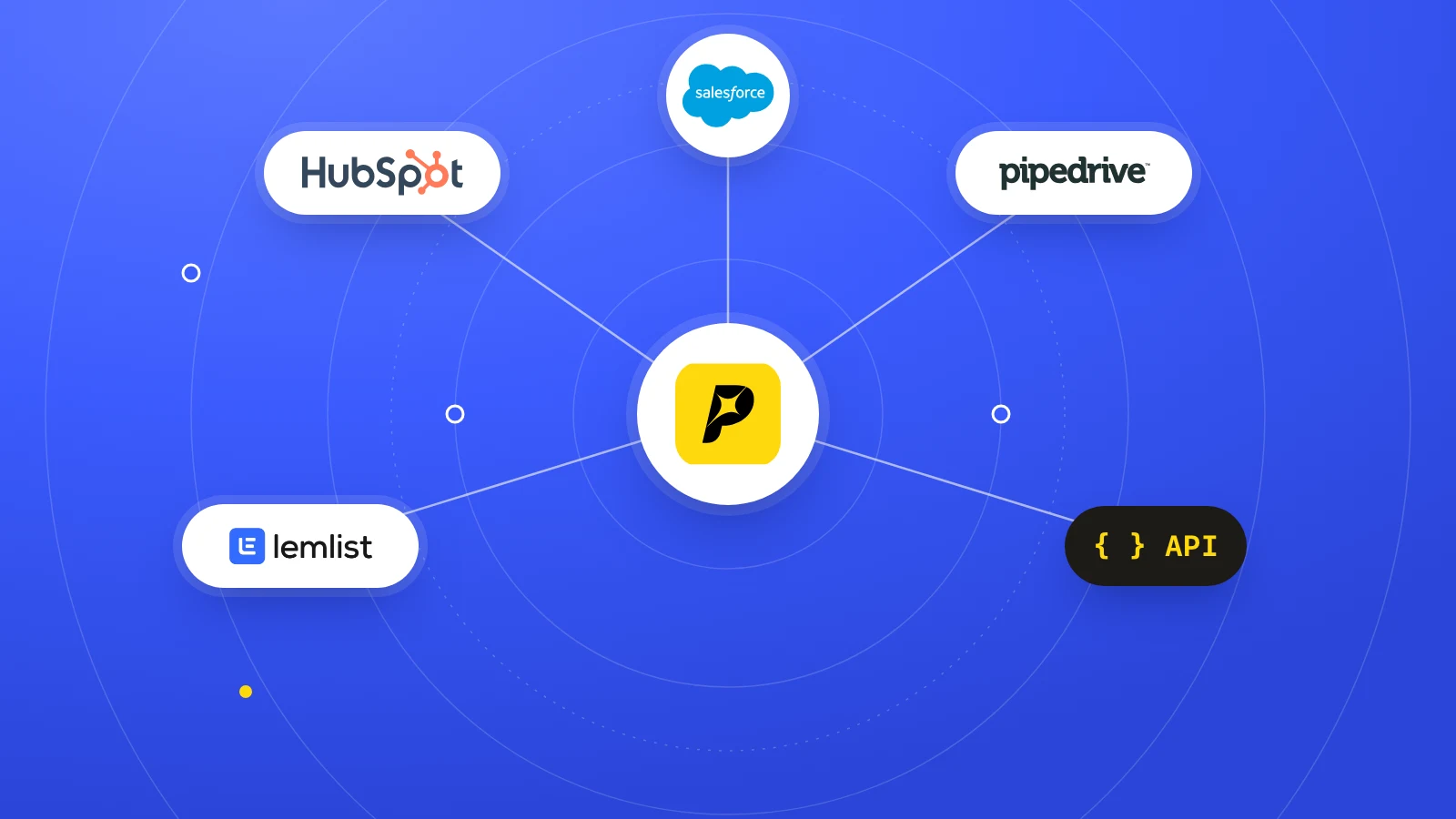
The practical stack usually starts with the CRM, then moves into the sales engagement layer. HubSpot, Salesforce, and Pipedrive are common CRMs for this kind of motion, while Outreach, Salesloft, and lemlist are common sequence engines. The point isn't the brand names. The point is that enriched contacts should land directly where reps work them.
Pipecorn fits naturally in that architecture because it supports automated delivery into CRMs and sequences, plus API and MCP endpoints for programmatic workflows. That matters when a team wants prioritized leads to push on a schedule instead of waiting for someone to upload a CSV. Its CRM sync guidance, including the Sales Navigator CRM sync page, is useful for thinking through the handoff layer.
A related part of the stack is voice. If the team depends on calling, the CRM and telephony layer should be connected cleanly, which is why a practical guide to CRM VoIP integration can help teams think through call logging and rep workflow without creating extra admin work.
Automate re-entry when new signals appear
The most valuable automations are the ones that bring an account back into play when the timing changes. Job-change alerts and new-hire alerts are especially useful here, because they can trigger re-enrollment automatically when a relevant contact changes role or when a target account adds the right decision-maker. That keeps the team from relying on memory or manual list refreshes.
The failure mode to watch for is simple. If the enrichment layer and engagement layer aren't connected properly, the SDR ends up re-keying the same fields, the sequence starts late, and the data loses trust. The remedy is to test three things in week one: field mapping, webhook delivery, and enrollment logic. If those three are stable, the rest of the stack usually behaves.
The cleanest outbound motion is the one where a rep spends their time on judgment, not on copying contact records between systems.
Metrics That Predict Pipeline Quality
A lot of outbound reporting looks busy while hiding the wrong thing. Leaders track activity because it is easy, then wonder why pipeline quality feels random. The better approach is to measure the funnel as a stack of distinct stages, with each stage giving a different diagnostic signal.
Use leading indicators before you chase revenue
Start with deliverability, then open rate, then reply rate, then positive reply rate, then meetings booked per 1,000 touches. Those are leading indicators. They show where the motion is leaking before lagging indicators like opportunity creation, pipeline value, and win rate have enough time to move. A practical benchmark source is still useful as a reference point for how narrow the top of the funnel is, with cold email open rates around 15–25%, reply rates around 1–5%, and deal conversion at 0.2–2% (industry benchmark).
The simplest scorecard keeps each stage separate.
| Funnel Stage | Metric | 2026 Benchmark | If Below Range |
|---|---|---|---|
| Prospecting | Deliverability | Qualitatively strong inbox placement | Check list quality, verification, and sender reputation |
| Opening | Open rate | 15–25% | Review targeting, subject lines, and domain health |
| Replying | Reply rate | 1–5% | Tighten targeting and sequencing relevance |
| Platform view | Average reply rate | 3.43% | Compare by segment, not just overall volume |
| Opportunity creation | Deal conversion | 0.2–2% | Check qualification quality and handoff discipline |
A table like this is not there to impress the team. It is there to show where the motion breaks.
Diagnose by stage, not by opinion
A low reply rate usually points to list quality or offer relevance, not just weak writing. A low meeting-to-opportunity conversion usually means the SDR qualified too loosely or the handoff to the closer was inconsistent. Rep dashboards should show behavior and sequence performance, while account-level scoring should show which segments deserve more budget. The wrong move is to coach activity without checking whether the account fit was ever there.
Stage-specific diagnostics matter because different failures look similar at a glance. If opens are acceptable but replies are weak, the subject line is not the core issue; the body, offer, or target segment is. If replies are healthy but meetings do not turn into opportunities, the qualification bar or handoff process is probably the problem. If deliverability drops first, everything upstream becomes noisy, and the team starts arguing about messaging when the inbox placement issue is the primary constraint.
For legal and compliance questions around measurement, suppression, and outreach rules, teams often want practical guidance that does not slow them down, which is why an AI legal assistant for business owners can be relevant when policy questions come up during rollout.
If a metric moves but the account quality does not, the team is probably optimizing the wrong layer.
Personalization, Compliance, and Scaling
The reflex to personalize everything sounds thoughtful, but it usually wastes effort. The better model is tiered personalization. Give the highest-value accounts deep manual work, keep lower-value accounts on lighter personalization, and let the rest run on a clean cadence. That way the team spends research time where it changes outcomes.

Personalize by leverage, not by guilt
The useful question is not, “Can we personalize this?” It's, “Does personalization change the odds enough to justify the time?” High-signal accounts can get manual-only treatment. Mid-tier accounts can get Low personalization with a few account-specific references. Lower-priority accounts can stay on Zero or minimal personalization until a signal changes the equation. That allocation model is much easier to scale than trying to make every email feel hand-written.
Put compliance into the workflow, not the footer
Compliance needs to be operational, not decorative. Teams should know their SOC 2 Type II, GDPR, and CCPA posture, keep suppression lists current, and be ready to provide DPAs on request. Country-specific consent rules matter too, especially when the outbound motion crosses regions. If the process can't show where consent and opt-out status live, the system isn't ready for scale.
Scale with vendor controls and capacity limits
The other scaling lever is vendor management. Credit-metered pricing with rollover helps teams control cost, and custom provider routing matters once the team starts pushing higher volumes or covering more countries. If the vendor can't adapt to those realities, the outbound motion will hit a ceiling fast. The healthiest rollout is the one where capacity limits, deliverability monitoring, and sequence tests are already built into the operating rhythm.
Pipecorn is one option in this category, since it combines verified emails and mobile numbers, waterfall enrichment, real-time sourcing, CRM delivery, and compliance posture in one workflow. If you're rebuilding outbound around signal-based prioritization, cleaner contact data, and automated handoffs, visit Pipecorn and see how the workflow maps to your current stack.