What Is Data Compliance for B2B Sales Teams
Understand what is data compliance and how GDPR, CCPA, and SOC 2 affect your outbound workflows. Practical guide for B2B sales teams.

Article summary
- Data compliance is the operational system that keeps personal data lawful, purposeful, secure, retained for the right period and supported by evidence across the B2B sales process.
- GDPR, U.S. state privacy laws, SOC 2 and DPAs work at different layers. Law sets the boundary, controls show how systems operate and contracts assign accountability.
- Five controls carry it into outbound workflows. Minimize the record, limit use to a stated purpose, enforce retention, verify consent and objection status, and restrict access.
- Governance improves data quality because it rejects data that has no clear operational reason to exist.
- Review vendors on evidence, from the SOC 2 report and its scope to privacy commitments, a DPA that matches the architecture and retention you can test.
- Run a mock access, correction or deletion workflow to find where the audit trail breaks.
Want to go further? Ask
 ChatGPT
 Claude
 Perplexity
 Grok
GrokOn this page
- 01Why Data Compliance Matters for B2B Sales Right Now
- 02Key Data Compliance Frameworks Every Sales Team Should Know
- 03Operationalizing Data Compliance in Outbound Workflows
- 04How Compliance Improves Data Quality and Outreach Effectiveness
- 05Vendor and Integration Compliance Checks
- 06Moving From Compliance as Constraint to Compliance as Advantage
By January 2026, aggregate GDPR fines had reached about EUR 7.1 billion, making data compliance a business discipline rather than a paperwork exercise. Data compliance is the operational system that keeps personal data lawful, purposeful, secure, retained for the right period, and supported by evidence across the B2B sales process.
For an SDR, that system determines whether a contact can enter a sequence, which fields can be enriched, who can access them, and when the record must be corrected or removed. For RevOps, it determines whether a vendor, CRM, enrichment workflow, and sales engagement platform can work together without creating an untraceable data trail.
Legal: "Where did this contact come from, and who else has a copy?"
RevOps, holding an old CSV export:

Why Data Compliance Matters for B2B Sales Right Now
The enforcement record gives sales leaders a practical reason to care. The CMS GDPR Enforcement Tracker recorded 2,685 fines totaling about EUR 6.11 billion by 1 March 2026. A broader DLA Piper survey through 10 January 2026 placed aggregate GDPR fines at EUR 7.1 billion. Those figures describe legal exposure, but they also reveal an operational problem: companies can't manage personal data casually and expect risk to remain contained.
Data compliance means collecting, storing, using, sharing, and deleting personal data according to applicable laws, contracts, and internal rules, while maintaining evidence that those controls operated. In an outbound motion, that includes lead sourcing, enrichment, CRM synchronization, list segmentation, sequencing, suppression, access management, and deletion requests. A privacy policy alone doesn't create compliance if the workflow can't show why a contact was collected or where the record went next.
The pipeline consequences of weak controls
A non-compliant data process creates more than a possible fine. It can leave sales teams unable to retrieve every copy of a record, honor an access or deletion request, explain a vendor's role, or prove that a campaign used data for a defined purpose. It can also damage sender reputation when stale, irrelevant, or improperly sourced contacts enter outreach.
The GDPR principles for businesses require data to be adequate, relevant, and limited to what is necessary, kept no longer than needed, kept accurate, and protected through technical and organizational measures. Those requirements map directly to sales operations:
- Collection: Enrichment should serve a defined ICP or campaign purpose, not accumulate every available field.
- Accuracy: Teams need correction and verification processes instead of treating an old CRM export as ground truth.
- Retention: Records need lifecycle rules, not indefinite storage because deletion feels inconvenient.
- Accountability: The organization must be able to identify owners, processors, access, and decisions.
Operational rule: If a sales team can't explain why a field exists, who can use it, and when it should disappear, that field isn't governed well enough for reliable outbound.
Treating compliance as infrastructure protects the pipeline in two directions. It reduces regulatory exposure while making the database more trustworthy for segmentation, routing, personalization, and reporting. Teams looking to strengthen the technical layer can review Pipecorn's best practices for data security, then translate those controls into CRM and enrichment procedures.
Key Data Compliance Frameworks Every Sales Team Should Know
Sales teams often treat GDPR, CCPA, SOC 2, and DPAs as interchangeable proof of “being compliant.” They operate at different layers. For RevOps, the useful question is what each framework changes in data collection, enrichment, vendor review, and outreach execution.
Regulations set duties
GDPR is a primary reference for European prospect data and has influenced privacy governance beyond Europe. It covers lawful processing, minimization, purpose, accuracy, retention, security, individual rights, and accountability. For an SDR, that means having a defensible reason to process contact data and a defined response to objections, access requests, corrections, and deletion.
The U.S. regulatory environment is more fragmented. California's CCPA and CPRA-style rules apply based on thresholds including gross annual revenue over $25 million, buying, selling or sharing the personal information of 100,000 or more California residents or households, or deriving 50% or more of annual revenue from selling California residents' personal information, as listed on the California Attorney General's CCPA page. These thresholds do not replace a broader legal assessment. They do show why a national GTM motion needs jurisdiction-aware rules for enrichment, routing, and outreach.
The U.S. regime is expanding. Eight states passed new broad privacy statutes in 2023, seven more did so in 2024, and 20 states were actively enforcing broad privacy laws by January 2026, according to this 2026 update on U.S. privacy laws. RevOps teams should expect differences in notices, access, deletion, consent, and vendor obligations rather than one universal U.S. rule.
Controls validate and contracts allocate responsibility
SOC 2 is not a privacy law. It is an independent examination of controls related to areas such as security, availability, processing integrity, confidentiality, and privacy. A SOC 2 report helps procurement assess whether a vendor has designed and operated relevant controls, but it does not automatically make the buyer's use of that vendor lawful. Pipecorn's SOC 2 compliance overview separates assurance reporting from statutory obligations.
A Data Processing Agreement, or DPA, defines how a processor handles personal data for a client. It should address processing instructions, confidentiality, security, subprocessors, assistance with rights requests, incident handling, and deletion or return of data. Regulations establish duties, control reports provide evidence, and DPAs assign responsibilities contractually.
For technical collection or enrichment decisions, teams can also browse data compliance guides. The operating model is clear: law sets the boundary, controls show how systems operate, and contracts assign accountability. That distinction helps sales teams choose usable data sources without treating a vendor certificate as permission to contact every record.
| Framework | What it is | What it changes for sales |
|---|---|---|
| GDPR | A regulation covering lawful processing, minimization, purpose, accuracy, retention, security, individual rights and accountability. | A defensible reason to process contact data and a defined response to objections, access requests, corrections and deletion. |
| U.S. state privacy laws (CCPA and others) | Fragmented state rules with their own applicability thresholds. | Jurisdiction-aware rules for enrichment, routing and outreach, with different notices, access, deletion, consent and vendor obligations. |
| SOC 2 | An independent examination of a vendor's controls. Not a privacy law. | Evidence for procurement that controls were designed and operated. It does not make the buyer's use of the vendor lawful. |
| DPA | A contract that defines how a processor handles personal data for a client. | Who handles instructions, confidentiality, security, subprocessors, rights requests, incidents and deletion or return of data. |
Operationalizing Data Compliance in Outbound Workflows
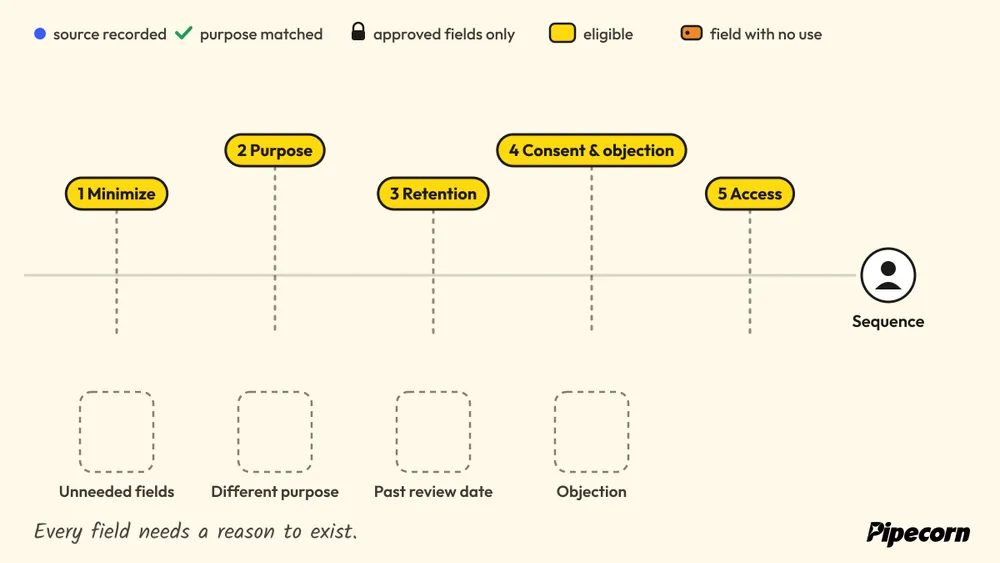
A compliant outbound workflow doesn't begin with a legal document. It begins with checkpoints inside the systems that collect, enrich, route, activate, and delete contact data. Five controls matter most.
1. Minimize the record before enrichment
Start with the fields the campaign actually needs. A verified work email or business phone number may support a defined B2B motion, while unrelated personal details, speculative attributes, or unused profile data expand exposure without improving execution.
Minimization also applies to provider selection. Teams should know what a vendor returns by default, which fields are optional, and whether the workflow can reject unnecessary data before it reaches the CRM. A narrower record is easier to secure, review, correct, and delete.
2. Limit use to a stated purpose
“Prospecting” is too broad to govern well. A campaign purpose might be reaching operations leaders at companies that match a defined ICP for a specific product category. That purpose should determine the audience, fields, sequence, access permissions, and downstream reporting.
Purpose limitation prevents one campaign's data from becoming a general-purpose pool for unrelated activity. When an SDR wants to reuse a contact for a different motion, the team should check whether the new use fits the original rationale and applicable notice or consent requirements.
3. Enforce retention in the CRM
Retention can't depend on a rep remembering to clean a list. RevOps should define lifecycle states, review dates, suppression logic, and deletion workflows that apply across the CRM, enrichment layer, exports, and sales engagement tools.
Retention enforcement keeps stale records from circulating through future campaigns and reduces the number of systems that hold obsolete data. It also creates evidence. A deletion event, suppression reason, and timestamp are more useful than a policy statement that says data is removed “when appropriate.”
4. Verify consent and objection status
Consent records need more than a checkbox. They should identify the collection context, the communication purpose, the relevant notice or preference, and any later withdrawal or objection. Where a campaign relies on another lawful basis, the organization still needs documented reasoning and an effective suppression process.
An SDR shouldn't have to interpret legal status manually before every call. The sequence tool should receive the current eligibility state from a controlled source, and an objection should propagate to every relevant activation channel.
5. Restrict access to the people who need it
Access controls should follow job responsibilities. SDRs may need approved contact and account fields, while administrators, analysts, and vendor managers may need different permissions. Exports deserve the same attention as the CRM because downloaded files often escape normal retention and logging.
Pipecorn's outbound sales automation capabilities are relevant only when the surrounding workflow also controls purpose, permissions, verification, and suppression. Automation can enforce a rule consistently, but it can't invent the organization's lawful purpose or replace ownership.
Practical test: A workflow is operationally mature when a manager can identify the source, purpose, owner, access history, retention state, and deletion path for a contact without reconstructing events from scattered spreadsheets.
How Compliance Improves Data Quality and Outreach Effectiveness
Compliance and data quality are often treated as competing priorities. In practice, disciplined governance can improve the inputs that sales teams rely on because it rejects data that has no clear operational reason to exist.
Minimization forces list builders to define what “qualified” means before enrichment begins. That reduces the temptation to buy or collect every available attribute and shifts attention toward fields that support routing, personalization, qualification, or contactability. The result isn't automatically a perfect database, but it is a database with clearer standards.
Retention creates a second quality effect. A contact that has remained untouched through role changes, company changes, objections, and repeated failed outreach should not remain active merely because storage is cheap. Lifecycle rules remove records that no longer support the campaign and reduce the chance that stale information will re-enter a sequence.
Governance as quality control
A governed workflow gives data quality teams better questions to ask:
- Can the source be identified? If not, the record is difficult to validate or defend.
- Does the contact match the intended purpose? If not, the record may be irrelevant even if the fields look complete.
- Has the record been verified recently enough for the use case? If not, it needs review or suppression.
- Can the team honor an objection across systems? If not, the record isn't operationally safe to activate.
- Does the CRM contain duplicate or conflicting versions? If so, enrichment may be multiplying confusion rather than resolving it.
A process that verifies business contact details, filters against targeting rules, and removes invalid records protects both compliance and deliverability. It can reduce unnecessary bounces and prevent repeated outreach to contacts who should no longer receive it, although the exact effect depends on list quality, sending practices, and channel controls.
The data quality standards guide provides a useful way to formalize those checks. The key principle is that compliance should sit inside quality assurance, not beside it.
The useful reframing: Compliance doesn't ask sales teams to accept worse data. It asks them to prove that the data is relevant, controlled, and still fit for its intended use.
Vendor and Integration Compliance Checks
A vendor's feature list tells RevOps what a platform can do. A compliance review determines whether the organization can use those features without losing control of personal data. Procurement should assess the full path from source to CRM to sequence, not just the interface where a rep clicks “export.”
Four checks for enrichment and sales tools
Security assurance comes first. Ask whether the provider has a current SOC 2 Type II report or another relevant independent assessment, what systems and services the report covers, and whether any exclusions affect the proposed workflow. A logo on a website isn't enough. Procurement should review the report, scope, testing period, exceptions, and complementary customer controls.
Privacy commitments need precision. A vendor claiming GDPR or CCPA alignment should explain its role, processing purposes, rights-request procedures, international transfers, subprocessors, and security measures. The buyer should compare those statements with the intended use of prospect data instead of treating “compliant” as a universal authorization.
The DPA should match the architecture. It should identify controller and processor roles, permitted instructions, subprocessors, assistance obligations, incident procedures, deletion, and audit rights. The agreement should also reflect how data moves through APIs, CRM integrations, webhooks, exports, backups, and support channels.
Retention guarantees must be testable. Ask what happens to source data, enriched fields, rejected records, logs, backups, and data held by subprocessors. “We delete data on request” leaves unanswered questions unless the contract and technical process define scope, timing, verification, and exceptions.
The vendor: "We delete data on request."
RevOps, asking about backups, logs and subprocessors:

Source mechanics and legal context need separate review. A tool's technical ability to retrieve information doesn't establish that the organization has a lawful, documented purpose for using it.
Verify claims instead of accepting them
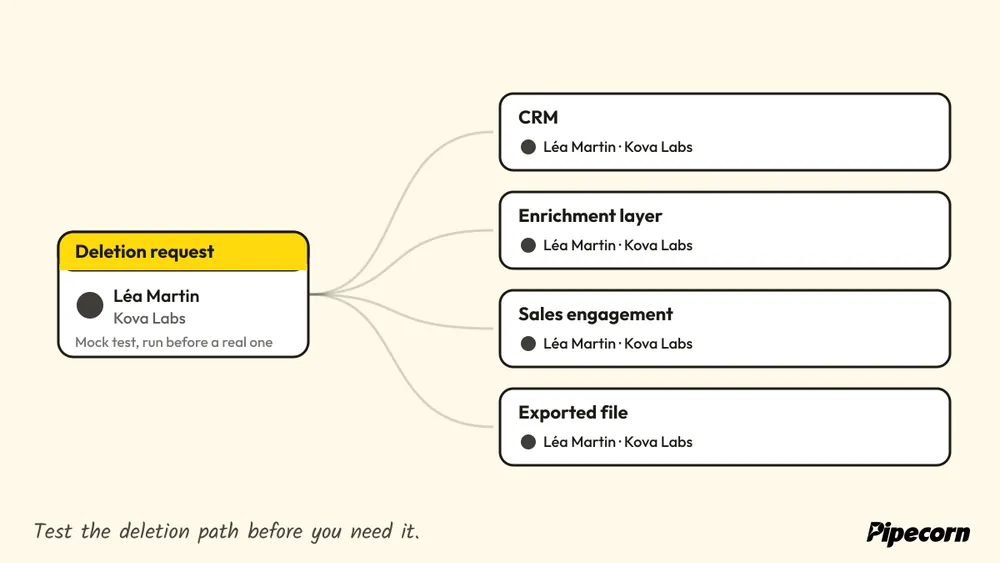
A credible review requests evidence, maps each vendor to the data inventory, and records the decision owner. It also tests a small workflow: create a record, synchronize it, apply a suppression or deletion request, inspect logs, and confirm the result across connected systems.
Pipecorn's Data Processing Agreement guidance can help teams frame the contractual questions. The final decision should weigh coverage and workflow fit against data provenance, control evidence, retention behavior, subprocessor visibility, and the effort required to answer a rights request.
Moving From Compliance as Constraint to Compliance as Advantage
A sales organization that treats compliance as a last-minute approval step creates friction at the worst possible moment. The team has already selected vendors, imported contacts, launched sequences, and distributed exports. Legal or security reviewers then have to reconstruct the data path under pressure, while sales sees every control as an interruption.
A mature organization makes different choices earlier. RevOps maps the data sources, assigns owners, defines the campaign purpose, limits fields, verifies vendor controls, and connects deletion and suppression events to every activation system. Sales leaders then receive lists that are narrower but more defensible, and SDRs spend less time questioning whether a record belongs in a sequence.
A practical operating sequence
The work can begin without a large legal department:
- Audit current flows. List every source, enrichment provider, CRM, sales engagement platform, export location, and integration that handles prospect data.
- Classify the fields. Separate necessary business contact fields from optional attributes and remove fields with no defined use.
- Review vendors. Request security reports, privacy documentation, DPAs, subprocessor information, and retention commitments.
- Build lifecycle rules. Define when records are reviewed, suppressed, corrected, or deleted, including what happens in downstream tools.
- Train the team on decisions. SDRs need clear rules for objections, consent status, personal versus business contact details, exports, and escalation.
- Test evidence. Run a mock access, correction, deletion, or incident workflow and identify where the audit trail breaks.
The GDPR requires a controller to complete a Data Protection Impact Assessment before processing likely to create a high risk to individuals' rights and freedoms. The GDPR Article 35 text also allows one assessment to cover similar processing operations with similar high risks. For sales teams, that makes a DPIA relevant when a new enrichment, profiling, monitoring, or automated activation process could materially increase risk.
Incident readiness matters too. Under the GDPR breach rule, a controller must notify the competent supervisory authority without undue delay and, where feasible, within 72 hours of becoming aware of a qualifying personal data breach, unless the breach is unlikely to create risk to individuals, as described in the GDPR breach notification requirements. A documented inventory and access trail help the organization determine what happened instead of searching through disconnected systems.
Compliance becomes a competitive advantage when it improves trust without blocking execution. Procurement moves faster because evidence is ready, data operations become more predictable because ownership is explicit, and outbound teams work from records that have a defined purpose and lifecycle. That is the difference between a privacy policy that sits in a footer and a data program that supports ambitious GTM work.
Pipecorn helps B2B teams build ICP-aligned lists, clean and verify contact data, enrich across more than 100 providers, and deliver qualified records into CRMs and sales engagement tools. Visit Pipecorn to evaluate how a controlled enrichment workflow can support more reliable, auditable outbound operations.