Data Quality Standards: A Practical Guide for Sales Teams
Master data quality standards to boost outbound sales performance. Learn dimensions, frameworks, metrics, and implementation steps with real examples

On this page
You launch a carefully targeted outbound campaign, then watch the first week unravel. Emails bounce because contacts changed companies, phone numbers route to disconnected lines, and several “decision-makers” hold titles that no longer match their responsibilities. SDRs spend dialer minutes chasing dead records, AEs enter meetings without the right stakeholder context, and pipeline reports count duplicate accounts as separate opportunities.
The common response is to call the CRM messy and ask operations to clean it. That framing creates the problem. Data quality is a revenue operating issue, because every inaccurate, incomplete, stale, or duplicated record changes who your team contacts, how they prioritize accounts, and what leadership believes about pipeline.
Formal data quality standards provide a shared language for fixing this. ISO 8000, OECD quality dimensions, and governance frameworks define what trustworthy data should mean, but sales teams need to translate those principles into validation rules, enrichment decisions, routing logic, and recurring ownership. Even a team evaluating an integrated CRM for Google Workspace still needs clear rules for what enters the CRM and when a record is safe to activate.
Why Your Sales Data Is Failing You
The campaign failure usually starts earlier
A sales team can build an apparently strong enterprise account list and still begin with unreliable inputs. One contact may have a valid email format but no longer work at the company. Another may be listed as a vice president even though the person moved into an advisory role months ago. A third record may belong to the right company but the wrong subsidiary, making the account appear qualified while sending the rep toward an irrelevant buying group.
These errors rarely stay isolated. A bounced email lowers the usefulness of a sequence, while an incorrect title sends messaging to someone without the authority or context to respond. Duplicate accounts then inflate coverage reports, so managers think the team has more qualified opportunities than it does.
Practical rule: A record isn't “good” because it exists in the CRM. It's good only when it's reliable enough for the next action your team intends to take.
Bad records create operational waste
The consequences appear in ordinary sales activity:
- SDR capacity: Reps burn time calling disconnected numbers or researching contacts who've already left the business.
- AE preparation: Account executives walk into meetings with outdated organizational information and weak stakeholder context.
- Forecasting: Duplicate companies and stale opportunities make pipeline coverage look healthier than the underlying buying activity.
- Sender reputation: Repeatedly contacting invalid addresses can damage the reliability of outbound infrastructure.
- Management decisions: Leaders may change territories, hiring plans, or campaign priorities based on records that don't represent current reality.
The root cause is usually not a lack of effort. Salespeople enter data while moving quickly, vendors return conflicting results, and systems apply different definitions to the same field. Without a shared standard, one team treats a missing employee count as acceptable while another blocks the record. One system normalizes company names, while another preserves free-text variations that create duplicates.
Standards turn opinions into operating rules
ISO 8000 is designed as an international reference for data quality and master data, maintained by ISO Technical Committee 184, Subcommittee 4. Its development moved from an initial proposal in 2002 to approved components in 2009, with the overview later republished as ISO 8000-1:2022, and the series now covers specialized areas such as measurement, master data, syntax, semantics, provenance, and governance over more than two decades (ISO 8000 background and development).
Sales teams don't need to implement every part of the standard. They do need to borrow its discipline: define quality, assign responsibility, measure failures, and create controls before bad data becomes an activated task. The rest of this guide translates that discipline into the daily realities of prospecting, enrichment, routing, and pipeline management.
The Six Dimensions of Data Quality That Matter
Sales teams often say they need “clean data,” but that phrase hides several different failure modes. A record can be complete yet inaccurate, valid in format yet stale, or consistent across systems while still describing the wrong person. A practical framework starts by separating the dimensions.

What each dimension means in sales
Accuracy asks whether the value is correct. A contact whose CRM title says “Chief Revenue Officer” but now works as a consultant fails an accuracy check, even if the spelling and formatting are perfect.
Completeness asks whether required information is present. A lead without industry, employee count, country, or account ownership may be impossible to segment or route correctly. Completeness should be defined by use case, not by a universal requirement that every field be filled.
Consistency asks whether the same entity is represented uniformly across systems. If Salesforce, a sales engagement platform, and an enrichment provider assign different revenue bands to the same account, reps and managers may act on incompatible assumptions.
Timeliness measures whether the information is current enough for the decision at hand. Funding information from eighteen months ago may still be historically correct, but it can mislead prioritization if the team uses it to identify current buying capacity.
Validity checks whether a value follows an accepted rule or format. A malformed email address, an impossible phone pattern, or a country and postal-code combination that cannot coexist should fail before activation.
Uniqueness asks whether each real-world account or person appears once in the relevant dataset. Duplicate accounts can split activity across records, inflate pipeline coverage, and make ownership unclear.
The OECD's statistical quality framework adds a broader perspective. It defines relevance, accuracy, credibility, timeliness, accessibility, interpretability, and coherence, while its 2015 Recommendation on Good Statistical Practice also emphasizes comparability (OECD Recommendation on Good Statistical Practice). For revenue teams, the lesson is important: quality isn't only error detection. It also includes whether people can understand, compare, and trust the information.
Prioritize by revenue motion
Don't try to improve every dimension at once. Rank them according to the action that follows the record.
| Sales use case | Dimensions to prioritize first | Why |
|---|---|---|
| Outbound prospecting | Accuracy, timeliness, validity | Reps need the right person, a usable channel, and current context |
| Territory planning | Uniqueness, consistency, completeness | Account counts and ownership must reflect reality |
| Forecasting | Accuracy, consistency, timeliness | Leadership needs current opportunities represented consistently |
| Compliance reporting | Completeness, accuracy, accessibility | Required records must be present, correct, and retrievable |
A small outbound team may accept a missing secondary firmographic field if the contact, company, and outreach channel are verified. It shouldn't accept an unverified email merely because the account record is otherwise complete. Quality is fitness for purpose, not a score that means the same thing everywhere.
Industry Frameworks and Standards Explained
Formal frameworks solve different problems, so sales leaders shouldn't treat them as interchangeable checklists.
ISO 8000 provides the strongest international foundation for master data and data quality. Its structure covers vocabulary, measurement, exchange, syntax, semantics, provenance, and governance. That breadth is valuable when multiple systems and organizations need shared definitions, but it can feel abstract to a 15-person outbound team deciding whether a contact should enter a sequence.
The standard also distinguishes syntactic, semantic, and pragmatic quality. Syntactic quality asks whether data follows its declared structure. Semantic quality asks whether it means what the organization intends. Pragmatic quality asks whether it serves a particular user purpose (ISO 8000-8 concepts and measurement). An email can pass a format check while failing semantic quality because it belongs to the wrong person, and it can pass both while failing pragmatic quality if the contact isn't relevant to the campaign.
The OECD framework is more explicitly focused on trust and usability in statistics. Its dimensions push teams to consider whether data is relevant, credible, interpretable, coherent, and comparable, not merely whether fields contain values. That is useful for dashboards and executive reporting, where a technically valid number can still mislead if teams define it differently.
DAMA-DMBOK is best understood as a governance model rather than a sales-specific validation standard. It helps organizations think about stewardship, policies, metadata, architecture, and lifecycle management. GDPR and CCPA add compliance obligations around personal information, including the practical need to maintain records that are accurate, current enough for their purpose, and manageable when people exercise data rights. Neither regulation gives an outbound manager a complete enrichment workflow.
| Framework | Primary focus | Key dimensions | Sales applicability |
|---|---|---|---|
| ISO 8000 | Master data quality, exchange, measurement, and governance | Structure, meaning, fitness for use, consistency, provenance | Strong foundation for CRM and enrichment controls, but requires translation into workflows |
| OECD framework | Statistical trust, usability, and comparability | Accuracy, credibility, relevance, timeliness, coherence, interpretability | Useful for reporting definitions and executive confidence |
| DAMA-DMBOK | Enterprise data management and stewardship | Governance, ownership, metadata, lifecycle control | Helps assign responsibility, but offers limited outbound-specific guidance |
| GDPR and CCPA | Personal-data rights and responsible handling | Accuracy, purpose, access, correction, control | Creates compliance requirements around prospect and customer records |
Teams handling vendor and customer information should also understand how operational controls relate to broader security assurance. A concise explanation of SOC 2 compliance requirements can help sales and RevOps leaders evaluate provider controls, but security assurance doesn't replace record-level accuracy or freshness checks.
The practical subset is straightforward: define critical fields, validate structure, verify meaning, record provenance, prevent duplicates, and assign owners for remediation. Those controls directly affect prospecting performance without forcing a small team to adopt every enterprise governance artifact.
Measuring Data Quality with Real Metrics
A dashboard that says “CRM health is good” isn't useful. RevOps needs measures tied to decisions, with a defined population, calculation, owner, and action when the result falls below the agreed threshold.
Build the measurement layer
Start with an accuracy rate for critical fields:
Accuracy rate = verified correct values ÷ fields tested × 100
Test email, phone, job title, company association, and other fields that determine activation. The source used for verification must be recorded, because a value can appear accurate while lacking reliable provenance.
Completeness uses the same discipline:
Completeness rate = populated required fields ÷ required fields across records × 100
Set different required fields for lead creation, SDR assignment, opportunity creation, and forecasting. A missing employee count might block account segmentation but not necessarily prevent a rep from researching a contact.
For timeliness, measure the age of the last successful verification and the share of records outside the freshness rule. Validity can be measured through pass and fail counts for email structure, phone normalization, country fields, and other business rules. Uniqueness requires a deduplication audit that compares matched records against the total database population.
Consistency needs a cross-system comparison. Select a field such as account owner, lifecycle stage, employee band, or industry, then calculate how often the CRM matches the designated source of truth. Teams can use the same approach when reviewing their data deduplication process.
| Metric | Dimension | Calculation method | Target benchmark |
|---|---|---|---|
| Accuracy rate | Accuracy | Verified correct critical fields ÷ tested critical fields | Set by use case and verification confidence |
| Required-field fill rate | Completeness | Populated required fields ÷ required fields | Define by pipeline stage |
| Verification age | Timeliness | Current date minus last successful verification | Set an acceptable freshness window |
| Format pass rate | Validity | Records passing format rules ÷ records tested | Establish rules for each field |
| Duplicate rate | Uniqueness | Duplicate records ÷ total records | Drive toward a documented tolerance |
| Cross-system match rate | Consistency | Matching values ÷ values compared | Define a system of record |
Avoid copying a benchmark from another company without understanding its motion. A high accuracy rate for email doesn't compensate for stale job titles, and a strong completeness score can hide a database full of duplicates. The useful question is not “Is our data clean?” It is “Can this record safely support the next revenue action?”
How Outbound Teams Apply These Standards
A standard becomes operational when it determines what happens to a record. Consider an enterprise SaaS team building a target account list. The team begins with CRM records, then applies waterfall enrichment instead of trusting a single provider.

Scenario one uses thresholds, not gut feel
The first pass checks account identity and deduplication. The next pass looks for a current contact, a business email, a usable mobile number where appropriate, and a title that matches the intended persona. Missing firmographic fields are filled through additional sources, while conflicting values are held for review rather than overwritten.
A record can pass directly to SDR assignment when the account association is clear, the contact matches the persona, required contact channels have passed verification, and the data meets the campaign's freshness rule. It should go to manual review when providers disagree about identity, the title is ambiguous, the person appears connected to multiple entities, or a critical field has weak provenance. Records that fail identity or contactability checks should remain inactive until another source resolves the issue.
This is the practical meaning of ISO 8000's distinction between syntax, semantics, and purpose. A correctly formatted email is only the first gate. The team still needs to know whether it belongs to the intended person and whether that person is relevant to the campaign.
Scenario two treats hygiene as a workflow
A sales development team can monitor new activity continuously while scheduling deeper reviews. Automated bounce checks remove or suppress unusable email addresses after campaign activity. Phone validation runs on a recurring schedule, and enrichment triggers when a contact changes role or when account information changes materially.
The team routes failures through a waterfall:
- Automated verification: Recheck the value and query another provider when appropriate.
- Source comparison: Compare the result with CRM history, company information, and current role signals.
- Manual review: Ask an operations owner to resolve ambiguity.
- Suppression or archival: Prevent failed records from entering active sequences.
The trade-off is real. Enrichment credits, provider contracts, and integration work cost money. Bad data also consumes sales capacity, creates poor buyer experiences, and can affect sender reputation. Teams should compare those costs against the actions the records support, rather than enriching every field for every contact.
For teams selecting a workflow, data validation techniques for outbound records should include schema checks, presence checks, format validation, freshness, confidence, and confirmation that the contact belongs to the intended account.
A short video can reinforce the operational flow, but it shouldn't replace the written rules and ownership model.

Building Governance Processes That Stick
Governance fails when it lives in a policy document no seller reads. It sticks when the CRM, enrichment workflow, and manager dashboard make the correct action easier than the incorrect one.
Assign ownership at the point of failure
Give a Sales Ops data-quality champion responsibility for the dashboard, exception queue, definitions, and escalation path. This doesn't mean one person manually fixes every record. It means someone owns the process and can answer questions such as which system wins when fields conflict, who approves a new validation rule, and how quickly failed records must be resolved.
Entry controls should protect seller speed. Require the fields that affect routing and activation, apply structural validation automatically, detect likely duplicates at creation, and defer nonessential enrichment until it can run in the background. A rep shouldn't have to complete an administrative questionnaire before saving a useful prospect, but the team shouldn't activate a record that lacks a verified channel or account relationship.

Create a repeatable remediation loop
Use a clear order of operations:
- Automated enrichment first: Resolve routine gaps without interrupting the rep.
- Manual review second: Route ambiguous identity, ownership, and policy questions to an assigned operator.
- Suppression or archival third: Keep failed records out of active campaigns when they can't be responsibly repaired.
Monitoring should surface records that haven't been touched within the team's defined freshness window, repeated delivery failures, unexpected title changes, and account conflicts. The alert matters only if it creates an owned task with a due date and an escalation path.
A practical calendar might look like this:
| Cadence | Checkpoint | Owner |
|---|---|---|
| Weekly | Review accuracy, validity, bounce, and exception dashboards | Sales Ops champion |
| Monthly | Audit duplicates, cross-system consistency, and unresolved failures | RevOps and system owners |
| Quarterly | Revalidate phone data, review definitions, and adjust thresholds | Sales leadership and RevOps |
Reps also need a feedback path. A “bad data” button, structured CRM reason, or Slack workflow can capture corrections at the moment a seller discovers them. That feedback should improve the rule or source, not disappear into an untracked message.
Your Implementation Roadmap
A workable rollout starts with the revenue decisions your data supports, not with a search for theoretical perfection. The sequence below gives a sales organization a practical 12-week implementation path.
Weeks one through four establish the baseline
Inventory the systems that create, enrich, transform, and consume prospect records. Choose the fields that determine activation, routing, segmentation, and forecasting, then assess them across accuracy, completeness, consistency, timeliness, validity, and uniqueness.
Document the current failure patterns. Separate a bad email from a wrong account association, and separate a duplicate from a missing firmographic field. Assign an owner to every issue category and publish the definitions in a place sales managers can use.
Weeks five through eight pilot the controls
Choose one segment, territory, or outbound motion. Add entry validation, duplicate detection, waterfall enrichment, verification, and exception routing without changing every sales workflow at once.
Use the pilot to test the trade-offs. Which fields improve targeting enough to justify enrichment? Which failures require human judgment? Which checks slow reps down, and which can happen asynchronously? Review campaign and pipeline signals alongside quality metrics, but don't claim causation unless the team has designed a credible comparison.
Weeks nine through twelve scale what works
Formalize ownership, service expectations, escalation rules, and system-of-record decisions. Add monitoring to the operating cadence, connect quality failures to the revenue actions they block, and train managers to coach behavior through the workflow rather than through occasional cleanup requests.
ISO 8000's process orientation is especially relevant here. Its management parts address computer-checkable requirements for master-data exchange, and ISO 8000-61 applies to structured databases as well as less structured assets such as images, audio, video, and electronic documents (ISO 8000-61 scope). Quality controls therefore belong across the data lifecycle, not only inside a CRM import.
The standards environment is also moving toward lifecycle governance for analytics and machine learning. ISO/IEC 5259-5:2025 formalizes a data quality governance framework for analytics and ML, while an ESMA 2025 review identifies an ongoing implementation gap and notes that new metadata requirements are expected in summer 2026 (ISO/IEC 5259-5:2025 sample, ESMA report on quality and use of data). Sales teams can take the same lesson without waiting for regulation: measure meaning and fitness for use, not just formatting.
Executive sponsorship matters because quality rules affect seller behavior, vendor spend, and system design. RevOps should own implementation with sales leadership, marketing, IT, and legal aligned on definitions and permissible use. Start with the records that influence pipeline this quarter, learn from actual failures, and expand only after the controls prove useful.
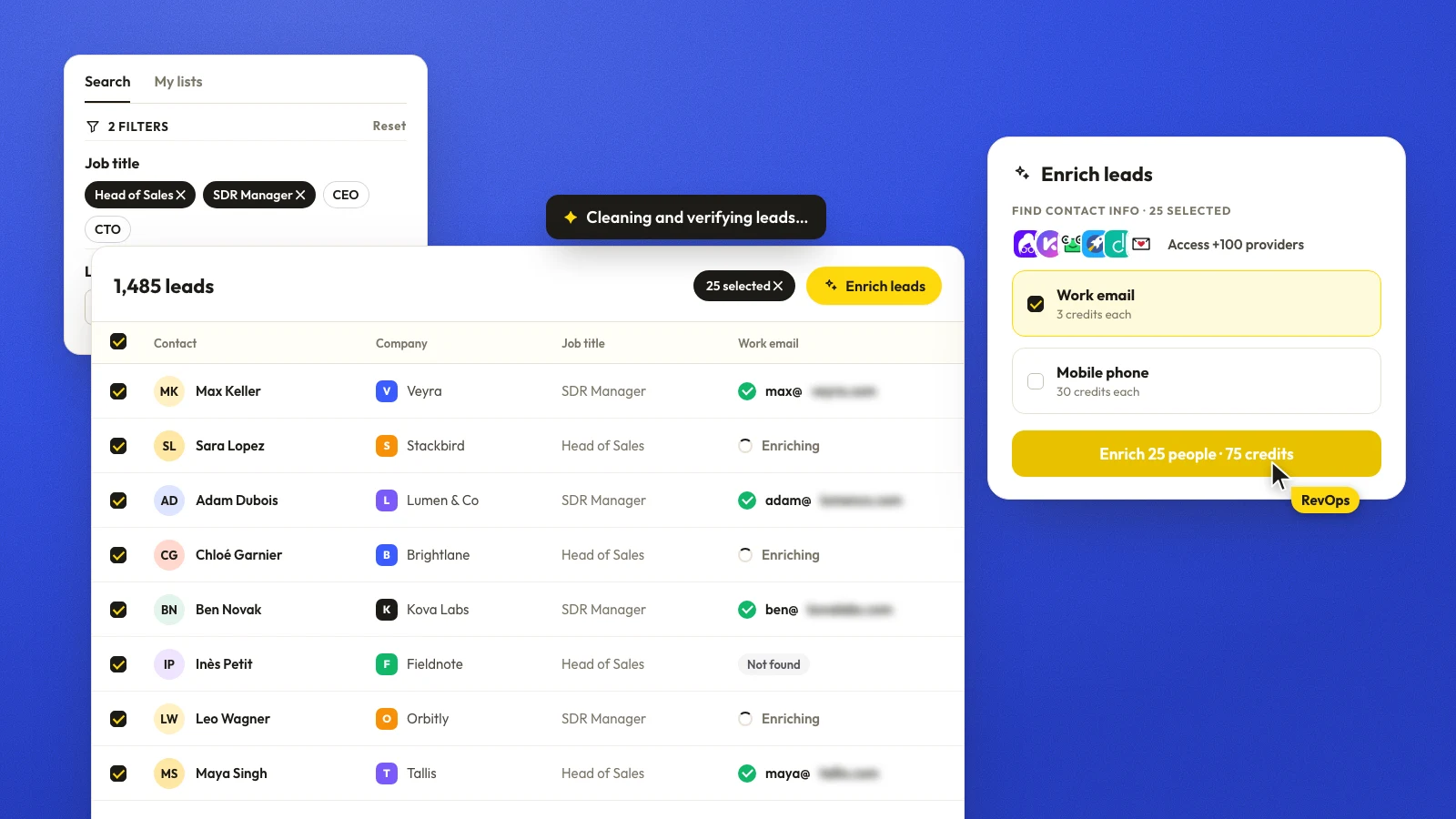
Pipecorn offers workspace-based account and persona list building, AI cleaning, waterfall enrichment across multiple providers, email and phone verification, job-change signals, and CRM or sales-engagement delivery. Visit Pipecorn to evaluate whether its verification and enrichment workflows fit your team's data quality standards and outbound process.