SaaS Lead Generation: A Complete Playbook for 2026
Master SaaS lead generation with proven strategies for ICP definition, outbound, enrichment, and metrics. Actionable playbook for VPs

Article summary
- SaaS lead generation is a portfolio-allocation problem. Paid, organic, outbound, partnerships, data quality and sales capacity work against the same commercial targets.
- Judge every lead source by qualified pipeline created, cost per opportunity and payback. Lead count alone should not survive a quarterly business review.
- Build the ICP in three layers, firmographic fit, technographic fit and intent. Intent changes prioritization and never overrides fit.
- An outbound stack is a chain of data decisions, from sourcing to waterfall enrichment, verification and engagement. Contacts are checked before they enter a sequence.
- Measure the conversion chain from contact to meeting, meeting to opportunity and opportunity to revenue, and give data quality its own panel.
- When outbound gets expensive, shrink the list, improve contact coverage and protect the accounts with the strongest fit and signals.
Want to go further? Ask
 ChatGPT
 Claude
 Perplexity
 Grok
GrokOn this page
- 01What SaaS Lead Generation Has to Deliver in 2026
- 02Defining the ICP Before You Spend a Dollar on Outreach
- 03Inbound, Outbound, and the Channel Allocation Question
- 04The Outbound Stack That Actually Moves Pipeline
- 05A Working SaaS Outbound Playbook From List to Meeting
- 06Metrics That Predict Pipeline, Not Just Activity
- 07Rethinking Volume When TAM Coverage and CAC Are the Real Levers
A VP of Sales inherits a stalled pipeline, three SDRs are working aged lists, marketing has sourced no revenue, and the CRO wants to know why customer acquisition cost has doubled. The team responds by adding more contacts and launching another sequence. That usually creates more activity, not more qualified pipeline.
SaaS lead generation in 2026 is a portfolio-allocation problem. Paid, organic, outbound, partnerships, data quality, and sales capacity must work together against the same commercial targets. The market is already moving toward digital, permission-based outreach, yet 61% of B2B professionals say their prospecting doesn't cover their total addressable market, according to SaaS lead generation industry data.
The operating question isn't “How can the team generate more leads?” It's “Which accounts deserve investment, which channel should reach them, and can the resulting pipeline support the company's unit economics?”
Acquisition cost has doubled and the pipeline is stalled.
The plan from the team:

What SaaS Lead Generation Has to Deliver in 2026
A SaaS team can hit its lead target and still miss revenue. The program must produce qualified, sales-ready pipeline at an acceptable acquisition cost. MQL volume is an input. Closed-won revenue, pipeline efficiency, and payback are the outputs leadership should manage.
Treat the channel mix as a portfolio, not a contest for the biggest lead count. Paid acquisition buys speed but exposes the team to rising costs. Organic search compounds demand but takes time to build. Outbound gives sales control over target accounts, but contact data, messaging, and rep capacity determine whether it creates meetings.
The economics are already tight. A 2026 benchmark places median B2B cost per lead at $213, up from $198 in 2025, with a $84 top-quartile result and $397 bottom-quartile result, according to the 2026 B2B lead-generation benchmark. Lead-to-customer conversion across all sources averaged 0.94%. Qualification, routing, and sales handoff therefore deserve the same operating attention as acquisition.
Four operating targets
Sales leadership should manage the portfolio against four outputs:
- Pipeline coverage of 3 to 4 times quota. This absorbs slippage, lost deals, and timing changes.
- Cost per booked meeting below $250. A meeting costing more than its expected pipeline contribution is not a growth asset.
- CAC payback below 18 months. Acquisition investment must return within a period the business can finance.
- Outbound contact rate above 25%. If reps cannot reach the intended personas, further message testing will not solve the problem.
Use these as operating recommendations, then adjust them for ACV, gross margin, sales-cycle length, and retention. RevOps should give paid, organic, and outbound the same economic scoreboard. Increase investment in channels that create qualified opportunities at an acceptable payback, and reduce spend where activity does not convert.
AI has increased the volume of generic outreach entering buyers' inboxes. AI can prioritize records, but it cannot repair a weak ICP or an unverifiable contact record.
Practical rule: Judge every lead source by qualified pipeline created, cost per opportunity, and payback. Lead count alone should not survive a quarterly business review.
Organic search remains a long-term allocation because it captures existing demand and compounds over time. Teams building that channel can use this practical guide to SemDash SEO for SaaS, especially when content must support discovery and conversion. Build one revenue model across marketing, SDR, AE, and RevOps, then make every channel prove its place in that model.
Defining the ICP Before You Spend a Dollar on Outreach
An ICP shouldn't be a static worksheet completed during annual planning. It should be a living operating document that changes when win rates, sales-cycle patterns, product usage, and loss reasons change.
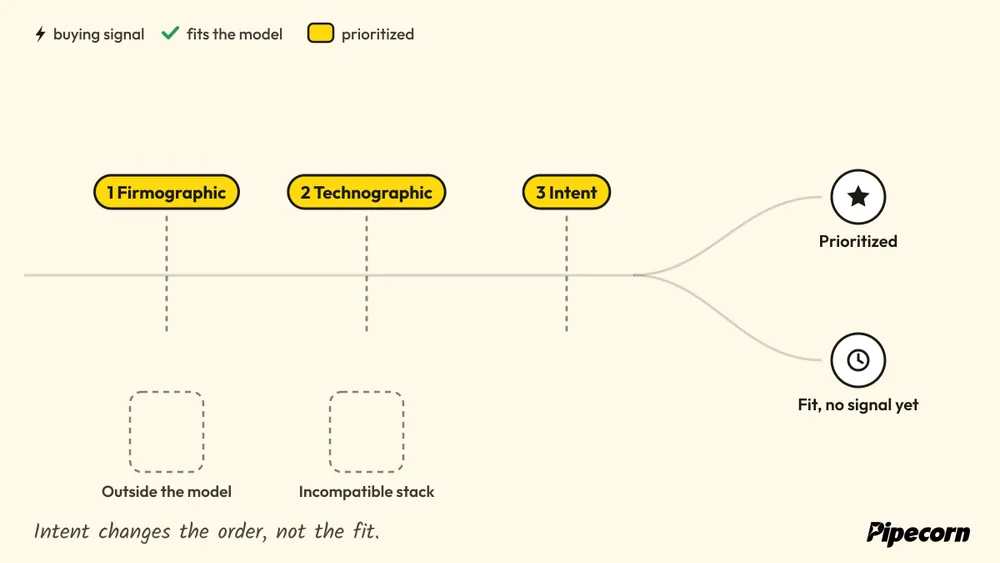
The first layer is firmographic fit. Define employee count, revenue band, funding stage, geography, and vertical. A broad market might contain 50,000 accounts, but the useful working universe is the subset with a credible need, budget, and buying motion. If the team can't explain why an account belongs in the ICP, it shouldn't enter an SDR queue.
The three layers
The second layer is technographic fit. A company running HubSpot has a different operating context from one running Salesforce. Segment and mParticle can indicate different data architectures, while AWS and GCP may reveal integration requirements or internal ownership. Technographics don't prove intent, but they help sales identify compatibility and timing.
The third layer is intent. Useful signals include G2 category visits, review-site activity, funding events, hiring surges, competitor comparison activity, and displacement events. Intent should change prioritization, not override fit. A poorly matched company with a single page visit remains a poor target.
| Layer | Signal Type | Example Filters | Source / Tool | TAM Impact |
|---|---|---|---|---|
| Firmographic | Company fit | Employee count, revenue, geography, industry, funding stage | CRM and account databases | Removes accounts outside the commercial model |
| Technographic | Stack fit | HubSpot or Salesforce, Segment or mParticle, AWS or GCP | Technographic providers and website data | Removes accounts that lack technical compatibility |
| Intent | Timing and urgency | G2 visits, review activity, hiring, funding, competitor displacement | Intent platforms, job boards, social signals | Prioritizes accounts with a credible buying window |
A useful worked example is a Series B RevOps SaaS selling to B2B SaaS companies in North America with 200 to 800 employees, recent funding between $20 million and $80 million, and a first RevOps lead being hired. The buying committee could include the VP of Revenue, the new RevOps leader, Sales Operations, Marketing Operations, Finance, and an executive sponsor.
The trigger events are visible: a new RevOps hire, rapid sales hiring, a recent funding announcement, or a change in CRM ownership. Disqualifiers should be equally explicit, including an incompatible stack, a company outside the service region, no relevant operating team, or a business model that cannot support the expected contract value.
Teams that need a fuller definition can use what an ICP is and how to structure it as a reference point. The final ICP should live in CRM fields and routing rules, not only in a strategy document.
Inbound, Outbound, and the Channel Allocation Question
Treat SaaS lead generation as a portfolio allocation problem. Each channel buys a different form of access, carries different costs, and covers different parts of the market. Rising CAC makes channel balance more important than loyalty to a single acquisition motion.
Inbound buys access to existing demand. SEO, content, paid search, webinars, and review-site presence reach buyers already researching a problem. Organic demand can become cheaper over time, but it requires consistent production and may leave named accounts untouched.
Outbound buys control over account selection. SDRs can target defined accounts, reach specific roles, and start conversations before demand appears in search. The cost is a fixed operating commitment that includes people, data, sequencing, coaching, and management.
SaaS acquisition conditions now favor a portfolio. One agency benchmark of more than 200 B2B SaaS companies reports that customer acquisition costs are up 38% since 2023, median payback has stretched to 14 to 18 months, and buyers consume about 13 pieces of content before engaging sales, compared with 8 in 2022, according to recent SaaS lead-generation reporting. Allocate budget across channels, then reallocate based on qualified pipeline and payback.
Decision matrix
| Scenario | Dominant Channel | Suggested Split | CAC Ceiling | When to Reallocate |
|---|---|---|---|---|
| Established category, strong search demand, fast sales cycle | Inbound | 60% to 80% inbound | Must remain below the payback model | Reallocate when qualified pipeline coverage weakens or paid saturation raises acquisition cost |
| High-value contracts and named-account selling | Outbound | 50% to 70% outbound | Must support target CAC payback | Reallocate when verified coverage is low or opportunity creation falls |
| New category requiring education | Balanced motion | 50% inbound, 50% outbound during the first year | Evaluate by opportunity and payback | Shift after enough conversion data exists to compare channel economics |
| Mixed demand and uncertain attribution | Portfolio approach | Adjust by qualified pipeline contribution | Set a blended ceiling | Reallocate quarterly, not based on raw lead volume |
These percentages are starting allocations, not universal benchmarks. Compare qualified pipeline, cost per opportunity, and payback before changing the mix. Do not shift funds because one channel produced more raw leads.
A practical first-year model starts with a balanced split. Inbound builds category education and captures active demand. Outbound tests account selection, messaging, and access to buying committees. Partnerships and communities can add influence where trusted distribution already exists.
The right channel mix covers the ICP while keeping CAC within payback tolerance.
Scale paid acquisition only while incremental pipeline remains economically sound. Fund organic consistently when the category has durable search demand. Increase outbound when strategic-account control matters or inbound leaves material parts of the TAM untouched. Reallocate quarterly, using pipeline economics rather than channel preference.
The Outbound Stack That Actually Moves Pipeline
An outbound stack is a chain of data decisions. A weak input creates bad enrichment, unreliable verification, wasted rep time, and poor pipeline. Build the stack around handoffs, not a list of brand names.
Start with data sourcing. Account records should cover firmographic, technographic, intent, and contact fields. Then add enrichment through a waterfall that checks multiple providers instead of accepting the first incomplete match. Apollo, ZoomInfo, Clearbit, and People Data Labs can serve different roles. Define the query order, required fields, and failure action before the workflow goes live.
Four infrastructure layers
The third layer is verification. Check email and phone records before they enter a sequence or dialer. Set rejection thresholds at ingestion. Do not wait for sender reputation or rep productivity to expose bad records.
The fourth layer is engagement. Sequencing, dialing, reply classification, CRM synchronization, and task creation belong in this layer. Tools can change. Data quality isn't.
| Function | What It Does | Selection Criteria |
|---|---|---|
| Account and contact sourcing | Finds companies and people matching the ICP | Coverage, geography, persona depth, transparent data origin |
| Waterfall enrichment | Queries multiple sources for missing fields | Match logic, provider routing, fallback behavior |
| Verification | Rejects invalid emails and phone numbers | Published accuracy, bounce controls, phone validation |
| Engagement | Sends sequences and manages calls | Deliverability controls, personalization, task workflows |
| Reply classification | Separates interest, objections, and disqualification | Routing speed, human review, CRM write-back |
| CRM integration | Records source, activity, and outcomes | Reliable sync, field mapping, API access |
Independent research places top-tier email accuracy around 90% to 95%, while free scraped lists can fall below 60%, as reported in B2B contact-data accuracy research. Use those gaps to challenge opaque vendor scores. Ask for match-rate, bounce-rate, and coverage evidence before committing budget.
Pipecorn is one option for the enrichment layer. It aggregates more than 100 providers for verified email addresses and mobile numbers, applies AI cleaning, and can deliver contacts into CRM and sales-engagement systems. Teams comparing architectures can review these lead enrichment tools, then assign each component one clear job and connect the handoffs through APIs.
A Working SaaS Outbound Playbook From List to Meeting
A reliable outbound motion starts with account selection, not email copy.
The team first builds a focused account list from the ICP. A working list can contain 500 to 2,000 companies, but the correct size depends on sales capacity, account value, and the depth of personalization required. Tier-one accounts receive intent signals such as G2 category visits, competitor comparison searches, relevant hiring activity, or a new executive appointment.
The operating sequence
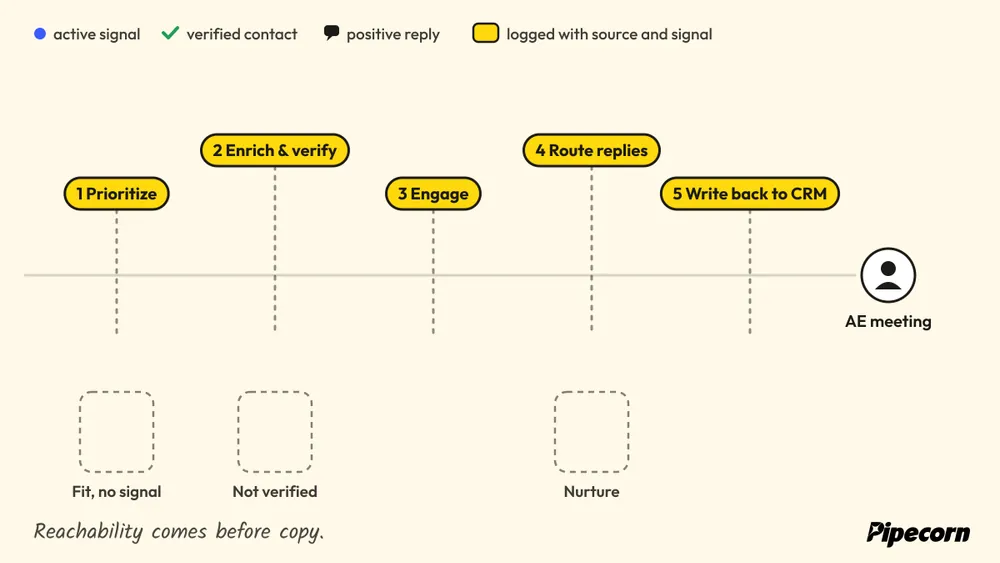
- Prioritize accounts. Separate high-fit accounts with active signals from accounts that only meet firmographic criteria.
- Enrich contacts. Build a buying-committee map, append mobile numbers for dialers, and verify email addresses before sequencing.
- Split the engagement motion. An SDR can run a five-step email and LinkedIn sequence with two cold calls. A BDR should give warm-intent accounts faster phone and LinkedIn follow-up.
- Route replies. Positive intent should reach an AE quickly. Objections should enter a nurture track with the original context preserved.
- Write outcomes back to CRM. Each meeting should record the source sequence and the intent signal that triggered prioritization.
The sequence should reflect the account's situation. A hiring signal can support a message about operational capacity. A competitor displacement event can support a migration or consolidation conversation. A generic feature pitch should not be sent solely because a contact record exists.
Cold outbound typically converts about 1% to 3% of total contacts into meetings, while well-targeted campaigns with appropriate deliverability can reach 35% to 50% open rates, 5% to 12% reply rates, and 1% to 3% meeting-booking rates, according to SaaS outbound lead-generation benchmarks. Those figures reinforce the sequence design: targeting and reachability come before copy refinement.
A practical 2026 B2B cold email playbook can help teams pressure-test sequencing and follow-up logic. The workflow itself should remain visible in CRM. A sales leader should be able to answer which account signal created the meeting, which persona responded, and whether the opportunity progressed.
Teams automating those handoffs can review outbound sales automation workflows, but automation should accelerate a controlled process, not multiply an unverified list.
Metrics That Predict Pipeline, Not Just Activity
A sales org can send emails, make dials, and launch sequences all week while creating little pipeline. RevOps should measure the conversion chain from contact to meeting, meeting to opportunity, and opportunity to revenue.
The SDR team after a week of emails, dials and sequences,
looking for the pipeline it created:

Use a 3% to 5% positive reply rate, a 0.5% to 1.5% meeting-set rate across total contacts touched, a 75% or higher show rate, and an opportunity creation rate above 50% from meetings as internal self-scoring benchmarks. These are planning targets, not external market claims.
The scorecard
| Metric | Benchmark | Why It Matters |
|---|---|---|
| Positive reply rate | 3% to 5% | Tests relevance and account selection |
| Meeting-set rate | 0.5% to 1.5% of contacts touched | Shows whether contact coverage becomes calendar value |
| Show rate | 75% or higher | Separates booked activity from attended conversations |
| Opportunity creation from meetings | Above 50% | Tests meeting quality and qualification |
| Email bounce rate | Below 3% | Protects deliverability and data integrity |
| Contact match rate | Above 80% | Indicates whether the target market is reachable |
| Accounts with a verified contact | Track as a coverage percentage | Shows whether account lists are usable |
Cost metrics complete the operating view. Track cost per qualified meeting, cost per opportunity, and pipeline value created per SDR per month. The CEO needs pipeline contribution, not an activity leaderboard.
Data quality needs its own panel. Verified mobile numbers can produce roughly 10% to 18% connect rates, compared with 2% to 4% for switchboards, according to direct-dial connect-rate guidance. Cognism's 2026 outbound report records 13.3% cold-call answered rates for SDRs using verified contact data, close to 14.4% for AEs calling warm leads, as shown in the State of Outbound 2026 report.
Data quality is a leading indicator. Weak inputs become pipeline problems later, after activity reporting has already made the team appear productive.
Quarterly reviews should identify the binding constraint: list coverage, contact accuracy, message relevance, response handling, or AE conversion. Compensation should reward qualified pipeline contribution instead of raw activity.
Use lead prioritization practices to convert the scorecard into routing rules. High-fit accounts with verified contacts and active signals should receive faster follow-up than unverified, low-intent records. That allocation protects rep capacity and directs attention toward opportunities most likely to progress.
Rethinking Volume When TAM Coverage and CAC Are the Real Levers
More leads don't automatically create more revenue. A larger list can hide poor fit, duplicate accounts, invalid contacts, and weak buying signals.
The stronger variable is account-level TAM coverage. RevOps should measure engaged accounts divided by accounts in the defined ICP. That view shows whether the team is reaching the market it claims to target, rather than rewarding MQL accumulation from outside the commercial model.
Three motions deserve separate investment:
- High-intent inbound: Usually the most efficient source when demand already exists, but volume is limited by category interest and search visibility.
- Named-account outbound: Gives sales control over strategic coverage, but requires fixed investment in people, data, coaching, and infrastructure.
- Ecosystem and partnership leads: Uses integrations, resellers, communities, and trusted relationships to extend distribution without relying entirely on paid acquisition.
A stricter allocation rule
If outbound cost per qualified opportunity exceeds 1.5 times the inbound benchmark for two consecutive quarters, the response shouldn't be a larger account list. Shrink the list, improve contact coverage, sharpen enablement, and protect the accounts with the strongest fit and signals. The threshold is a management rule for disciplined reallocation, not a universal market statistic.
SDR quotas should reflect coverage requirements. A rep responsible for strategic accounts needs an account plan, persona coverage, verified contacts, and clear engagement standards. A rep working transactional demand may need a different design. Treating both motions as identical activity factories distorts performance.
A useful lead-sourcing benchmark can help teams evaluate whether sourcing supports the intended coverage model. The review should ask three direct questions:
- Are the right accounts being engaged?
- Does each priority account have a verified route to the buying committee?
- Does engagement create qualified opportunity at a CAC the business can absorb?
The answer determines budget allocation more reliably than total lead count. In 2026, VPs of Sales should protect pipeline by protecting ICP discipline. Fewer accounts with richer data and better enablement will usually outperform a broad, unqualified list that keeps SDRs busy but leaves the revenue forecast exposed.
Pipecorn helps B2B sales and RevOps teams build ICP-aligned account and persona lists, enrich them across 100+ data providers, verify emails and mobile numbers, and route qualified contacts into CRM and sales-engagement workflows. Visit Pipecorn to evaluate whether its sourcing and enrichment workflow fits the team's SaaS lead-generation model.