
What Is an ICP? the 2026 B2B Outbound Guide
What is an ICP? Learn how an Ideal Customer Profile drives B2B outbound sales, with examples, signals, and steps to build one that converts in 2026.

On this page
- 01The Outbound Reality That Creates the Need for an ICP
- 02Defining an ICP in Plain Language
- 03ICP Versus Persona, Account Fit, and Buying Committee
- 04Why ICP Quality Moves Real Numbers
- 05Building and Validating an ICP Step by Step
- 06Two Real ICP Examples You Can Steal
- 07Operationalizing the ICP in Your Outbound Stack
- 08Putting Your ICP to Work This Quarter
An Ideal Customer Profile, or ICP, is a scored account-level model that combines firmographic, technographic, and behavioral attributes to identify the companies most likely to buy, succeed, and stay with your product. Teams with documented ICP-based segmentation can see 1.7x higher marketing-sourced pipeline conversion, while Tier 1 ICP segments can produce a 36% higher win rate and 4.2x three-year customer lifetime value versus lower-tier segments, according to B2B ICP and buyer persona benchmarks.
The definition matters because outbound teams rarely fail from a lack of available accounts. They fail because limited sales capacity gets spent on companies that were never strong candidates. A useful ICP decides who enters the workflow, how that account is scored, which contacts matter, and what happens when new signals change the priority.
The Outbound Reality That Creates the Need for an ICP
An SDR manager opens the CRM on Monday morning and sees a freshly purchased account list. It contains thousands of companies, but the fields that matter are inconsistent. Some records have outdated industries, others lack technology data, and many contain contacts who aren't involved in the purchase.
Marketing is still debating the persona document. Sales wants a sequence launched immediately. The VP asks why the previous campaign generated so little pipeline despite heavy activity. Nobody can answer the most important question: which accounts deserved the touches in the first place?
That problem appears before copywriting, sequencing, or enrichment. Reps can't contact every company in a market, and they shouldn't try. An outbound program needs an upstream filter that removes low-fit accounts before they consume research time, contact data, personalization, and management attention.
Practical rule: If a rep has to decide from scratch whether every account is worth pursuing, the ICP hasn't been operationalized.
A formal ICP gives the team an account-level standard. Gartner describes it as a set of firmographic, environmental, and behavioral attributes associated with accounts expected to become a company's most valuable customers, as explained in its B2B ideal customer profile guidance. That makes the ICP more than a positioning exercise. It becomes a filter for list building, lead scoring, routing, and prioritization.
A strong filter also improves downstream data quality. When the team knows the industries, technologies, operating conditions, and buying signals that matter, enrichment workflows can reject irrelevant records, CRM rules can route qualified accounts, and SDRs can spend more time on accounts that resemble proven customers. The ICP won't fix weak messaging or poor execution, but it prevents those problems from being applied indiscriminately across the market.
Defining an ICP in Plain Language
Start with a simple definition: an ICP describes the company, not the person, that best fits your offer. In practice, it works as a weighted scoring model built from three layers. Each layer answers a different qualification question.

Firmographics establish who can buy
Firmographic data describes the account's basic structure. Useful fields include industry, revenue band, headcount, geography, funding stage, and business model. These attributes narrow the market to companies that can plausibly experience the problem, afford the solution, and support a viable sales motion.
For example, a company selling revenue operations software might focus on B2B SaaS businesses in the United States and Europe, with a defined employee range and an established sales organization. A consumer brand may have substantial revenue but still be a poor fit if its sales process, systems, and buying motion don't resemble the customers the product serves.
Firmographics answer, “Could this company be a suitable customer?”
Technographics confirm implementation fit
Technographic data shows how the company operates. Look for CRM platforms, sales engagement tools, data warehouses, integration requirements, and signs of tooling maturity. A target may fit the industry and size criteria but lack the systems needed to adopt your product.
Consider a hypothetical account with a Series B SaaS profile, 100 to 500 employees, HubSpot and Snowflake in its stack, and a need to connect sales and marketing data. Those technologies don't prove the company will buy, but they can indicate that implementation is feasible and that the account understands the category.
Technographics answer, “Can this company use and deploy the solution?”
Behavioral signals indicate timing
Behavioral signals add urgency. They include hiring activity, product-page visits, funding events, executive changes, technology replacements, and intent activity. These signals distinguish an account that fits in theory from one that may have a relevant problem now.
A company that recently posted several engineering roles, hired a new revenue leader, or repeatedly visits integration pages deserves different treatment from an otherwise similar account with no visible change. The behavior doesn't guarantee demand. It gives the sales team a reason to adjust priority.
Behavioral data answers, “Why might this account be worth contacting now?”
The final ICP should translate these layers into weights and thresholds. It shouldn't read like a paragraph about a “forward-thinking mid-market buyer.” It should tell the stack how to score an account, what disqualifies it, and which conditions move it into a higher-priority tier.
ICP Versus Persona, Account Fit, and Buying Committee
Many outbound programs use these terms interchangeably, then wonder why good accounts produce weak meetings or stalled opportunities. The concepts connect, but they operate at different levels.
A buyer persona describes an individual, such as a VP of Revenue Operations who owns forecasting, process design, or sales systems. The ICP describes the company employing that person. Account fit applies the ICP model to a specific company and produces a qualification result. Buying-committee fit evaluates the people inside that account, including their roles, influence, access, and relationship to the purchase.
| Concept | Scope | Data Source | Example |
|---|---|---|---|
| ICP | Target company | Firmographics, technographics, behavioral data, closed-won patterns | B2B SaaS company with the operating profile and systems associated with strong customers |
| Persona | Individual buyer or user | Role, responsibilities, pain points, goals | VP of Revenue Operations responsible for forecasting and sales process |
| Account fit | Specific prospect account | Scored account attributes and disqualifiers | A named SaaS company receives a Tier 1 fit score |
| Buying committee | Group of stakeholders | Contact roles, influence, access, relationships, engagement | Economic buyer, champion, technical evaluator, and operational user |
Consider a campaign targeting revenue operations leaders. The ICP might be precise, but a particular account could still have weak account fit because its business model or technology doesn't match the model. That creates a low-conversion problem. Another account might fit well, yet the team may reach only a junior user with no influence, producing a low-meeting problem. A third account may contain an enthusiastic champion but no executive sponsor or technical evaluator, creating a stalled-deal problem.
The distinction matters operationally. Account scoring determines whether the company enters the program. Persona data determines who should be contacted. Buying-committee mapping determines whether the opportunity has enough coverage to progress.
A qualified account isn't automatically a qualified buying group.
Gong's sales ICP guidance similarly distinguishes the company-level profile from the individual buyer while emphasizing the need to validate the model against closed-won outcomes. Workshop consensus can produce a plausible profile, but customer evidence should decide which attributes remain in the scoring model.
Why ICP Quality Moves Real Numbers
A list can look precise and still waste a quarter. The accounts may match broad firmographic criteria, yet lack an active problem, accessible stakeholders, or a workable path to implementation. ICP quality determines which accounts enter the funnel, which contacts reps research, how messages are customized, and where sales capacity goes.
A useful ICP scoring model treats fit as a live combination of three inputs:
- Fit: Does the company resemble customers that buy, adopt, expand, and stay, based on firmographic and technographic attributes?
- Need: Are recent behavioral or intent signals connected to a problem the product addresses?
- Feasibility: Can the team reach the relevant stakeholders, support implementation, and pursue the account within current constraints?
These inputs should feed list building, data cleaning, and routing rules, not remain in a strategy document. A high-fit account without a current need signal can sit in a monitored segment. A moderately fitting account showing urgent hiring or technology change may deserve review. A high-fit, high-need account with reachable stakeholders should receive the most sales attention.
| Tier | Fit Score | Need Signals | Feasibility | Expected Outcomes |
|---|---|---|---|---|
| Tier 1 | Strong alignment across core attributes | Clear, recent activity tied to the problem | Reachable stakeholders and workable sales path | Highest personalization and sales priority |
| Tier 2 | Partial or mixed alignment | Some relevant activity, but timing is less clear | Viable path with gaps to resolve | Targeted outreach and active monitoring |
| Tier 3 | Weak or uncertain alignment | Little evidence of current need | Low accessibility or poor implementation fit | Nurture, lower-cost coverage, or exclusion |
The commercial case is measurable. Teams using documented ICP segmentation can see 1.7x higher marketing-sourced pipeline conversion. Tier 1 ICP segments can produce a 36% higher win rate and 4.2x three-year CLV than lower-tier segments, according to the 2024 B2B ICP benchmark report.
Those figures should guide measurement, not dictate copied thresholds. Review whether each score changes conversion, meeting quality, or routing outcomes. A weak model sends reps toward accounts that consume capacity without resembling successful customers. A signal-driven model concentrates effort where fit, need, and feasibility overlap, then updates as account data changes.
Building and Validating an ICP Step by Step
A usable ICP starts with customer evidence, not a workshop filled with assumptions. The build sequence below works because it connects strategy to fields the sales stack can read.
Start with closed-won patterns
Pull the recent closed-won book and examine the attributes shared by customers who bought, adopted, expanded, and stayed. Review industry, size, geography, technology, deal context, sales cycle characteristics, and the stakeholders involved.
Clustering can reveal groups that broad averages hide. One segment may be attractive because it has a consistent operational problem. Another may look similar on paper but require heavy implementation work or produce weak retention. Include lost deals and poor-fit customers so the model learns what to exclude.
Add signals that change priority
Layer firmographic, technographic, and behavioral inputs. Useful examples include hiring activity, funding announcements, tool replacements, executive moves, product-page visits, integration research, and changes in the buying committee.
Rank signals by their relationship to conversion rather than by how easy they are to collect. A field that appears in every database isn't automatically useful. A less common signal may matter more if it consistently appears before qualified opportunities.

Weight the model and test it
Assign contribution scores using regression, lookalike modeling, or a transparent rules-based method. Set thresholds for Tier 1, Tier 2, and Tier 3, then apply the model to a holdout cohort that wasn't used to create it.
Compare reply quality, meeting creation, opportunity progression, and disqualification reasons by tier. If Tier 3 accounts perform like Tier 1, the model is not separating priority effectively. If strong opportunities are repeatedly excluded, the thresholds or source data need attention.
For a practical companion to this work, review Pipecorn's lead qualification process and map each qualification rule to a field, signal, or routing action.
The model should be refreshed quarterly, with a full rebuild when win-rate patterns shift materially. Current GTM guidance increasingly favors live signal stacking and more frequent refreshes over annual definitions, as discussed in 2025 ICP definition trends.
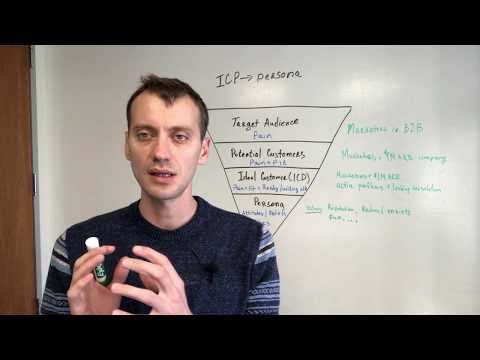
Use the following walkthrough as a visual reference for the build and validation flow.
Two Real ICP Examples You Can Steal
A useful ICP becomes easier to design when you can see the attributes working together. The examples below are anonymized operating models, not universal templates. Their value is in the structure, especially the combination of fit criteria, live signals, and disqualifiers.
| Dimension | SaaS RevOps ICP | PE-Backed Services ICP |
|---|---|---|
| Company profile | B2B SaaS company operating across the United States or Europe | Private-equity-owned portfolio company |
| Scale | 200 to 2,000 employees, with $20M to $500M ARR | $50M to $1B in revenue, with 100 to 5,000 employees |
| Commercial context | Series B or later, with an established revenue organization | Recently closed acquisition or add-on transaction |
| Technology | Salesforce or HubSpot, Outreach or Salesloft, ZoomInfo or Apollo, and a modern data warehouse | No required technology stack |
| Behavioral signals | Recent CRO hire, SDR expansion, legacy dialer replacement, repeat visits to pricing or integration pages | PE press release, advisor change, newly funded add-on acquisition, leadership turnover |
| Disqualifiers | Consumer brands, companies below the target employee range, pre-revenue businesses | Consumer-only businesses, companies below the target revenue or employee range, transactions without integration need |
The SaaS example uses technographics as a meaningful part of the fit model. A company already running a modern CRM, engagement platform, enrichment source, and warehouse may have the systems needed to adopt a revenue intelligence product. A recent CRO hire or SDR expansion adds timing, while repeat visits to pricing or integration pages provide a stronger reason to prioritize the account.
The services example works differently. It doesn't require a particular stack because the buying trigger comes from corporate events. A recent acquisition, leadership change, or advisor transition can create integration complexity even when the portfolio company uses ordinary systems.
The right signals depend on how the customer experiences the problem. Don't force technology criteria into a services ICP when the trigger is organizational change.
Disqualifiers protect the model from false positives. Without them, a large consumer business can look attractive because of its revenue, while a pre-revenue company can look promising because of its headcount growth. An ICP needs both positive evidence and explicit reasons to stop.
Operationalizing the ICP in Your Outbound Stack
An ICP becomes valuable when it controls what the sales stack does. The operating flow should move from account discovery to enrichment, scoring, verification, routing, and engagement without requiring a manual interpretation at every handoff.
Start with account creation. List-building tools should apply firmographic and technographic filters before producing a raw account set. Enrichment then fills missing fields, checks company changes, and supplies the contact data required for the assigned buying roles. A waterfall approach can query multiple providers when the first source lacks a verified email or mobile number, rather than treating one database as complete.
Turn signals into field updates
Behavioral and relationship signals should update the account record, not sit in a separate dashboard. A new executive hire, job change, hiring spike, technology replacement, or relevant intent event can increase the account's need score and trigger a review.
The workflow should also clean records against the ICP. If a company no longer meets a core criterion, the system can lower its score or remove it from active sequences. If a champion changes jobs, the account may retain value while the contact strategy changes.
For teams building agency programs, data signals for agency lead generation can help organize the relationship between target accounts, market activity, and outreach timing. The principle is the same: use signals to decide when an account deserves attention, rather than treating every record as equally urgent.

Let score determine routing
Routing rules should reflect the economics of rep attention. Tier 1 accounts can go to senior reps for research-led sequences and coordinated multi-threading. Tier 2 accounts can receive targeted automation with review points. Tier 3 accounts can enter nurture, a lower-touch motion, or an exclusion list.
The integrations matter. Enrichment providers should write to the CRM, the CRM should calculate or store the account score, and sales engagement platforms such as Outreach or Salesloft should use that score in sequence enrollment. Pipecorn is one option for sourcing and cleaning this data, with real-time contact sourcing, AI-based validation against targeting rules, waterfall enrichment across providers, and CRM or sales engagement integrations.
Pipecorn's data enrichment services provide a useful reference for designing the handoff between missing data, verification, and CRM delivery. The specific tools can vary, but the rule shouldn't: the ICP must operate as a live filter, not a quarterly spreadsheet export.
Putting Your ICP to Work This Quarter
A practical ICP program needs a small number of decisions that sales, marketing, and operations can enforce together. Treat the following as an operating checklist, not a documentation exercise.
- Lock the Tier One attributes: Choose the firmographic, technographic, and behavioral conditions that define your highest-priority accounts. Include disqualifiers so the team knows when to stop.
- Instrument closed-won analysis: Connect customer outcomes to account fields, technology, buying roles, sales context, and observed triggers. Review lost and poor-fit accounts too.
- Wire the ICP into the stack: Make list tools, enrichment workflows, CRM fields, routing rules, and engagement platforms use the same score and tier definitions.
- Schedule a quarterly review: Compare performance by tier, inspect false positives and false negatives, and update the model when buyer behavior or win patterns change.

The common failure is treating the ICP as a slide deck that nobody references after planning day. Other teams skip sales-floor validation, so the model reflects leadership assumptions rather than rep experience. Data decay creates another problem: an account may have fit last quarter, but a leadership change, technology replacement, acquisition, or market shift can alter its priority.
A focused thirty-day start is enough to create momentum. Pull your best customers, extract the attributes they share, score the existing account base, and route the highest-priority segment into a live sequence. Then capture the outcomes by tier and use that evidence to improve the next version.
The objective isn't a perfect model. It's a model that makes better decisions than an unfiltered list and improves as the team learns.
Pipecorn helps outbound teams source verified emails and mobile numbers, clean records against ICP rules, enrich missing account and contact data, and deliver prioritized leads into CRMs and sales engagement tools. Visit Pipecorn to turn your ICP from a planning document into a working list-building and routing workflow.