
7 B2B Lead Generation Services Compared
Compare 7 b2b lead generation services by pricing, features, integrations, buyer fit, and when to outsource or build in-house.

Article summary
- Outsourced SDR partners, managed demand-generation agencies and data-led platforms solve different constraints, so the service type matters more than the label.
- Managed SDR or appointment setting fits a company without recruiting, coaching, quality assurance or campaign-management capacity.
- Multi-channel agencies fit programs that need coordinated email, LinkedIn, calling and paid touchpoints, at the cost of more coordination and attribution work.
- Data-led services fit niche research and enrichment problems. A data platform fits teams that already own execution and need coverage, verification and handoffs.
- Agree attribution rules before the engagement and run a controlled pilot with acceptance criteria for data, meetings, routing and follow-up.
Want to go further? Ask
 ChatGPT
 Claude
 Perplexity
 Grok
GrokOn this page
The best choice depends on whether a buyer needs managed meetings, multi-channel campaign execution, or verified data infrastructure. The B2B lead generation services market reached about USD 3.34 billion in 2026, with a projection of USD 9.18 billion by 2035, so the practical question isn't whether the category matters, but which operating model fits the sales team. (Business Research Insights)
The popular advice is to choose the vendor with the biggest database or the most booked meetings. That shortcut fails because outsourced SDR partners, managed demand-generation agencies, and data-led enrichment platforms solve different constraints. A company without recruiting, coaching, or campaign-management capacity may need execution. A RevOps-led team may already have execution and only need better contact coverage, verification, signals, and routing.
This comparison evaluates pricing transparency, delivery model, persona fit, CRM and sales-engagement integrations, geographic coverage, data quality, compliance, and internal management capacity. Vendor descriptions come from each provider's public pages, checked on 3 October 2026. Recommendations are editorial judgment.
The build-versus-buy decision is central. Pipecorn fits teams that want to keep outbound execution in-house while building an ICP workspace, cleaning and validating records, enriching through multiple sources, and pushing qualified contacts into HubSpot, Salesforce, Pipedrive, Outreach, Salesloft, lemlist, or webhooks. The service type matters more than the label. A meeting provider sells operating capacity, a demand-generation agency sells coordinated campaign execution, and a data platform sells infrastructure that internal teams control.
Seven proposals, seven definitions of "a qualified meeting".
The buyer, comparing them line by line:

1. Pipecorn
Pipecorn fits teams whose constraint is contactability, with outbound execution remaining inside the company. The B2B data platform combines real-time sourcing, AI cleaning, and waterfall enrichment across 100+ data providers to deliver verified work emails and mobile numbers into CRM and sales-engagement workflows. Its published database contains about 553 million people and 37.9 million companies, while the company reports about 93% enrichment across its provider network. (Pipecorn)
The operating choice is control. Internal SDR and RevOps teams define the ICP, build company and persona lists, validate records, select signals, and decide when qualified contacts enter a sequence. Pipecorn supports HubSpot, Salesforce, Pipedrive, Outreach, Salesloft, lemlist, and webhooks, plus API and MCP endpoints and a Chrome extension for browsing workflows. Those integrations support a build approach for teams that already own messaging, sequencing, and follow-up. Companies seeking a fully managed appointment-setting partner need a different delivery model.
Why the data model matters
Single-source databases can leave gaps in countries, personas, or phone fields. Pipecorn's waterfall model routes lookups across multiple sources and selects providers by country, while AI cleaning checks records against ICP rules. Job-change tracking, new-hire alerts, hiring signals, technology signals, and social engagement signals give teams more ways to prioritize timing rather than treat every contact as equally ready.
The credit model makes the economics visible, although usage varies by channel. Pipecorn lists a Free plan with 500 leads and 150 credits per month, with paid plans starting at $83 per month billed yearly. A verified email costs about 3 credits, while a verified mobile costs about 30 credits, and credits are spent only on contacts actually found. (Pipecorn pricing)
| Item | What the pricing page says |
|---|---|
| Free plan | 500 leads exported and 150 credits per month |
| Paid plans | From $83 per month billed yearly |
| Verified email | About 3 credits |
| Verified mobile | About 30 credits |
| Contact not found | No credits spent |
Practical rule: Estimate verified mobile demand before selecting a plan. A phone-first motion can consume credits faster than an email-led workflow, even with the same target-account count.
Pipecorn also reports SOC 2 Type II auditing and support for GDPR and CCPA, with data-processing agreements available. Custom provider routing and priority support are limited to higher tiers. For teams that need verified reachability, real-time signals, and automated handoffs while retaining execution internally, the platform offers a more focused purchase than a generic lead list.
2. SalesRoads
SalesRoads fits teams that need outsourced SDR execution with visible operating controls. Its model combines dedicated SDRs with a client strategist, an SDR performance coach, an optimization specialist, and a research and data team, with CRM integration among the program deliverables. The site advertises cancel-anytime terms with no long-term commitment, which can reduce uncertainty during an initial build-versus-buy decision, while pricing is quoted on request. (SalesRoads)
The service sells operating capacity, not merely contact records. Buyers should ask which reports cover dials, conversations, show rates, and pipeline. Because the program includes its own research and data team, buyers should ask how records are sourced and verified before calls start, and whether the geography, personas, and qualification rules fit the sales team's market.
CRM integration changes the economics of the purchase. A team with a defined sales process and reliable feedback loop can buy execution without rebuilding its data and engagement stack. A team still testing its ICP or meeting criteria may need tighter controls before adding outsourced SDR capacity.
Buyers should ask for the launch timeline in writing, from kickoff to the first live calls. A fast launch can reduce the need for internal recruiting and coaching. The trade-off is cost: a premium SDR program may be inefficient for a small single-representative test when the offer, ICP, or follow-up process remains unsettled.
The useful question is not call volume alone. It is whether the client can accept the meeting definition, inspect CRM activity, and give weekly feedback that improves qualification.
Multinational programs need extra checks. Buyers should confirm localization, language coverage, data ownership, and regional compliance before signing. Teams comparing managed SDR execution with an internal, data-led stack can also review this comparison of outbound prospecting agencies in the UK, especially when geographic coverage affects the operating model.
3. Belkins
Belkins suits buyers evaluating multi-channel demand generation, not only outsourced SDR execution or data-led enrichment. Its site lists cold email, cold and intent calling, voicemail, SMS and WhatsApp, LinkedIn, and paid advertising, alongside appointment setting. That breadth can coordinate campaign production and sales follow-up, though it also creates more operating dependencies than a phone-led engagement. (Belkins)
Belkins also lists account-based marketing and HubSpot CRM consulting among its services. Account-based work and clean CRM reporting matter in complex B2B sales, where one contact may represent only an early signal and several stakeholders can shape an opportunity. Coordinated channel management may reduce the risk of email, LinkedIn, paid media, and sales activity being measured as unrelated campaigns.
Belkins does not publish a starting price on its pricing page, so budget owners need a scoped quote. Channel mix, geography, account complexity, and reporting requirements can expand the scope quickly. A small team testing one message in one market may therefore find managed demand generation heavier than a focused enrichment or SDR pilot.
Where attribution becomes decisive
Managed demand generation fits teams that lack capacity to coordinate research, campaign production, outreach, and reporting. Evaluation becomes more difficult when sales cycles are long and the provider is judged mainly on meetings instead of pipeline influence. Buyers should define attribution rules for sourced contacts that convert through a later channel, return months later, or join an existing account's buying group.
HubSpot consulting can create a basis for that discussion, but the result still depends on agreed definitions, CRM hygiene, and consistent opportunity data. Integration depth should shape the build-versus-buy decision: a team with clean HubSpot workflows may absorb the reporting model more easily, while a team with fragmented CRM and sales-engagement systems may face additional implementation work.
Belkins' review scores on Clutch (4.9) and G2 (4.8) support initial shortlist consideration, but recent reviews and segment fit deserve more weight than aggregate reputation. For a small team, the main constraint is absorption capacity: whether it can manage the operational scope and assess each channel's incremental contribution.
4. CIENCE
CIENCE combines managed SDR execution with data operations, research, and AI-supported personalization. That breadth gives it three possible roles in a GTM program: running outbound for a team that lacks capacity, building a motion with an internal team, or supplying data and API support for a more technical workflow. (CIENCE)
The model is useful when contact research is inseparable from outreach quality. CIENCE describes dedicated support for research, deliverability, operations, and scheduling around SDR execution, alongside industry playbooks and a public starting price for managed services (from $5,600 per month). Its AI-plus-human approach is intended to handle the repetitive parts of audience construction and campaign operations while preserving human involvement in qualification and messaging.
The advantage is flexibility across GTM maturity. A new outbound team may buy execution. A growing team may use a managed program while defining its internal process. A RevOps function may instead evaluate the data and operational components, keeping more of the execution inside its own CRM and engagement stack.
What to validate before purchase
Breadth creates a staffing question. Global delivery can produce different team seniority and subject-matter depth across projects, so the buyer should confirm the named team, manager involvement, escalation path, and replacement process. Review sentiment can vary by platform, which makes recent, segment-relevant references more valuable than a broad case-study library.
A practical pilot should separate data quality from SDR activity. If the target list is inaccurate, a low response rate might reflect sourcing rather than messaging. If records are valid but qualification is weak, the problem may sit in the playbook or handoff. Teams building that operating layer should also examine outbound sales automation workflows before deciding which tasks belong with an agency and which should remain internal.
The agency: "Reply rates are low, let's rewrite the copy."
The RevOps lead who checked the list first:

CIENCE is most compelling when the buyer values a menu of service models. It is less compelling when the need is narrowly defined, such as verified mobiles delivered to a CRM, because a broader managed engagement may introduce cost and management overhead that a data-led platform avoids.
5. Callbox
Callbox is a long-standing global provider for multi-touch, multi-channel lead generation and appointment setting. Its campaign pods can include SDRs, a campaign manager, research analysts, copy support, and quality assurance, while execution spans phone, email, LinkedIn, and web retargeting. (Callbox)
The campaign-pod structure fits organizations that want a coordinated external team rather than one outsourced caller. Callbox also offers ABM campaigns, an in-house CRM called Callbox Pipeline included in the subscription, and dashboards intended to make campaign activity visible. Its delivery footprint across North America, EMEA, APAC, and Latin America makes it relevant for buyers that need regional coverage, though regional execution should be validated rather than inferred from a global footprint.
Callbox's pricing page includes an estimator that gives an order-of-magnitude budget before detailed scoping, with one campaign pod estimated at $16,000 to $32,000 per month. That is high for some SMBs, so the platform is better matched to campaigns where the value of coordinated research, messaging, and follow-up justifies a broader team. Buyers should ask which roles are assigned, how much time each role receives, and whether the same pod remains in place after launch.
Phone quality is a load-bearing issue in any Callbox comparison. Industry benchmarks report that verified mobile numbers connect about 61% more often than office or direct lines, while SaaS SDR cold-call connect rates are often 5% to 8%, with top teams reaching 12% to 18% when they use verified mobile data and clean caller ID. (Martal cold-calling benchmarks) Those figures are industry benchmarks, not a Callbox guarantee.
This is why a buyer should inspect the source and freshness of phone records instead of accepting campaign volume as a proxy for reachability. A guide to finding business phone numbers provides useful context for evaluating whether the campaign's data layer supports its calling promises.
6. Martal Group
Martal Group is an outsourced SDR and multi-channel outbound provider with a strong fit for B2B technology companies targeting North America. Its site describes fractional, full-time and enterprise sales teams, service tiers that add customer onboarding and account management, deliverability specialists, automated multivariate testing, and appointment booking. (Martal Group)
Published team options and service tiers help a buyer estimate the shape of a program before a detailed scoping call. That transparency is useful for teams comparing a fractional external motion with the cost and management burden of internal hiring. Strong aggregated review scores across major directories also support consideration, although review quality can't replace validation of market, persona, and deal-cycle fit.
Martal's value is operationally concentrated. The provider can supply a sales team, partly based in the US, and manage the activity needed to launch an outbound program, while the client retains responsibility for offer quality, sales acceptance, and closing. Buyers should clarify which activities each tier includes.
A published tier is a starting assumption, not a forecast. The forecast becomes credible only after the ICP, territory, qualification standard, and sales follow-up owner are documented.
The main trade-off is cost structure. Pricing is not published, so the final cost requires sales contact and scope definition. That can make the service less attractive for a narrow market test, especially if the company hasn't yet established its ideal customer profile.
An in-house team may prefer to use Martal for a controlled expansion into a new geography or segment, then retain the playbook internally. An organization that lacks both SDR management and sales-operations capacity may value a longer engagement. The decision should account for internal time, not just the quoted retainer.
7. LeadGenius
LeadGenius fits buyers whose constraint is custom data operations rather than SDR capacity. Its model combines managed research, enrichment, targeted acquisition, buying-committee mapping, and account intelligence for niche or difficult-to-source segments. (LeadGenius)
The commercial structure centers on data rather than seats. LeadGenius quotes pricing to the buyer's needs and scale and integrates with CRMs and marketing automation platforms. That positioning suits RevOps and GTM engineering teams that need data placed in operational systems, while sales teams handle engagement through existing tools.
Its AI plus human-in-the-loop research and coverage in EMEA, LATAM, and APAC may help when standard databases miss specialist personas, local companies, or nuanced buying committees. Privacy and compliance also form part of the offer, with alignment to GDPR and LGPD, reflecting the operational cost of weak data. Independent research found that nearly three quarters of respondents considered lead data inaccurate, outdated, or non-compliant enough to affect pipeline, while about 75% estimated that at least 10% of their lead data had one of those problems. (Demand Gen Report on lead-data quality)
More records can still create more work when enrichment produces invalid contacts, compliance exposure, or SDR rework. The same research found that 92% were considering or had already invested in automated lead-data governance. For buyers, that supports validation rules and ongoing controls instead of periodic spreadsheet cleanup.
The build-versus-buy decision depends on the handoff. CRM and sales-engagement integrations reduce manual routing, but the client still needs a defined data specification, acceptance rules, delivery architecture, and outreach owner. A small company seeking a turnkey SDR team may therefore find LeadGenius less suitable. Teams comparing custom research with subscription-based enrichment can review data enrichment services before choosing between managed data work, outsourced SDR execution, and a broader demand-generation program.
Top 7 B2B Lead Gen Services Comparison
| Solution | Implementation complexity | Resource requirements | Expected outcomes | Ideal use cases | Key advantages |
|---|---|---|---|---|---|
| Pipecorn | Low–Medium, plug-and-play integrations, API/extension available | Subscription + credits (pay-per-verified contact), basic GTM/config time | High coverage and verified contact rates, faster list-building, lower bounce | Outbound-first SDR/BDR teams, GTM engineers replacing multiple vendors | Waterfall across 100+ providers, credits spent only on found contacts, SOC 2 Type II, GDPR and CCPA support |
| SalesRoads | Low, outsourced program run by a dedicated team | Budget for dedicated SDR(s) and managed service, CRM access | Call activity and appointments run by an external team | Teams wanting fully outsourced SDR/appointment setting with no long-term commitment | Strategist, performance coach and research team around the SDRs, cancel anytime |
| Belkins | Medium, multi-channel coordination and attribution setup | Agency budget scoped on request, HubSpot CRM consulting available | Omnichannel pipeline growth and coordinated full-funnel outreach | Companies seeking multi-channel outreach and appointment setting | Omnichannel outreach, strong review scores on Clutch and G2 |
| CIENCE | Medium–High, managed SDR + integrated ops and playbooks | Managed SDR fees, ops/research support, integration with CRM | Scalable SDR execution, industry-specific playbooks, steady lead flow | Mid-to-enterprise teams needing managed SDR programs and playbook expertise | Flexible service models, extensive playbooks and transparent starting prices |
| Callbox | Medium–High, campaign pods, in-house CRM and ABM frameworks | Higher monthly investment per campaign pod ($16k to $32k estimated), regional resourcing | Large-volume campaigns, global reach, ABM-style engagement | Global or enterprise programs requiring multi-touch outbound and reporting | Long experience, global delivery, in-house CRM and estimator tool |
| Martal Group | Medium, tiered programs with on-shore talent and deliverability support | Tiered programs, pricing on request | Managed outreach and appointment booking | Teams wanting an experienced external sales team and clear tiers | Published team options and service tiers, strong client reviews |
| LeadGenius | Medium, custom research/enrichment and technical delivery | Custom pricing on request, CRM or MAP integration work | High-quality, hard-to-source contacts and account intelligence | Net-new markets, niche personas, RevOps/GTM engineering integrations | Buying-committee coverage, AI plus human research, GDPR and LGPD alignment |
Match the Service to Your Sales Capacity
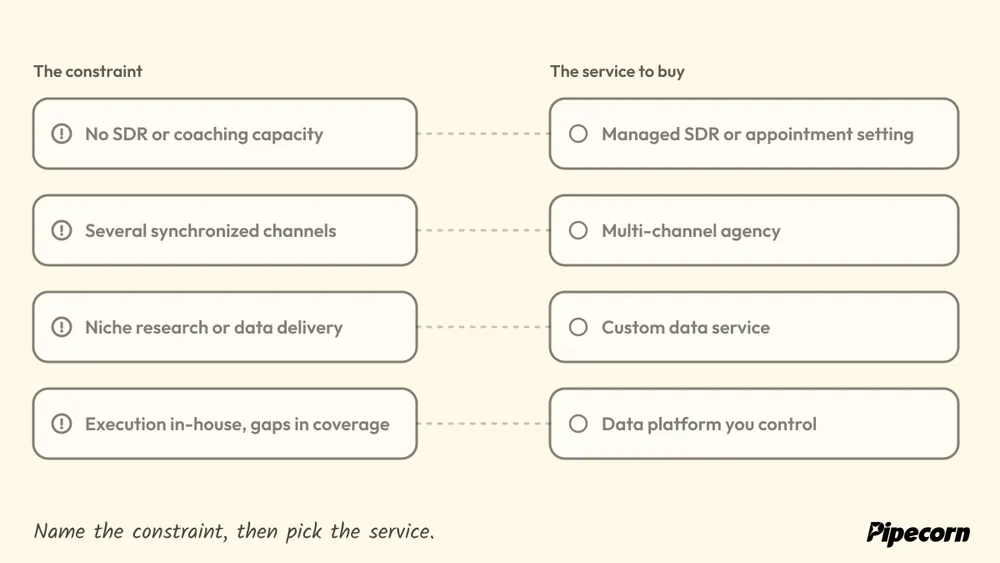
The shortlist becomes clearer when the constraint is named precisely. Outsourced SDR or appointment-setting services make sense when a company lacks recruiting, coaching, quality assurance, or campaign-management capacity. SalesRoads, Martal Group, and similar providers can supply people and operating discipline, but the buyer gives up some control and must manage handoff quality, meeting definitions, and feedback loops.
Multi-channel agencies fit programs that need coordinated email, LinkedIn, calling, paid media, retargeting, or events. Belkins and Callbox are relevant when the campaign needs several synchronized touchpoints, while CIENCE offers a broader range of managed execution and data operations. The trade-off is scope. More channels create more coordination and attribution work, not automatically better economics.
Data-led services are better when the bottleneck is niche research, enrichment, buying-committee mapping, compliance, or warehouse delivery. LeadGenius suits bespoke research. Pipecorn suits teams that already own execution but need broader coverage, verified emails and mobiles, real-time signals, and automated CRM or engagement handoffs.
Attribution deserves a separate decision gate. If a lead closes six months later through a different channel, the supplier's impact shouldn't disappear under last-touch reporting. Buyer guidance increasingly recommends agreeing attribution rules before engagement, because a provider can be operationally busy while remaining commercially unproven. (Kayako's lead-generation buyer guidance)
A lead closes six months later through a different channel.
Every vendor in the stack:

The market's scale makes this discipline more important. B2B lead generation services expanded from about USD 1.9 billion in 2021 to a projected USD 3.7 billion by 2027, implying nearly 12% CAGR over that period. (Uplead lead-generation statistics) Growth has created more vendor choice, not a universal best provider.
A practical selection process should:
- Define the ICP and geographies: Document target companies, personas, buying committees, exclusions, and regional requirements.
- Estimate record and mobile demand: Separate total contacts from the number that must have verified mobiles, because phone-first economics differ from email-led programs.
- Map destinations: Confirm required CRM, sales-engagement, API, warehouse, and webhook integrations before evaluating delivery promises.
- Run a controlled pilot: Set acceptance criteria for valid data, qualified meetings, routing speed, attribution, and sales follow-up.
- Price the full motion: Include provider fees, credits, internal management, CRM work, sales enablement, quality review, and opportunity conversion.
Teams with no internal execution capacity should buy managed SDR or appointment-setting support. Teams with a multi-channel campaign requirement should buy coordinated demand generation. Teams with specialist data problems should buy custom research or enrichment. Teams with capable RevOps and SDR leadership should keep execution in-house and use Pipecorn to improve contact coverage, verification, signals, and handoffs.
For a broader market perspective, Big Moves Marketing's lead-generation company guide can add another comparison point, but vendor selection should still follow the operating model rather than brand visibility.
Pipecorn gives in-house sales and RevOps teams a practical data layer for B2B lead generation services, combining multi-provider enrichment, verified emails and mobiles, ICP cleaning, real-time signals, and CRM or sales-engagement delivery. Teams that want to build or improve an outbound workflow without outsourcing execution can explore Pipecorn and assess whether its credit model and integrations fit their target markets.