Cold Call Coaching: How to Coach SDRs on Their Real Calls
A manager hears a handful of the hundreds of cold calls a team makes each week. A scorecard for the first minute, a way to review every call, and a 30-minute weekly 1:1 built on real calls.

Article summary
- Cold call coaching means reviewing SDRs' real calls, scoring them against one shared standard and practicing one fix at a time.
- A manager coaching eight reps can review only a few calls per rep a month, according to Praiz, and the calls picked tend to be the long or flagged ones.
- Score every recorded call automatically, then listen only to the calls the scores point to.
- Keep the scorecard to five or six criteria on the first minute and the ask, and drop any criterion that would not change what you coach.
- Calls that end on "wrong person" or "they left the company" are a list problem, fixed in the data before the dial.
- Run a 30-minute weekly 1:1 on real calls, with one fix practiced on a real objection and checked in next week's scores.
Want to go further? Ask
 ChatGPT
 Claude
 Perplexity
 Grok
GrokOn this page
- 01How to coach SDRs on cold calls
- 02How to review cold calls without listening to all of them
- 03What should a cold call scorecard include?
- 04What call scoring reveals across the team
- 05How to give feedback on cold calls: a weekly coaching routine
- 06Can AI coach cold callers?
- 07FAQ about cold call coaching
Cold call coaching means improving how SDRs run cold calls by reviewing their real calls, scoring them against one shared standard, and practicing the fixes. It works best when it starts from what reps actually said on the phone, not from what they remember of the call or from a script read in a meeting room.
The problem is volume. A busy team makes hundreds of cold calls a week, and a manager hears a handful of them. So the feedback a rep gets is about the few calls the manager happened to catch, and those are rarely the calls that show the rep's habits.
This guide gives you a way to cover every call without listening to all of them, a scorecard for the first minute you can copy, the patterns to look for across the team, and a 30-minute weekly 1:1 built on real calls.
The sales manager, after listening
to the two longest calls of the week:

How to coach SDRs on cold calls
To coach SDRs on cold calls, record every call, score each one against the same short scorecard, look for patterns across the team, and spend the weekly 1:1 on one fix shown on the exact moment of a real call. Then check that the fix shows up in next week's scores.
That gives you a loop with five parts:
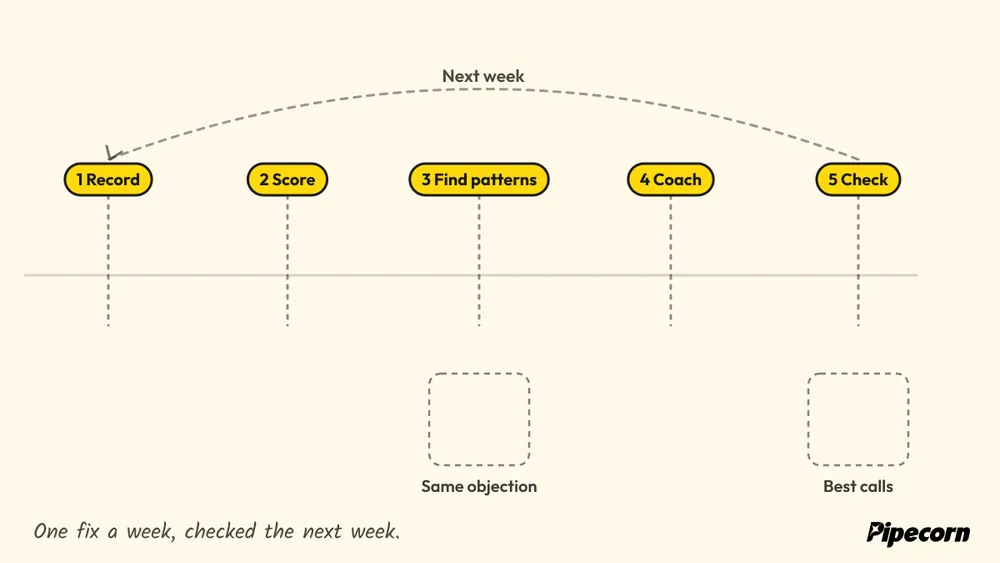
- Record. Every cold call is recorded and transcribed, from the dialer or the video tool.
- Score. Every call is checked against the team's scorecard once it ends.
- Find patterns. The scores and the objections are read across reps and weeks.
- Coach. The 1:1 picks one fix and practices it on a real objection.
- Check. Next week's score on that criterion shows whether the fix held.
The rest of this guide takes each part in turn.
How to review cold calls without listening to all of them
You review cold calls without listening to all of them by scoring every call automatically and then listening only to the calls the scores point to. Listening to a sample does not work, because the sample is biased.
Start with the math for your own team. Multiply your reps by the conversations each one has a day, then by the average length of a conversation. Compare the result with the hours you really have for listening.
Here is an example with made-up numbers. Six SDRs who each have eight conversations a day produce 48 conversations a day, or 240 a week. At four minutes each, that is 16 hours of audio every week, before a single note or a single 1:1. Praiz's own call scoring guide puts it the same way. A manager coaching eight reps, it says, can realistically review a few calls per rep per month.
The calls a manager does hear are not random. Left to choose, managers tend to pick the long calls, which look like good ones, or the calls a rep flags because something odd happened. The short calls, where the prospect hung up after 20 seconds, often hold the most common failure, and they are the ones nobody listens to. Feedback built on that sample is about outliers, not habits.
Call scoring tools close that gap. Each recorded call is checked against the manager's criteria once it ends, the same way every time, so scores compare across reps and across weeks. The manager then opens the calls worth hearing, such as the lowest score of the week on the opener, or the call where a rep handled "we already use a tool" well.
Praiz is one example. It is a call analysis platform that scores sales calls against a team's own criteria. It records calls from dialers such as Aircall, Ringover and Minari, and from Google Meet, Microsoft Teams and Zoom, and it can send the results to the CRM. It works after the call, with no prompts during it.
A tip if you are choosing a tool. Check that the vendor helps you set up the scorecard and adjust it in the first weeks. Praiz sees many teams get stuck on writing the criteria, so the setup help matters as much as the scoring.
One more check before you record. Tell prospects the call is recorded and follow the consent rules of the countries you call. They differ between US states and across Europe, so confirm them with whoever handles legal for your team.
What should a cold call scorecard include?
A cold call scorecard should include five or six criteria that cover the first minute of the call and the ask at the end, each scored yes or no or from 1 to 5. Keep it short. Praiz's guide recommends staying under ten criteria, and for a cold call fewer is better, because the call itself is short.
Copy this scorecard and adjust it to your own method.
| Criterion | How to score it | What good sounds like |
|---|---|---|
| Opener | 1 to 5 | The rep says who they are and why they are calling in the first few seconds, without asking "how are you today?" |
| Reason for the call | 1 to 5 | The reason is about the prospect, such as a recent change on their side, not a feature list. |
| One discovery question | Yes or no | The rep asks one open question about how the prospect handles the problem today, and lets them answer. |
| First objection | 1 to 5 | The rep acknowledges the objection, asks one question about it, then reframes. No argument. |
| Clear ask with a date | Yes or no | The call ends on a specific next step with a day and a time, not "I'll send you an email." |
| Talk ratio | Track only | The prospect talks more as the call goes on. Coach it only when it is far off. |
For openers to test against this scorecard, start with our cold call script examples.
The reason for the call lands better when it rests on a signal from the prospect's world. A job change is the clearest one. A new Head of Sales is likely to review how the team works in their first months, so "I saw you started as Head of Sales in September, and I thought you might be looking at how the team books meetings" gives them a reason to keep listening. Score whether the reason is specific to the prospect. A reason that could be read to anyone scores low.
For objections, score the reaction, not the words. Reps who learn a fixed answer to "send me an email" sound scripted the moment the prospect says something slightly different. A rep who acknowledges, asks one question and then reframes can handle the variations too.
Before you lock the scorecard, ask one question about each criterion. Would a low score on it change what you coach this week? If it would not, drop it. A criterion nobody acts on adds noise to every score.
Last, calibrate. Have two managers, or a manager and a senior rep, score the same five calls separately and compare. Where they disagree, the criterion is not clear enough yet. Rewrite it until two people give the same score to the same call.
What call scoring reveals across the team
Once every call is scored, SDR coaching no longer has to go one rep at a time. You can look at the whole team. The patterns tell you what to coach first, and who can teach it.
Start with the objections. List the ones that come back most and how often each one ends the call. On cold calls they tend to include:
- "Send me an email."
- "We already use a tool for that."
- "We have no budget."
- "That's not my area."
They do not weigh the same. "Send me an email" often ends a call that a good next question would have saved. "That's not my area" may mean the list is targeting the wrong role. Count both how often each objection comes up and how often the call ends right after it. The second number tells you where coaching will change results.
Then look at the openers. Compare the openers on calls that got past the first 30 seconds with those on calls that did not. You will usually find a few lines that keep prospects on the phone and a few that lose them, and you can share both with the team.
The scores also show who handles which objection well. Pair reps on that basis. The rep who keeps calls alive after "we already use a tool" listens to calls with the rep who loses them there, and the other way round on a different objection. Keep the best calls in a library, sorted by objection, so anyone can hear how a teammate handled the exact moment they find hard.
One pattern is not a coaching problem at all. When many calls end on "wrong person" or "they left the company", no amount of practice will fix it. That is a list problem. The numbers ring a switchboard, a former employee or a colleague, and the fix is in the data before the dial. If that pattern shows up, compare the phone number enrichment tools for cold calling on your own contacts before you coach anyone on it.
The SDR, coached for ten minutes on their opener
for a call that rang the company switchboard:

How to give feedback on cold calls: a weekly coaching routine
Give cold call feedback once a week, in a short 1:1 built on real calls, with one fix at a time. Chris Beall of ConnectAndSell makes the same point on the Market Dominance Guys podcast. Find the first point where the call breaks down, he says, work on that part until it holds, and drill the corrected line before the next call.
Use this 30-minute agenda every week:
- Score trend, 5 minutes. Look at the rep's scores for the week next to the week before, criterion by criterion. Name what moved.
- One strength, 5 minutes. Play a moment from a real call where the rep did something well, and say why it worked.
- One fix, 10 minutes. Play the exact moment of a real call where the rep lost the prospect. Agree on what to say instead, in the rep's own words.
- Role-play, 10 minutes. Practice the fix on that same objection, several times, until the new line comes out without thinking.
Pick one fix per week, not three. A rep who works on the opener, the ask and the talk ratio at once will improve none of them. Write the fix down and check that criterion's score in the next 1:1. If it moved, pick the next fix. If it did not, keep the same one for another week.
Two team habits help between the 1:1s. Once a month, listen to the best cold call of the month together and let the rep explain what they were thinking. And give new SDRs the best-calls library before their first dial, so they hear how the team handles the common objections before they meet them live.
Can AI coach cold callers?
Yes, partly. AI can score every recorded call against your scorecard, track objections across the team and play a prospect for role-play practice. A manager still picks the fix and runs the 1:1. Three kinds of tools use the word AI, and only the first two help with coaching.
| Kind of tool | What it does | Role in coaching |
|---|---|---|
| Call analysis | Records and transcribes real calls, scores them against your criteria and tracks objections across the team. | The coaching this guide describes. The manager still runs the 1:1. |
| AI role-play | Lets a rep practice against a simulated prospect that pushes back. | Useful for drilling a fix between 1:1s, though the objections are generated and not your market's. We cover role-play prompts in how to use AI for cold calling. |
| AI voice agents | Place calls themselves. | None. They replace the call. |
For coaching, start with the first kind. Real calls show what your prospects actually say, and that is what your reps need to get better at.
FAQ about cold call coaching
How often should you coach SDRs on cold calls?
Once a week works for most teams, in a 1:1 of about 30 minutes built on that week's calls. Add short feedback right after a call when a rep asks for it. Weekly keeps one fix in focus long enough to see it in the scores.
How many calls should a manager review each week?
Fewer than without scoring, because the scores pick them. For each rep, take the lowest score on the criterion you are coaching, one strong call to play back as a strength, and any call the rep flags. Jump to the moment the score points to instead of playing the whole call.
Do you need consent to record cold calls?
US federal law needs the consent of only one party to the call, and the rep is that party (18 U.S.C. § 2511). Some states, such as California, require everyone on the call to agree. In Europe, GDPR requires you to tell people their call is recorded and why. The simplest rule is to tell every prospect at the start of the call, and to have whoever handles legal confirm it for each market.
Can new SDRs learn from recorded calls?
Yes. A library of the team's best calls, sorted by objection, lets a new SDR hear how a colleague handled "send me an email" or "we already use a tool" before their first dial. It shortens the time before they sound confident on the phone.
Written with Praiz, from a brief by Vincent Roulois, CEO and co-founder of Praiz.