Best Phone Number Enrichment Tools for Cold Calling (2026), Tested on Real Calls
A scale-up gave six phone enrichment tools the same contacts and had reps call every number. Coverage, precision and price per mobile, by market.

Article summary
- A scale-up, Hyperline, gave six phone enrichment tools the same contacts and had its reps call every number. A number only counted when the rep reached the right person.
- Across 170 US and UK contacts, Pipecorn found the right mobile for 76% of the contacts with a confirmed number, FullEnrich for 68%, Cognism, Apollo and ZoomInfo for 59%, Zeliq for 53%.
- Precision ranks the tools differently. Zeliq was the most precise in the US (68%) and Cognism in the UK (73%), while Pipecorn led on coverage in both.
- No single tool found every number. One provider found 26 of the 34 confirmed numbers, the best pair 31, and it took four providers to reach all 34.
- Price per mobile depends on how each tool bills: by credit, by seat or by annual contract. Test on your own list, per country, before you sign.
Want to go further? Ask
 ChatGPT
 Claude
 Perplexity
 Grok
GrokOn this page
- 01What is the best phone number enrichment tool for cold calling?
- 02How the tools were tested
- 03The results, side by side
- 04The 6 best phone number enrichment tools for cold calling
- 05Coverage vs precision: which matters for cold calling?
- 06Is one phone data provider enough?
- 07What a mobile costs with each tool
- 08How to run the same test on your own list
- 09Compliance before you dial
- 10Where Pipecorn fits
- 11Frequently asked questions
Search for the best phone number enrichment tools for cold calling and you get a page of listicles, each written by a vendor that ranks itself first. None of them shows what happened when a rep actually dialed the numbers. That is the only result that matters to a calling team, because a mobile that rings the wrong person costs a dial, a minute and sometimes a bad first impression.
This guide uses a test that did dial them. A scale-up, Hyperline, wanted a phone provider for its own sales team, so its Head of Growth, Quentin Kozyra, ran six providers on the same contacts, had the reps call every number, and published his method and takeaways on LinkedIn. Below you will find what each tool found, how precise its numbers were, what a mobile costs with each one, and how to rerun the same test on your own list.
Every phone enrichment listicle on page one,
about the tool that wrote it:

What is the best phone number enrichment tool for cold calling?
On the contacts Hyperline called, Pipecorn found the right number for the most people, in every market tested. The best tool for your team still depends on where you call and what you value more, more good numbers or fewer wrong ones. Here are the quick picks from the test.
- Most right numbers overall: Pipecorn. 76% coverage across the US and UK, 82% in the US, 71% in the UK and 93% in France.
- Most precise numbers in the US: Zeliq. 68% of its graded US numbers reached the right person, against 58% for Pipecorn, with 76% coverage.
- Most precise numbers in the UK: Cognism. 73% precision, but it returned no number at all for 31% of UK contacts.
- Strong runner-up on coverage: FullEnrich. 68% across the US and UK, and 86% in France.
- All-in-one with sequences and a dialer: Apollo. The cheapest mobiles at list price, and 53% coverage in the US, tied for the lowest.
- Enterprise suite with intent data and a dialer: ZoomInfo. 65% coverage and 57% precision in the US, its strongest market.
How the tools were tested
A scale-up ran this test, not us. Quentin Kozyra, Head of Growth at Hyperline, wanted to choose a phone provider for his own sales team, so he sent the same list to six tools: Pipecorn (still called ProntoHQ at the time), FullEnrich, Cognism, Apollo, ZoomInfo and Zeliq. Each tool worked on its own, with no waterfall between them. Then the sales team called the numbers, and a number counted as good only once a rep reached the right person.
 Quentin KozyraHead of Growth @ Hyperline | Growth, GTM, and AIin
A month ago I turned phone enrichment into a contest at Hyperline. Thanks to this project, I can already say we will improve our connection rate by 20%.
The setup: 6 providers on the same list, no waterfall. […] 170 contacts, 169 enriched. Then we actually called.
Here are the 3 things I am taking away.
1. Decide what matters before you pick a provider. Volume of good numbers, or precision? You rarely get both. Pipecorn found the most good numbers. […] Two different bets. Pick yours first, then pick your tool.
2. There is no perfect provider, only a good stack. Pipecorn covered 76% of all the good numbers we found. To get the rest you do not need a better primary, you need the most complementary secondary. Coverage compounds when providers pull from different sources. No need to stack many tools, just the most complementary one.
3. The right stack changes by country. Some providers were excellent on the US and weak on the UK. A stack that wins in one market can quietly lose in another. Test per geography, not in aggregate.
Hyperline is a Pipecorn customer today. Pipecorn did not run the test, choose the contacts or grade the calls. The US and UK figures come from Quentin's analysis file (data as of June 12, 2026). The French figures are rates he shared with us afterwards, for five of the six tools.
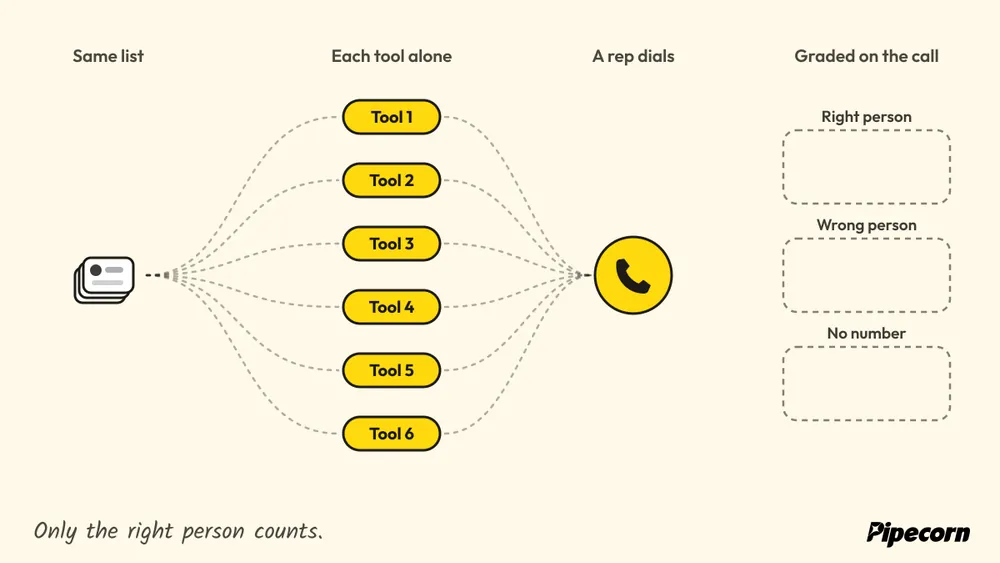
Three measures come out of the calls, and they answer different questions.
- Coverage. Of the contacts where a rep confirmed a good number, the share where this tool returned that number. It tells you how many good dials a tool gives you.
- Precision. Of the numbers a rep could grade on the phone, the share that reached the right person. It tells you how many dials you waste.
- No number. The share of contacts the tool returned nothing for. Those are contacts a rep cannot call at all.
Two limits are worth keeping in mind. The sample is small: 170 contacts in the US and UK, 34 of them with a confirmed good number. And it is one company's list, with one company's buyer profile. Treat the results as a strong signal and a method to copy, then test on your own contacts.
The results, side by side
Across the 170 US and UK contacts, Pipecorn found the right mobile for 76% of the contacts with a confirmed number, eight points ahead of FullEnrich and seventeen ahead of the next three. On precision the six were close, from 47% to 57%, with Cognism ahead.
| Tool | Coverage | Precision | No number |
|---|---|---|---|
| Pipecorn | 76% | 53% | 5% |
| FullEnrich | 68% | 52% | 6% |
| Cognism | 59% | 57% | 17% |
| Apollo | 59% | 51% | 9% |
| ZoomInfo | 59% | 48% | 18% |
| Zeliq | 53% | 47% | 11% |
The averages hide the most useful part. Split by country, the order changes, and so does the tool with the most precise numbers.
| Tool | US coverage | US precision | UK coverage | UK precision | France coverage | France precision |
|---|---|---|---|---|---|---|
| Pipecorn | 82% | 58% | 71% | 48% | 93% | 72% |
| FullEnrich | 71% | 52% | 65% | 52% | 86% | 65% |
| Cognism | 53% | 45% | 65% | 73% | 73% | 52% |
| Apollo | 53% | 47% | 65% | 55% | 67% | 52% |
| ZoomInfo | 65% | 57% | 53% | 38% | 55% | 40% |
| Zeliq | 76% | 68% | 29% | 26% | Not shared | Not shared |
Zeliq is the clearest example. It was second on coverage in the US and last in the UK. Cognism went the other way, mid-table in the US and the most precise tool in the UK. A tool that wins your home market can quietly lose the next one, which is why Quentin's third takeaway reads "Test per geography, not in aggregate."
The 6 best phone number enrichment tools for cold calling
Each tool below gets the same four answers: who it suits, what the call test showed, what a mobile costs, and the trade-off you accept by choosing it. Prices come from each vendor's own pricing page, read in October 2026.
1. Pipecorn
Best for calling teams that want the most right numbers per list, in the US and in Europe. Pipecorn runs a waterfall across 100+ data providers, checks the line and the owner, and only charges for the numbers it finds.
What the test showed. The highest coverage in every market tested: 76% across the US and UK, 82% in the US, 71% in the UK, 93% in France. It also returned no number for only 5% of contacts, the lowest of the six. Its precision was mid-table, 53% overall, behind Zeliq in the US and behind Cognism, Apollo and FullEnrich in the UK.
Price. A mobile costs 30 credits and an email 3. Plans start at $49 a month for 3,000 credits, about $0.49 a mobile, with unlimited seats, credits that roll over while you subscribe, and a free plan of 150 credits a month. Details on Pipecorn pricing.
Trade-off. Pipecorn finds and verifies data and builds lists. It does not send sequences or dial: it syncs to HubSpot, Salesforce or Pipedrive, and your sequencer and dialer take it from there.
2. FullEnrich
Best for teams that already have their lists and want a waterfall for emails and mobiles, billed by credit.
What the test showed. Second on coverage, 68% across the US and UK and 86% in France, with precision close to Pipecorn's, 52% against 53%. It returned no number for 6% of contacts. For the full head-to-head, see Pipecorn vs FullEnrich.
Price. A mobile costs 10 credits and an email 1, about $0.55 a mobile at the entry tier billed monthly, according to FullEnrich's pricing page. The trial is a one-time 50 credits, and credits are kept 3 months, or 12 on annual plans.
Trade-off. No Chrome extension since June 2024, so enriching a profile you are looking at means copying it into the web app. List building happens elsewhere.
3. Cognism
Best for UK-focused teams that care most about not dialing the wrong person.
What the test showed. The most precise numbers in the UK, 73%, and the best overall precision at 57%. The catch is volume: Cognism returned no number for 31% of UK contacts and 17% overall, and its US coverage was 53%. In France it found the right number for 73% of contacts, at 52% precision. If you need more of your contacts to be callable, compare it on your list first. The market tabs are in Pipecorn vs Cognism, and our Cognism alternative page covers the price side.
Price. Cognism lists two plans, Standard and Pro, each with 5 seats included, and counts 1 credit per revealed contact. It publishes no dollar figures; its pricing page sends you to a demo.
Trade-off. An annual quote before you can see a price, and fewer numbers to dial than the coverage leaders.
4. Apollo
Best for small teams that want data, sequences and a dialer in one tool, at a low list price.
What the test showed. 59% coverage across the US and UK, 65% in the UK but 53% in the US, its weakest market. Precision was 51% overall and 55% in the UK, where it beat Pipecorn. In France it found the right number for 67% of contacts. More detail in Pipecorn vs Apollo.
Price. Apollo is the cheapest per mobile at list price. On Apollo's pricing page, Basic is $49 a seat a month billed annually, with 30,000 credits a seat a year, and a phone number costs 8 credits. If a seat's 2,500 monthly credits all went to phones, that is about $0.16 a mobile. The free plan gives 900 credits a seat a year.
Trade-off. Every seat is billed, credits expire at the end of each billing cycle, and fewer of the numbers reach the right person in the US.
5. ZoomInfo
Best for enterprise teams calling the US that want a full sales suite with intent data, a dialer and outreach workflows.
What the test showed. Its best market was the US, at 65% coverage and 57% precision, against 82% and 58% for Pipecorn. The UK was much weaker, at 53% coverage and 38% precision, and so was France, at 55% and 40%. ZoomInfo also returned no number for 18% of US and UK contacts. See Pipecorn vs ZoomInfo for the market tabs.
Price. ZoomInfo's pricing page has a quote form and no prices. It says the price depends on features, the number of licences and credit usage, with one credit for every profile exported. Vendr's data on 1,576 ZoomInfo purchases puts the median contract at $33,500 a year.
Trade-off. The biggest budget on this list and a sales call before you know it. Strong in the US, uneven elsewhere.
6. Zeliq
Best for US-focused teams that want enrichment inside a sales engagement tool, with credits that never expire.
What the test showed. Second-best US coverage, 76%, with 68% precision, close to the leaders. In the UK it found the right number for 29% of contacts, the lowest result in the test.
Price. On Zeliq's pricing page, Starter is $59 a user a month for 750 credits, and a mobile costs 10 credits, so about $0.79 a mobile if every credit goes to phones. Credits never expire and roll over to the next month. There is a free plan with no credits included.
Trade-off. Priced per user, and a big drop outside the US in this test.
Coverage vs precision: which matters for cold calling?
For most calling teams, coverage matters more, as long as precision does not fall off a cliff. Coverage decides how many contacts on your list a rep can reach at all. Precision decides how many dials go to the wrong person. A tool with high precision and low coverage gives you clean numbers for a short list, and the rest of the list sits there uncalled.
The rep dials the "verified" mobile for the VP of Sales.
The person who picks up:

Quentin put the choice plainly in his post: "Decide what matters before you pick a provider. Volume of good numbers, or precision? You rarely get both." In his test the spread on precision was narrow, 47% to 57% across the US and UK, while coverage ran from 53% to 76%. The bigger gap was in how many good numbers each tool gave the team.
There is one case where precision should come first: a small, high-value account list where every wrong call burns a contact you cannot replace. There, a precise tool for that market, then a second tool for the gaps, beats the widest single source.
Is one phone data provider enough?
No. In Hyperline's test, no single tool found every confirmed number, and the gains from adding a second and third source were large. Quentin's second takeaway says it in one line: "There is no perfect provider, only a good stack."
| Providers combined | Best combination in the test | Confirmed numbers found |
|---|---|---|
| 1 | Pipecorn | 26 of 34 |
| 2 | FullEnrich + ZoomInfo | 31 of 34 |
| 3 | Cognism + FullEnrich + ZoomInfo | 33 of 34 |
| 4 | Apollo + Cognism + FullEnrich + ZoomInfo | 34 of 34 |
That is the case for waterfall enrichment: query several sources in sequence, stop at the first verified result, and pay once. You can build that stack yourself with several contracts, or use a tool that runs the waterfall for you. Either way, the question to ask a vendor is how many sources sit behind its number, and what it does when they disagree.
What a mobile costs with each tool
The cheapest list price per mobile is not always the cheapest bill. Tools charge in three different ways, and the model changes the total more than the headline rate does.
- By credit, unlimited seats. You pay for the data you find, whatever the team size. Pipecorn and FullEnrich work this way.
- By seat. Each rep is a seat, and each seat comes with credits. Apollo and Zeliq work this way, so a team of ten pays for ten seats even if two reps do most of the calling.
- By annual contract. Licences, credits and features are quoted together. Cognism and ZoomInfo work this way.
The pricing page has a form where the price should be.
Your CFO, three calls later:

| Tool | Billing | Entry price | Cost of one mobile | Unused credits |
|---|---|---|---|---|
| Pipecorn | Credits, unlimited seats | $49 a month, 3,000 credits | 30 credits, about $0.49 | Roll over while you subscribe |
| FullEnrich | Credits, unlimited seats | Entry tier, monthly | 10 credits, about $0.55 | Kept 3 months, 12 on annual |
| Apollo | Per seat, annual | $49 a seat a month | 8 credits, about $0.16 | Expire each billing cycle |
| Zeliq | Per user | $59 a user a month, 750 credits | 10 credits, about $0.79 | Never expire |
| Cognism | Annual quote, 5 seats included | Not published | 1 credit per revealed contact | Not published |
| ZoomInfo | Annual quote | Not published, $33,500 median (Vendr) | 1 credit per exported profile | Not published |
To compare two tools fairly, divide what you would pay by the number of right-person mobiles each one gives you on your list. A cheap number that reaches the wrong person, or a contact with no number at all, still costs a rep's time.
How to run the same test on your own list
You can copy Hyperline's method with free plans and trials. Keep it per country, and keep the callers blind to the source if you can.
- Pick the contacts. Take about 200 contacts per market you call, from your real target list, with no number already on file.
- Send the same list to each tool alone. No waterfall between them, no manual fixes, same day.
- Have your reps dial every number. Mix the numbers so a rep does not know which tool each one came from.
- Grade every call. Right person, wrong person, dead line or no answer. Only "right person" counts as good.
- Compute the three measures per market. Coverage, precision and the share with no number, then the cost per right-person mobile.
Compliance before you dial
Enriched numbers are still personal data, and the rules depend on the country you call. This is general guidance, not legal advice, so check your own case with counsel.
- Europe and the UK. Under GDPR, B2B calling usually relies on legitimate interest. Tell people where you got their number when you call, and honour an opt-out straight away.
- Do-not-call registers. Screen your list against the registers that apply: TPS and CTPS in the UK, Bloctel in France, the National Do Not Call Registry in the US. Check which ones cover business lines.
- US mobiles. The TCPA restricts calls to mobile numbers made with an autodialer or a prerecorded voice without prior consent. Know how your dialer places calls.
- Your vendor. Ask where its data comes from, whether it can document it, and how it handles an opt-out request.
Where Pipecorn fits
Pipecorn is built for the job this test measured: finding the mobile that reaches the right person. It runs a waterfall across 100+ providers, so you get the stack effect without managing four contracts, and it builds the list too, from company import, lookalikes, hiring and tech signals and job-change alerts. The Chrome extension reveals a mobile from a profile in one click, and every contact syncs to HubSpot, Salesforce or Pipedrive for your dialer. Seats are unlimited, credits roll over, and the free plan gives you 150 credits a month to run your own test. If you are also comparing finders for direct dials, our B2B phone number finder guide covers the criteria.
Frequently asked questions
What is phone number enrichment?
Phone number enrichment adds a phone number, usually a mobile or a direct dial, to a contact you already have, such as a name and company or a LinkedIn profile. The tool looks the person up in one or more data sources and returns the number it finds, often with a check on whether the line is live and belongs to that person.
How accurate is phone number enrichment?
Less than vendor pages suggest. In Hyperline's call test, the share of graded numbers that reached the right person ranged from 47% to 57% across the US and UK, and from 26% to 73% within a single country. That is why a call test on your own list beats any accuracy claim.
What is a good connect rate for cold calling data?
There is no universal benchmark, because connect rate depends on your market, your titles and your dialer as much as on the data. Measure your own baseline first, then compare. In his post, Quentin wrote that the project would improve Hyperline's connection rate by 20%.
What is the difference between a mobile, a direct dial and a switchboard number?
A mobile rings the person's own phone. A direct dial rings their desk line without going through reception. A switchboard is the company's main number, where someone has to transfer you. For cold calling, mobiles and direct dials are the ones worth paying for.
Which phone enrichment tool is best for Europe and France?
In this test, Pipecorn had the highest coverage in both the UK (71%) and France (93%), with 72% precision in France. Cognism had the most precise UK numbers, 73%, with fewer contacts covered. In France, FullEnrich came next at 86%, then Cognism at 73%, Apollo at 67% and ZoomInfo at 55%. Zeliq has no French figures in the test.
Is there a free phone number enrichment tool?
Several tools have a free plan. Pipecorn gives 150 credits a month, five mobiles at 30 credits each. Apollo gives 900 credits a seat a year, and ZoomInfo Lite and Zeliq's Basic plan are free too. A free plan is enough to run the five-step test above on a small list.