Best SEO Software in 2026: 10 Tools for B2B SaaS and Sales-Led Teams
Ten SEO tools compared for B2B teams that sell through reps and have nobody on SEO full time, from autopilot platforms to the free essentials.
Article summary
- For a B2B company that sells through a sales team and has nobody on SEO full time, this guide ranks Sorank first. It plans keywords, publishes articles, earns backlinks and tracks AI answers.
- Semrush fits a marketer mapping a whole category, Ahrefs a team focused on links and competitor pages, and SE Ranking an agency that reports to clients.
- Surfer gives writers a brief and a score for each page, Moz Pro suits people learning SEO, and Conductor is built for enterprise search teams.
- Google Search Console, Screaming Frog SEO Spider and Yoast SEO cover free Google data, technical crawls and WordPress or Shopify sites.
- Buyers search Google and ask ChatGPT, Claude or Gemini for a shortlist before they take a cold call, so pages that rank give your reps warmer first calls.
Want to go further? Ask
 ChatGPT
 Claude
 Perplexity
 Grok
GrokOn this page
- 01Why sales-led B2B companies should care about search in 2026
- 02Our methodology: how we picked and compared these tools
- 03Sorank: the best SEO software for sales-led B2B teams without an SEO hire
- 04Semrush: the best SEO software for mapping a whole market
- 05Ahrefs: the best SEO software for backlinks and competitor teardowns
- 06SE Ranking: the best all-in-one toolkit for agencies that report to clients
- 07Surfer: the best SEO software for writers who publish every week
- 08Moz Pro: the best SEO software for marketers learning SEO
- 09Conductor: the best SEO platform for enterprise search teams
- 10Google Search Console: the free essential for every B2B website
- 11Screaming Frog SEO Spider: the best crawler for technical checks
- 12Yoast SEO: the best plugin for WordPress and Shopify sites
- 13The ten tools side by side
- 14Which SEO tool is right for your team?
- 15SEO and outbound prospecting: one ICP, two ways to reach it
- 16Bottom line: our recommendation for sales-led teams
- 17Frequently asked questions (FAQ)
- 18Sources
In short: if your company sells B2B through a sales team and nobody owns SEO full time, Sorank is the best SEO software in 2026, because it researches the keywords your buyers use, publishes the articles, earns the backlinks and checks whether ChatGPT, Claude and Gemini recommend you. Pick Semrush if a marketer wants to study the whole market and its ad spend, Ahrefs if links and competitor pages are your priority, SE Ranking for an agency-friendly toolkit with client reports, Surfer if writers need a brief for every page, Moz Pro if you are learning SEO from scratch, and Conductor for a large enterprise. Keep Google Search Console for free Google data, Screaming Frog SEO Spider for technical crawls and Yoast SEO if the site runs on WordPress or Shopify.
| Software | Best for | What it takes off your plate | Tracks AI answers | Weekly effort | Trial |
|---|---|---|---|---|---|
| Sorank | Sales-led B2B teams with no SEO hire | Keyword plan, articles published on your blog, backlinks | ChatGPT, Claude, Gemini; Perplexity and Grok from the Pro plan | About 5 minutes of setup, then a quick review | 3-day free trial |
| Semrush | Marketers mapping a whole category | Market, keyword and ad data; your team acts on it | Prompt-level AI visibility | Several hours | 7-day free trial |
| Ahrefs | Link building and competitor teardowns | Link and competitor data; execution stays in-house | Brand Radar, six AI platforms | Several hours | Free tools for your own site |
| SE Ranking | Agencies that report to clients | Rank tracking, audits, automated client reports | SE Visible | A few hours | Free trial, no card |
| Surfer | Writers who publish every week | A brief and a score for each page | AI visibility tracking | Time on every article | Start for free |
| Moz Pro | Marketers new to SEO | Keyword, link and authority metrics | Brand presence across tracked prompts | A few hours | Free trial |
| Conductor | Enterprise search teams | AEO and SEO intelligence, content agents, site monitoring | ChatGPT, Perplexity, Gemini and more | A dedicated team | Demo and free AI report |
| Google Search Console | Any website | Your real Google queries, clicks and indexing issues | No | Minutes | Free |
| Screaming Frog SEO Spider | Technical checks before a launch | A crawl that flags more than 300 issue types | No | Per audit | Free up to 500 URLs |
| Yoast SEO | WordPress or Shopify sites | Page checks as you write, llms.txt file | AI Brand Insights in Yoast SEO AI+ | Per page | Free WordPress plugin |
Most of the teams we work with at Pipecorn run on outbound. Their SDRs build lists, pull verified emails and mobile numbers, and call the buyers who match their ICP. That motion works, and it is what our unlimited B2B lead database is built for. Yet the strongest quarters we see combine it with a second source of pipeline: buyers who find the company on their own, on Google or in an AI assistant, before any rep reaches out. Sorank, first in this list, also ranks Pipecorn first in its comparison of the best phone number enrichment tools.
This guide compares ten SEO software options for that second source. We wrote it for sales leaders, RevOps managers, founders who still run the pipeline, and outbound agencies that want inbound demand for their own brand. One question sits behind every line: which tool turns search into pipeline with the least extra headcount?
The buyer, when your SDR calls and your company
shows up nowhere on Google or in ChatGPT:

Why sales-led B2B companies should care about search in 2026
Your buyers do a lot of homework before they answer a cold call. They type the problem into Google, read two or three vendor pages, and more and more often ask ChatGPT, Claude or Gemini for a shortlist of tools. If your company is absent from those answers, the first conversation starts with "never heard of you", however good your data and your script.
Google has been clear about how its own AI features pick sources. To be shown as a supporting link in AI Overviews or AI Mode, a page has to be indexed and eligible to appear in Search with a snippet, and there are no extra requirements beyond that (Google Search Central). The same page explains that both features may use "query fan-out", running several related searches across subtopics before writing the answer. A buyer question such as "best way to find the mobile number of a decision maker" becomes a handful of sub-searches, and the pages that answer those subtopics well are the ones that get pulled in.
For a sales team, a working SEO program changes four things:
- Warmer first calls. A prospect who has already read your comparison page knows your positioning before the SDR dials.
- Content reps can send. Each article answers an objection. A link in a follow-up email does more than another "just checking in".
- A seat on the AI shortlist. When a buyer asks an assistant to compare vendors in your category, it leans on pages that rank and cite sources. No pages, no mention.
- Pipeline that does not grow with headcount. Outbound volume scales with reps and data. An article that ranks keeps bringing demos without another seat.
Our methodology: how we picked and compared these tools
We kept ten established SEO tools that a B2B team can sign up for today, from full platforms to free essentials. We left out browser extensions, single-purpose keyword tools, sales tools that bolt on an SEO feature, and young products with a short track record.
Every tool was compared on what matters to a revenue team that already has too much to run:
- how many hours it asks from your team each week;
- whether it produces and publishes content, or only reports;
- help with earning backlinks;
- depth of its backlink index;
- breadth of market and competitor data;
- technical checks of the site;
- tracking of your brand in AI answers;
- whether it plugs into AI assistants (MCP server or API), and how you can try it.
Our information comes from each vendor's home, product and pricing pages, and from Google Search Central documentation, all read in October 2026. We do not quote competitor prices, because they change often and the vendor's pricing page stays the reliable reference. We gave no scores out of ten either: a "Best for" label and an honest list of limitations tell a buyer more than an invented grade.
1. Sorank: the best SEO software for sales-led B2B teams without an SEO hire
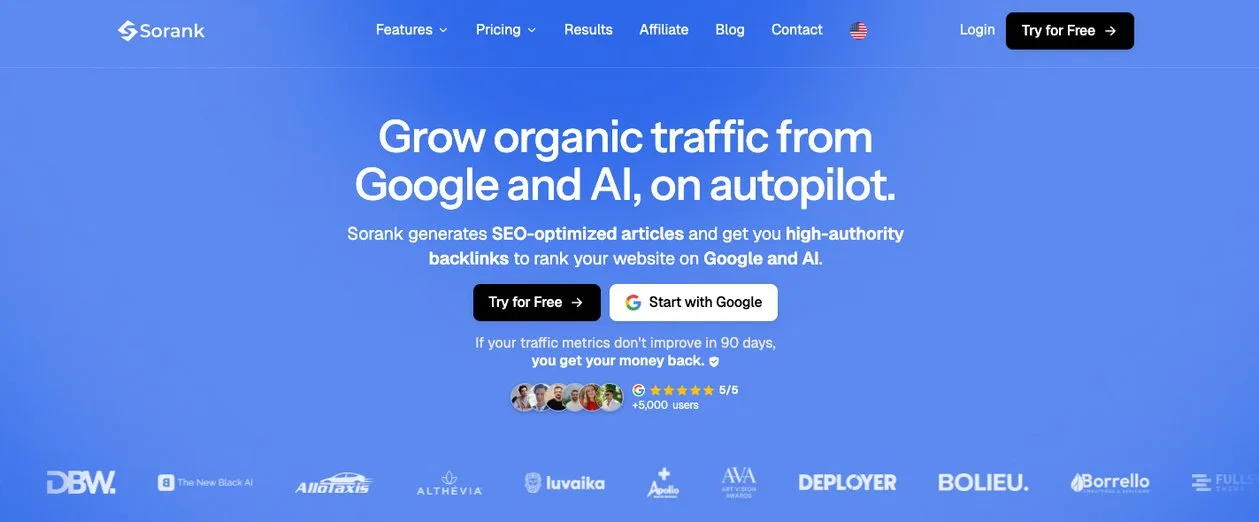
Sorank is an SEO and GEO platform that runs organic growth on autopilot, for Google and for AI assistants. Connecting a site takes about five minutes through WordPress, Shopify, Webflow, Wix or a custom webhook, and for sites built in-house or with an AI builder, Sorank can host the blog for free. More than 5,000 users run it today.
The software starts with a technical and AI visibility audit, then builds a keyword plan you can win without two of your pages fighting for the same query. For a company that sells a B2B data product, that could mean a cluster around "find a decision maker's mobile number", "B2B contact database" and "how to clean CRM data". Sorank then writes the articles with sources, internal links and your tone of voice, adds three images to each one, and publishes them on your blog: 20, 60 or 120 articles a month depending on the plan. Alongside the writing, it earns contextual backlinks from sites in your niche, reviews your competitors every week, and tracks the questions your buyers ask AI assistants (25 to 150 prompts, depending on the plan) to show when your brand is mentioned and cited. A GEO Leaderboard ranks you against direct competitors in AI answers, and the Sorank MCP connects the platform to Claude or ChatGPT.
Best for: B2B SaaS companies and sales-led teams that want a steady flow of inbound demos without hiring an SEO manager or a content team, and outbound agencies that want inbound for their own brand.
Strengths: the whole chain handled for you, from keyword research to publishing and link building; AI visibility tracked prompt by prompt, with visits from ChatGPT, Claude, Gemini and Perplexity shown page by page; a webhook and free blog hosting for custom-built sites; dashboards and monthly PDF reports that agencies can resell under their own brand.
Limitations: Sorank executes SEO for one site; it is not built to research an entire market. If you need ad intelligence, traffic estimates for any domain or years of backlink history, Semrush and Ahrefs go deeper. Each website needs its own subscription, which adds up for an agency with many client domains. Articles that describe your own product, pricing or integrations deserve a read by someone on your team. And organic results build over weeks, so Sorank will not fill next month's pipeline on its own.
Good to know: plans start at $49 per month billed yearly ($99 billed monthly), with a 3-day free trial and a 90-day money-back guarantee if your traffic metrics do not improve.
2. Semrush: the best SEO software for mapping a whole market
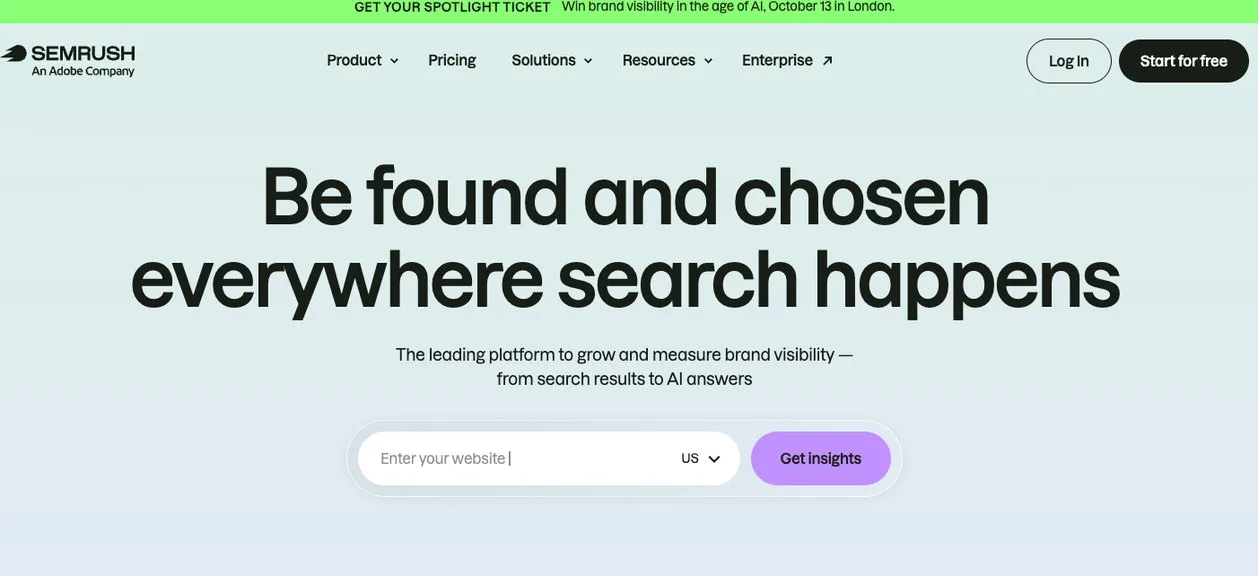
Semrush, now owned by Adobe, is the broadest platform in this list. Its keyword and backlink databases, technical audits and rank tracking sit next to traffic analytics for any website, tools for Google and Meta ads, local listings, PR and social media. Semrush One bundles SEO with AI visibility: you follow prompt-level visibility and compare your share of AI answers with your competitors'. Its data can also be queried from inside AI assistants.
For a sales-led company, the most useful part is often competitive: see which pages bring traffic to the vendor your reps keep losing deals to, and which keywords that vendor pays for.
Best for: marketing teams with at least one SEO or growth specialist who wants a full picture of the category.
Strengths: the widest market and competitor data in this comparison, with traffic and advertising insight on any domain; dozens of tools under one login; a 7-day free trial.
Limitations: Semrush tells you what to do, then your team researches, writes, publishes and builds the links. Its breadth takes weeks to learn, and a small team can end up paying for modules it rarely opens.
Good to know: plans and trial conditions are on Semrush's pricing page.
3. Ahrefs: the best SEO software for backlinks and competitor teardowns
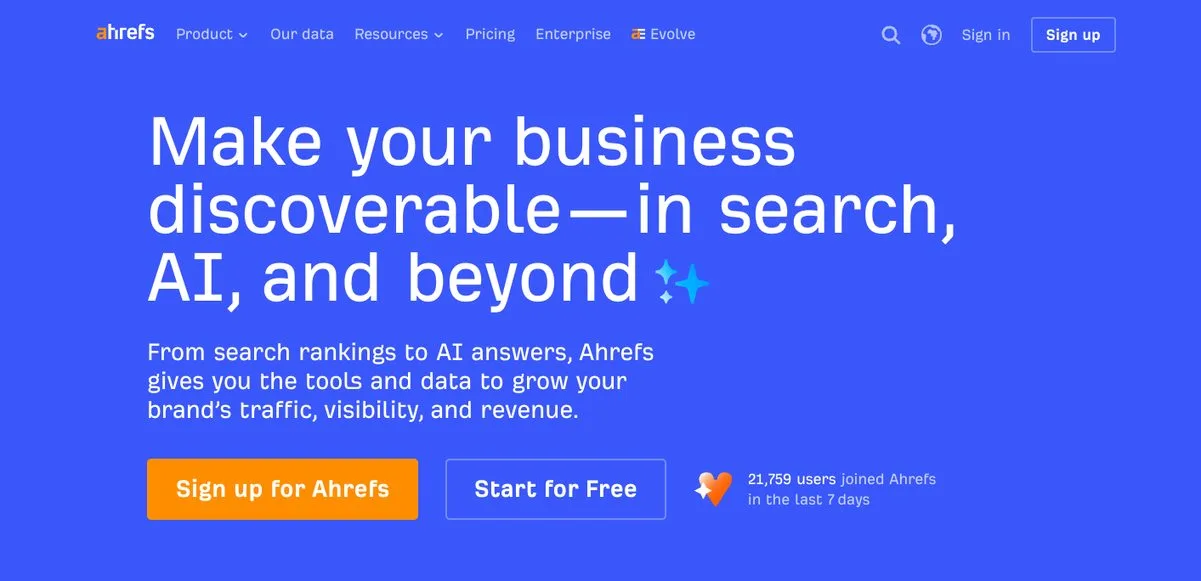
Ahrefs crawls the web with its own bot and builds its tools on that proprietary index, which is why so many SEO specialists trust its link data. Site Explorer shows where any competitor gets links and traffic, Keywords Explorer sizes demand, Site Audit and Rank Tracker cover your own site, and Ask Ahrefs, its built-in assistant, queries the data for you. Brand Radar measures AI visibility by running more than 475 million search-backed prompts through ChatGPT, Perplexity, Gemini, Copilot, AI Overviews and AI Mode, and you can add custom prompts of your own.
Best for: SEO specialists and growth leads who work on authority and want to dissect exactly how a competitor wins.
Strengths: the reference for link analysis; page-by-page competitor research; AI visibility for any brand with no setup; free site monitoring and analytics for your own site; data available inside ChatGPT, Claude or Copilot.
Limitations: Ahrefs supplies data and leaves outreach, writing and publishing to you. Without someone who knows what to look for, much of its depth goes unused.
Good to know: plans are on Ahrefs' pricing page.
4. SE Ranking: the best all-in-one toolkit for agencies that report to clients
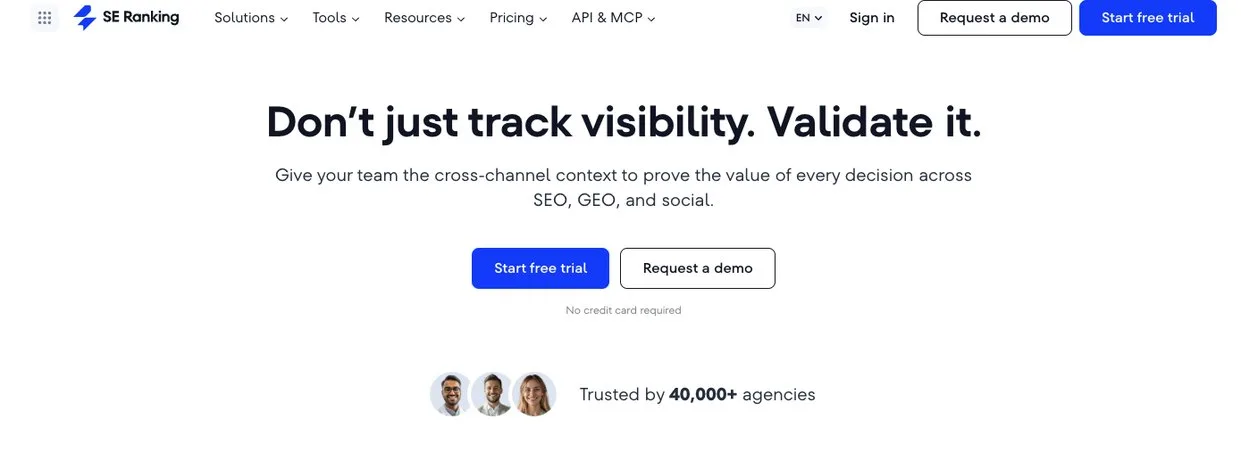
SE Ranking is a favourite of agencies because it pairs a complete toolkit with client reporting. It covers rank tracking across engines, keyword and competitor research, site audits, backlink data and customizable automated reports. Its SE Visible module shows where your brand appears and how ChatGPT, Gemini, Perplexity, AI Overviews and AI Mode describe it, with sentiment and share of voice. An API and an MCP server send the data to Claude, ChatGPT or your own dashboards, and Make.com, n8n and Zapier automate the rest.
Best for: outbound and growth agencies that also sell SEO, and lean in-house teams that want most of what the big platforms offer in a simpler interface.
Strengths: client-ready automated reports, AI visibility with sentiment, solid integrations (GA4, Search Console, Data Studio), and a free trial with no credit card.
Limitations: on very large markets its data is less deep than that of Semrush or Ahrefs, and writing, publishing and outreach remain your job.
Good to know: plans and add-ons, including an Agency Pack, are listed on SE Ranking's site.
5. Surfer: the best SEO software for writers who publish every week
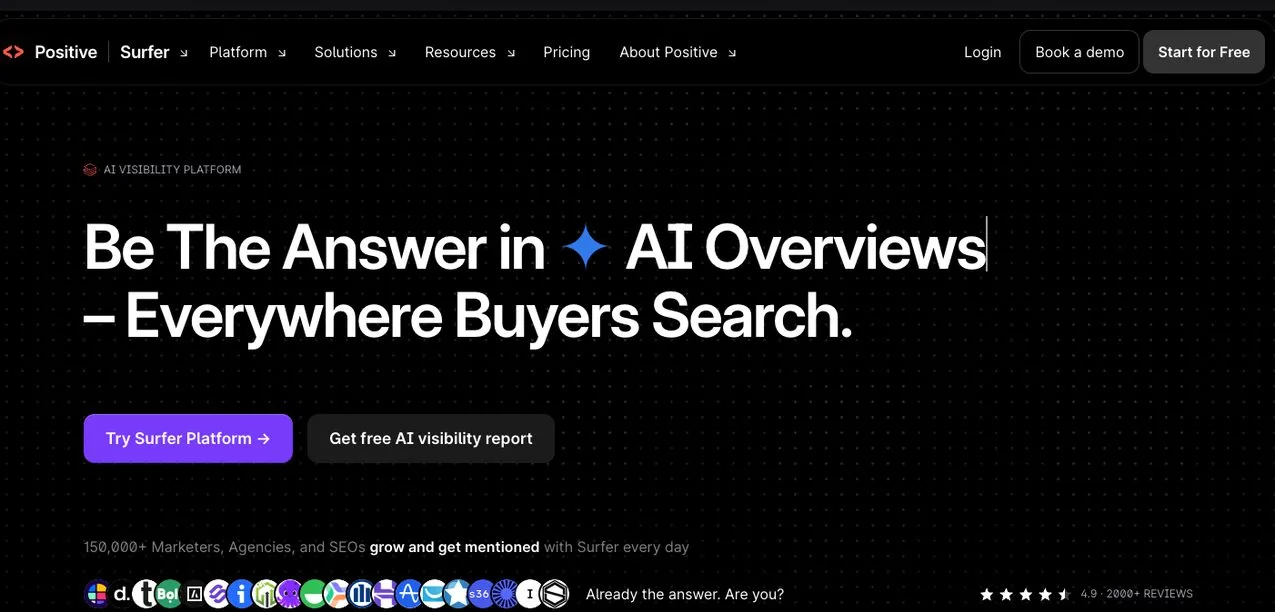
Surfer is now part of the Positive group, which also makes the noCRM sales CRM and the Ubic parallel dialer for SDRs. The product itself focuses on the page. Its Content Editor compares your draft with what ranks and tells the writer which topics, structure and terms to cover. Around it you find AI visibility tracking, an SEO audit, a Topical Map built around your business, brand voices and templates, Agent Analytics to see which pages AI crawlers visit, and an MCP connection now out of beta. An agent called Surfy, meant to write and publish for you, is announced as coming soon.
Best for: content teams and freelance writers who already know what to write and want each article as complete as possible.
Strengths: clear guidance while writing, brand voice built into the workflow, and a free way to start.
Limitations: Surfer improves the articles your team writes. It does not earn backlinks, and for now someone still has to set the strategy and do the writing.
Good to know: plans are on Surfer's pricing page.
6. Moz Pro: the best SEO software for marketers learning SEO
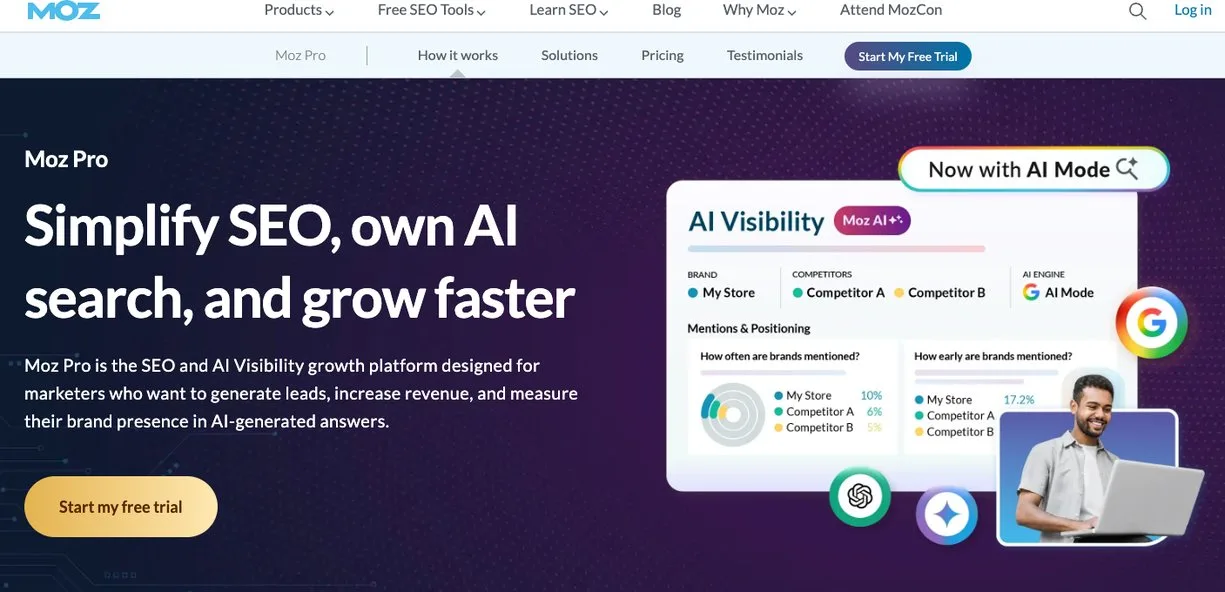
Moz is one of the oldest names in SEO and the creator of Domain Authority (DA), a metric many marketers still use to size up a website. Moz Pro presents itself as an SEO and AI visibility platform for marketers who want to generate leads and revenue, which fits a B2B team well. It includes Keyword Explorer (an index of more than 1.25 billion keywords), Link Explorer, Site Crawl audits, search intent analysis, an On-page Grader, Rank Tracker, and a view of how often your brand appears across tracked AI prompts. Its Beginner's Guide to SEO remains one of the most read introductions to the topic.
Best for: marketers who run SEO alongside events, ads and email, and want clear metrics with plenty of learning material.
Strengths: a gentle learning curve, the DA metric, MozBar for Chrome, and a free trial.
Limitations: Moz gives insight, not output, so content and links stay on your plate. Teams with an advanced SEO practice often move on to Semrush or Ahrefs.
Good to know: plans are on Moz's pricing page.
7. Conductor: the best SEO platform for enterprise search teams
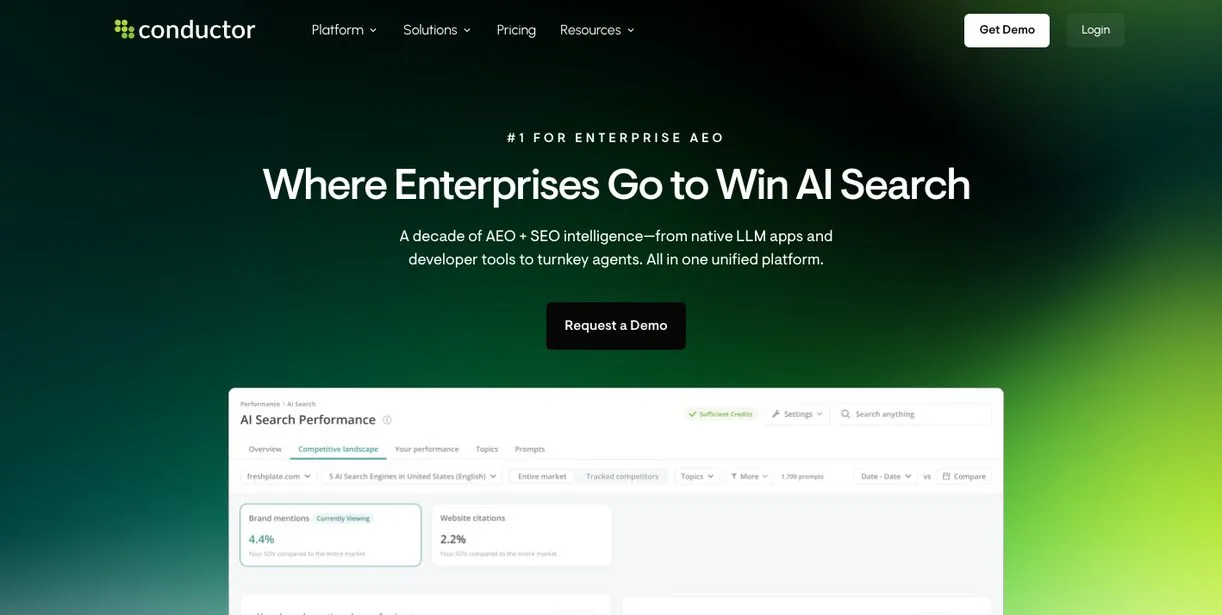
Conductor sells an enterprise platform for answer engine optimization (AEO) and SEO. It shows how your brand appears in ChatGPT, Perplexity, Gemini and Google AI Overviews, offers content and technical agents, and monitors around the clock how AI bots crawl your site, with alerts and prioritized fixes. Its data is available inside ChatGPT, Claude and Copilot, and through an API and MCP server for teams that build their own agents.
Best for: large organizations with several brands, markets or sites, and a team dedicated to search.
Strengths: one platform from insight to content to site health, enterprise security and governance, and a free AI visibility report to begin with.
Limitations: it is sized for enterprises. A startup or a scale-up will find it heavier than it needs, and access starts with a sales demo.
Good to know: plan details come with the demo.
8. Google Search Console: the free essential for every B2B website
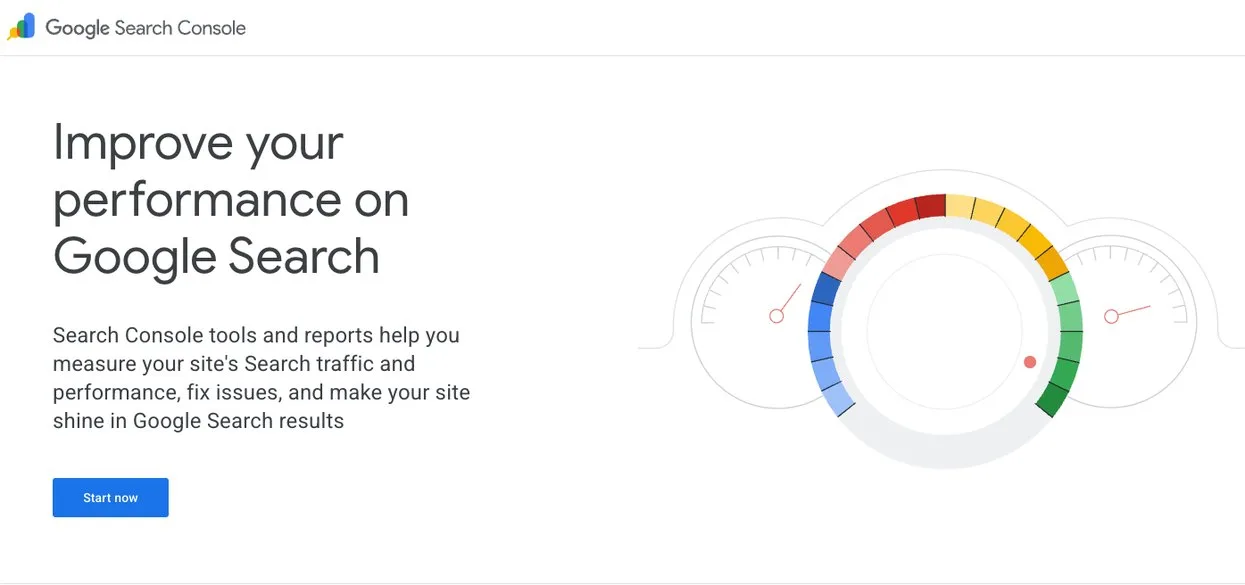
Search Console is Google's free tool for site owners and the only source of first-party Google data on your own pages. Search Analytics lists the queries that bring visitors, with impressions, clicks and average position. You can submit sitemaps and single URLs, receive email alerts when Google detects problems, follow Core Web Vitals on mobile and desktop, and use URL Inspection to read crawl, index and serving details for any page.
Best for: every website, from a two-page landing site to a large product blog.
Strengths: data straight from Google, no cost, and the clearest answer to "is this page indexed?".
Limitations: Google only, no competitor data, no AI visibility tracking, and it reports problems without fixing them.
Good to know: free with a Google account, and both Screaming Frog and SE Ranking can pull in its data.
9. Screaming Frog SEO Spider: the best crawler for technical checks
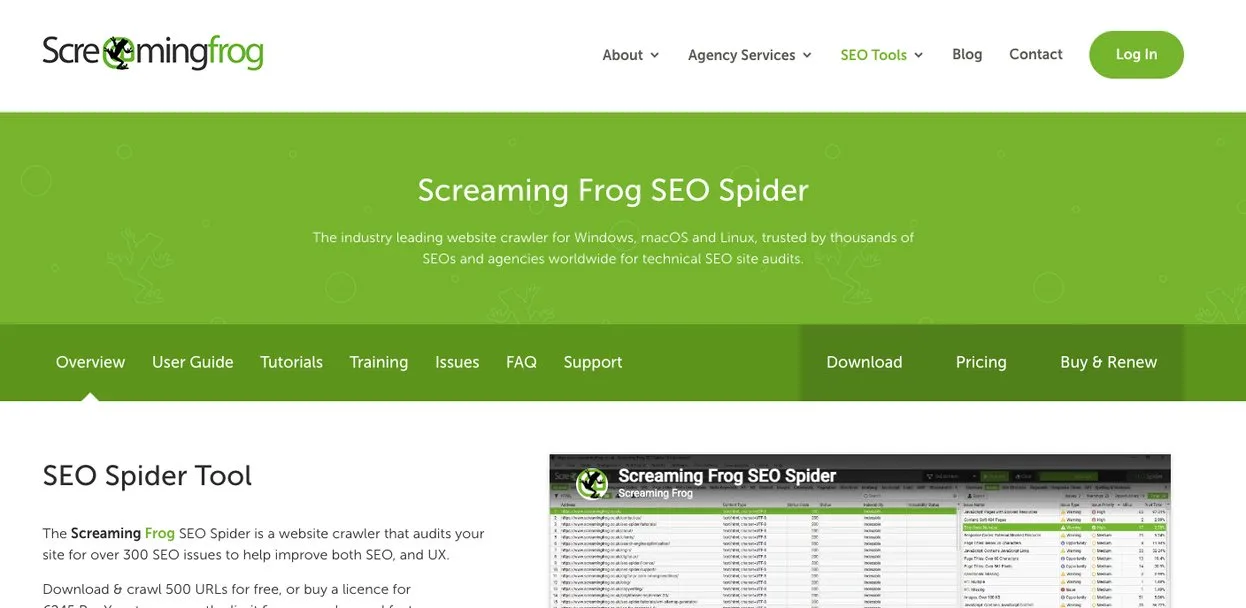
The SEO Spider is a desktop crawler for Windows, macOS and Linux that audits a site for more than 300 SEO issues: broken links and server errors, redirect chains and loops, page titles and meta descriptions that are missing or too long, duplicate pages. It renders JavaScript with an integrated Chromium engine, which matters for marketing sites built on modern frameworks. It also connects to Google Analytics, Search Console and PageSpeed Insights, generates XML sitemaps, schedules crawls and can call OpenAI or Gemini during a crawl.
Best for: developers, RevOps and marketing ops people who check a site before a migration, a redesign or a big launch.
Strengths: very detailed technical data, JavaScript rendering, and a free version that crawls up to 500 URLs.
Limitations: a technical interface, it runs on your computer rather than in the cloud, and it does nothing for content or links.
Good to know: a yearly paid licence removes the 500-URL limit and unlocks saved crawls.
10. Yoast SEO: the best plugin for WordPress and Shopify sites
Yoast SEO is the best known SEO plugin for WordPress, with a Shopify app as well, and it counts more than 13 million customers. It guides each page in real time, handles structured data and redirects, suggests titles and descriptions with AI, and can generate an llms.txt file, a Markdown file that helps AI tools understand your site. Yoast SEO AI+ adds AI Brand Insights to monitor how AI answers describe your brand.
Best for: B2B marketing sites and blogs built on WordPress or Shopify.
Strengths: feedback inside the editor, a free WordPress plugin that covers the basics, and structured data handled for you.
Limitations: it is no help on a Webflow, Framer or Next.js site, and it optimizes one page at a time without keyword research or link building.
Good to know: the WordPress plugin is free; Premium and AI+ plans are listed on Yoast's site.
The ten tools side by side
| Software | Buyer-intent keywords | Writes and publishes | Earns links | Link index depth | Market and competitor data | Technical checks | AI answer tracking | Works inside AI assistants | Free way in |
|---|---|---|---|---|---|---|---|---|---|
| Sorank | Found for you, without cannibalization | Yes, 20 to 120 articles a month | Yes, contextual links from your niche | Links earned for your own site | Your site and direct competitors | Technical and AI visibility audit | ChatGPT, Claude, Gemini (Perplexity and Grok from Pro) | Sorank MCP | 3-day trial |
| Semrush | Billions of keywords | Content tools; you write | PR and pitching tools; you send | Complete | The broadest: traffic, ads, audiences | Yes | Prompt-level, with AI share of voice | Yes | 7-day trial |
| Ahrefs | Very broad | AI writing tools; you edit | Link prospects; you pitch | The reference, built on its own web index | Very broad, search-led | Yes | Brand Radar | ChatGPT, Claude, Copilot | Free tools for your own site |
| SE Ranking | Broad | Content tools; you write | Backlink monitoring | Good | Broad | Yes | SE Visible | MCP and API | Free trial, no card |
| Surfer | Topic and intent research | Finest per-article guidance; you write | No | No | Limited | SEO audit | Yes | MCP | Free start |
| Moz Pro | 1.25 billion keyword index | On-page Grader; you write | No | Good, with DA | Good | Site Crawl | Tracked prompts | Not its focus | Free trial |
| Conductor | Broad | Content agents for enterprise teams | No | Not its focus | Broad, enterprise | Always-on monitoring | ChatGPT, Perplexity, Gemini, AI Overviews | ChatGPT, Claude, Copilot, MCP | Demo and free AI report |
| Google Search Console | Your own queries | No | No | Your own links | No | Indexing, Core Web Vitals | No | No | Free |
| Screaming Frog SEO Spider | No | No | No | No | No | The most detailed crawl | No | Calls OpenAI or Gemini during a crawl | 500 URLs free |
| Yoast SEO | No | Real-time checks while writing | No | No | No | Basic, inside WordPress or Shopify | AI Brand Insights (AI+) | No | Free plugin |
Two readings of this table matter. If your bottleneck is execution (nobody has time to research, write, publish and chase links), Sorank is the only tool here that does that work for you. If your bottleneck is knowledge, Semrush wins on market and competitor data and Ahrefs remains the reference for link analysis, with Surfer giving the sharpest help on a single article and Screaming Frog the deepest crawl. Search Console belongs in every setup, and Yoast in every WordPress one.
Your marketer, after opening the keyword report
to check one number:

Which SEO tool is right for your team?
- Founder-led sales, no marketer yet: Sorank. It publishes while you sell, and Search Console tells you which pages Google has picked up.
- A sales team of a few dozen reps and one marketer: Sorank to keep the blog moving every week, so the marketer spends time on campaigns and sales enablement instead of writing.
- RevOps owns the website and the stack: Screaming Frog before every release, Search Console for indexing, and Sorank's webhook or free blog hosting if the site is custom-built.
- An SEO or growth specialist is already on board: Semrush for market and competitor data, or Ahrefs if authority is the bottleneck. Add Sorank when publishing becomes the constraint.
- An outbound agency adding inbound: Sorank for the agency's own brand, with white-label reports if clients ask for SEO, and SE Ranking if client reporting comes first.
- A content team with writers but no SEO process: Surfer to brief each article, plus Search Console to see what ranks.
- An enterprise with several products and regions: Conductor, run by a dedicated search team.
- A marketing site on WordPress or Shopify: Yoast SEO on top of whichever tool you choose.
SEO and outbound prospecting: one ICP, two ways to reach it
Sales leaders sometimes treat SEO as a marketing side project. We see it differently: inbound and outbound work on the same list of accounts, and each makes the other cheaper. Here is how they connect.
- Same ICP, same words. The job titles, pains and tools your SDRs qualify on are your keywords. The objections reps hear every day on calls are your best article topics.
- Inbound tells outbound who is looking. When a target account reads your comparison page or requests a demo, reps call with context instead of a generic opener. Combine that with signals such as job changes of past champions, and the call list sorts itself by intent.
- Outbound gives inbound its proof. Every deal your reps close can become a case study, and case studies are exactly what buyers and AI assistants look for when they compare vendors.
- Both depend on clean data. An article can bring a lead, but if the email bounces or the mobile number is wrong, the follow-up never lands. That is why we verify emails and mobiles through waterfall enrichment across more than 100 providers before they reach your CRM.
Outbound agencies have one more reason to care. Their own prospects search for "outbound agency for SaaS" or "cold calling agency in the UK", and ask AI assistants for a shortlist before they reply to anyone. Our page for outbound agencies shows how they run every client on one data platform; a blog that ranks does the same job for the agency's own pipeline.
A few content formats work especially well for sales-led B2B companies, and they are also the ones AI assistants quote:
- Comparison pages ("your product vs a competitor"), fair about where each one wins.
- Alternatives pages for the incumbents your buyers already know.
- Use-case pages written per persona, such as sales managers, RevOps or recruiters.
- Integration pages for each CRM and sequencer you connect with, since buyers search "does it work with HubSpot?".
- Original data, such as a benchmark or a survey of your users, which gives AI assistants a fact they can only cite from you.
Bottom line: our recommendation for sales-led teams
For a B2B company that sells through a sales team and wants search to feed the pipeline without a new hire, Sorank is the most direct choice: it does the work, from keyword research to publishing and link building, and shows whether AI assistants recommend you. Semrush and Ahrefs stay the references for teams with an SEO specialist who wants to study the market and execute in-house. SE Ranking, Surfer, Moz Pro and Conductor each fit a specific team shape, while Google Search Console, Screaming Frog SEO Spider and Yoast SEO are the free or low-cost basics around them. A common path we see: start with Sorank and Search Console, then add Semrush or Ahrefs the day you hire your first SEO.
Frequently asked questions (FAQ)
What is the best SEO software for a B2B SaaS in 2026?
For a sales-led team without an SEO specialist, Sorank, because it runs the work on Google and in AI answers instead of handing you a list of tasks. For a team that wants to study its market in depth, Semrush; for links and competitors, Ahrefs. Google Search Console is the free tool to connect first, whatever you pick.
Can Sorank replace Semrush or Ahrefs?
For a team that wants results without running SEO itself, yes: Sorank covers keyword research, writing, publishing, backlinks and AI visibility tracking. For an expert who wants to explore the data of a whole market, check ad spend or audit years of backlinks, Semrush and Ahrefs go further, and many teams run Sorank alongside one of them.
Is SEO worth it if outbound already fills our pipeline?
Yes, for two reasons. Outbound volume is capped by the number of reps and the hours in a day, while an article that ranks keeps bringing demos without extra cost. And inbound leads usually arrive with more context, which shortens the first call. The two channels reinforce each other rather than compete.
Does Google penalize articles written with AI help?
Not for the tool used. Google's guidance says generative AI can help research a topic and structure original content, but that generating many pages without adding value for users may break its spam policy on scaled content abuse (Google Search Central). It also asks publishers to fact-check AI output before publishing, which is why someone on your team should read anything that describes your product.
How can we tell whether ChatGPT recommends our product?
Track the prompts your buyers type, such as "best B2B contact database" or "tool to find verified mobile numbers", and check the answers over time. Sorank, Semrush, Ahrefs Brand Radar, SE Ranking, Moz Pro, Surfer and Conductor all offer AI visibility tracking, with different prompt counts and platforms.
How long before SEO produces pipeline?
Sorank's own estimate is that first AI citations appear around three weeks, Google traffic ramps up in two to four months, and the compounding effect becomes strong around month six (Sorank pricing and FAQ). Your category's competition and your domain's history shift those numbers, which is why it pays to start before you need the pipeline.
Which SEO tool suits an outbound agency?
For the agency's own visibility, Sorank, since it publishes and earns links without taking time from client work. For agencies that sell SEO as a service, SE Ranking's client reporting or Sorank's white-label dashboards, depending on whether the client wants reports or results.
Sources
- "AI features and your website", Google Search Central documentation, read in October 2026: developers.google.com
- "Google Search's guidance on using generative AI content on your website", Google Search Central: developers.google.com
- "Spam policies for Google web search" (scaled content abuse), Google Search Central: developers.google.com
- Google Search Console product page and its feature list: search.google.com
- Sorank plans, trial, guarantee and FAQ: sorank.com/pricing
- Ahrefs Brand Radar, how AI visibility is measured: ahrefs.com
- Screaming Frog SEO Spider, features and free version: screamingfrog.co.uk
- Yoast SEO, llms.txt feature: yoast.com
- Home, product and pricing pages of Semrush, SE Ranking, Surfer, Moz, Conductor and Yoast, read in October 2026.