What Does ICP Stand for in Business? B2B Example
ICP means Ideal Customer Profile: the company you should target. See a B2B example, ICP vs buyer persona, and how to turn fit into a call list.

On this page
- 01Table of Contents
- 02What ICP Actually Means in a Business Context
- 03ICP vs Buyer Persona, TAM, and SAM
- 04The Four Attribute Layers of a Real ICP
- 05How to Build an ICP From Scratch
- 06Operationalizing the ICP in Daily Outbound Work
- 07How to Validate the ICP Is Actually Working
- 08Why the ICP Is the Contract Between Strategy and Execution
In business, ICP stands for Ideal Customer Profile: a description of the companies that are the best fit for your product. In B2B sales, your ICP answers which account should we target? A buyer persona answers who should we speak to inside that account?
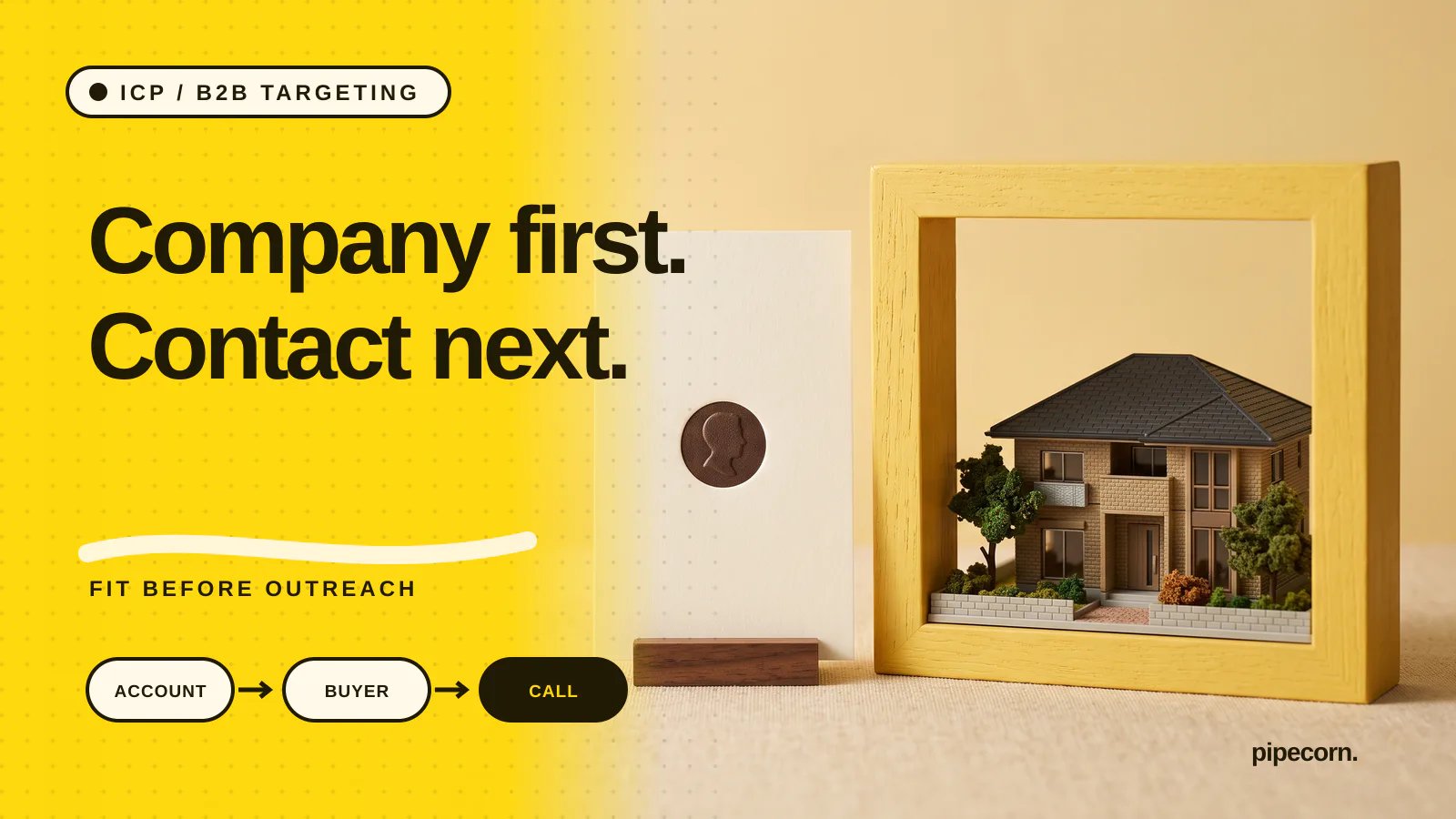
For example, an outbound agency might target French B2B software companies with an established sales team. That is an account profile. The Head of Sales who needs more qualified conversations is a buyer persona. The example below shows how to separate company fit, buyer role, and timing before building a call list.
Editorial review: September 7, 2026. The worked example is illustrative, not a customer case study or performance benchmark.
Table of Contents
- What ICP Actually Means in a Business Context
- ICP vs Buyer Persona, TAM, and SAM
- The Four Attribute Layers of a Real ICP
- How to Build an ICP From Scratch
- Operationalizing the ICP in Daily Outbound Work
- How to Validate the ICP Is Actually Working
- Why the ICP Is the Contract Between Strategy and Execution
What ICP Actually Means in a Business Context
An ICP turns a broad market into a set of account-selection rules: industry, company size, geography, relevant operating needs, and reasons your product could help. It is a hypothesis to validate against customer evidence, not a guarantee that a company will buy. Gong's sales ICP guide makes the same core distinction: ICPs describe companies; personas describe the people within them.
For a rep, that is the difference between “everyone in my territory” and “the accounts worth spending time on.” A company can look attractive on paper and still be a poor fit if it lacks the right tools, buying signals, or operating context. ICP turns that judgment into a repeatable targeting model, so the call list, scoring rules, and CRM routing logic all point in the same direction.
What those attributes look like in real life
Firmographic data is the easiest place to start. It includes the company's industry, size, geography, and stage.
Environmental data adds context around the company's situation, such as growth phase, market pressure, or compliance environment. Behavioral data covers what the account is doing, like visiting your site, reading pricing pages, or engaging with your content.
Practical rule: if a detail does not help a rep decide whether to contact an account, score it, route it, or ignore it, it probably does not belong in the ICP.
A B2B ICP example: account, person, and trigger
Account fit — who belongs on the list?A French B2B software company with an established sales team, selling through outbound conversations. Its sales team needs more relevant accounts to contact.
Buyer persona — who owns the problem?The Head of Sales or outbound team lead. Their job title guides contact selection; it is not the ICP itself.
Timing signal — why reach out now?A recent SDR hiring announcement may justify researching the account now. It is a signal to investigate, not proof of budget or purchase intent.
Exclusion — when should we stop?A consumer-only app with no outbound sales motion fails this example's account criteria, even if a senior contact's phone number is available.
One useful way to make this concrete is to connect the profile to daily tooling. A rep can use the ICP to decide which accounts should appear first in outbound lists, which records deserve enrichment, and which leads should be routed into a faster sales path. For a practical example of how teams translate profile criteria into persona-based account research, see this Sales Navigator personas guide.
Once you start reading accounts through that lens, prospecting gets cleaner. Instead of asking, “Who can I email today?”, the better question becomes, “Which companies match the profile that turns into revenue?”
ICP vs Buyer Persona, TAM, and SAM
ICP gets confused with other go-to-market terms because they all sound like “target audience.” They're not the same thing. An ICP describes the company or account, while a buyer persona describes the individual decision-maker inside that account. That distinction matters because enterprise buying usually involves more than one person, and account-level definition helps teams route inbound leads and disqualify poor-fit opportunities earlier in the funnel.
TAM and SAM sit at a different level entirely. TAM, or total addressable market, is the broad universe of every possible customer in theory. SAM, or serviceable addressable market, is the part of that universe your product can realistically serve. ICP sits inside those definitions and tells you which accounts are worth prioritizing first.
Quick comparison of the four terms
| Concept | What It Defines | Used By |
|---|---|---|
| ICP | The best-fit account or company | Sales, RevOps, marketing |
| Buyer persona | The individual inside the account | Sales, marketing, product |
| TAM | The full theoretical market | Leadership, planning |
| SAM | The reachable slice of the market | Strategy, forecasting |
A practical way to remember it is simple. TAM tells you how big the ocean is, SAM tells you where your boat can go, ICP tells you which fish are worth catching, and persona tells you who's holding the rod on the buyer side.
Operational takeaway: if routing, scoring, and outbound lists are built off personas alone, reps end up talking to the right person at the wrong company.
For reps and managers, the safest way to stay aligned is to treat ICP as the account filter and personas as the messaging layer. If you need a concrete refresher on the persona side, this internal guide on Sales Navigator personas helps separate account targeting from contact-level outreach.
The Four Attribute Layers of a Real ICP
A useful ICP gets more precise when you score more than one kind of signal. Teams do best when they organize the profile into four layers, then decide which ones predict good deals for their business. The point isn't to collect everything. The point is to collect the right things and weight them accurately.
Start with firmographics and technographics
Firmographics are the company basics, such as industry, revenue band, headcount, and geography. These are usually the first filters in an outbound list because they're easy to validate and easy to explain to a rep.
Technographics tell you what the company already uses. If your product depends on an existing CRM, cloud provider, or marketing stack, technographics show whether the account is even compatible.
Good ICP data is specific enough that a rep can act on it without asking for clarification.
For example, “uses Salesforce” is more useful than “uses enterprise software.” “Has 200-plus employees” is better than “mid-market-ish.” Precision is what makes routing and enrichment work.
Add behavior and situational triggers
Behavioral signals show interest. That can include website visits, content downloads, pricing-page views, or repeated engagement from a target account. These are often the strongest signals for prioritization because they reflect active attention.
Situational triggers are changes that make an account more likely to buy now. Think funding, leadership hires, expansion into a new market, or new compliance pressure. These triggers matter because timing changes intent.
- Firmographics: is this the right kind of company?
- Technographics: does its existing stack fit your requirements?
- Behavior: is there a relevant, legitimately collected signal of interest?
- Situational trigger: has something changed that makes a conversation timely?
A strong ICP usually blends all four layers instead of leaning on only one. Firmographics help you rule out obvious bad fits. Technographics and behavior help you prioritize. Triggers help you time the outreach.
The best version is the one your team can maintain. If the profile gets too long, reps stop using it. If it's too vague, it stops separating high-fit accounts from everything else.
How to Build an ICP From Scratch
A useful ICP usually starts with live customer evidence, not a brainstorm. Pull your best accounts first, then look for the patterns they share across fit, buying behavior, tool stack, and the problems they were trying to solve. That gives you a profile your team can use, the same way a sales ops team would use a scoring model to sort accounts before they ever enter a sequence.
Start by reviewing your strongest customers and the deals that moved cleanly from interest to closed-won. Ask what those accounts have in common in the company itself, in how they buy, in the tools they already use, and in the work they are trying to get done. A rep's memory can help, but it often gives too much weight to memorable wins and too little weight to the steady, repeatable deals that reveal the pattern.
Then convert those shared traits into criteria your team can apply. Some fields should act as hard filters, like geography or stack compatibility. Others work better as scoreable signals, like hiring patterns, new funding, or repeated engagement with pricing content. That is where the ICP stops being a slide and starts behaving like an operating rule for list building, routing, and prioritization.
Reverse-engineer the common traits
A practical way to build the profile is to work backward from accounts that already proved they were a fit. Start with the companies that bought well, stayed, and expanded, then look for shared traits across them. The point is not to describe your favorite customer. The point is to find what consistently shows up before a deal becomes worth the effort.
One simple way to keep the process grounded is to separate obvious fit from useful signal. Obvious fit covers the basics, like industry, size, geography, and stack compatibility. Useful signal covers the subtler parts, like whether the buying team already uses a tool your product connects to, whether they are hiring for the problem you solve, or whether they have been active on relevant pages.
Score it, then test it
A real ICP gets stronger when each attribute has a weight. That weight should come from closed-won patterns, not from what sounds impressive in a planning meeting. If a trait looks attractive but does not show up often in actual revenue, give it less weight or remove it.
Then compare the profile against closed-won and closed-lost opportunities. If the model keeps favoring accounts that look polished but never convert, the profile is probably too surface-level. If it misses the accounts your team wins most often, the criteria need to be sharper and closer to the signals that show up before a deal closes.
Practical rule: a useful ICP should let a rep look at an account and answer, “Do we pursue this or not?” without opening three tabs and asking for help.
That test matters because reps need a profile they can apply quickly inside the CRM, in enrichment tools, and in outbound routing. If the answer depends on interpretation every time, the scoring model is too loose to guide action.
Write it as a working document
The final version should fit on one page and read like a field tool, not a strategy memo. Use plain language. Include the account types you want, the ones you do not want, the scoring logic, and the signals that matter most. A new rep should be able to pick it up and know what to do with it on Monday morning.
Operationalizing the ICP in Daily Outbound Work
An ICP earns its place when it changes what sales ops and reps do inside the tools they use every day. In outbound, that means the profile is not just a planning document. It becomes the rule set for building lists, cleaning records, routing accounts, and deciding which outreach gets triggered.
Start with list building. Reps and ops teams use the ICP to assemble company and persona lists that match the right industry, tech stack, and buying stage. If the target says mid-market software firms with a certain stack, the list should reflect that, not whatever looks active in a database that morning. From there, lead cleaning can check whether a contact still fits the targeting rules before it enters a sequence.
Enrichment comes next. If an account fits the ICP but the record is thin, waterfall enrichment can fill gaps across multiple providers instead of depending on one database. Real-time sourcing helps when static records go stale, and job-change tracking helps you catch a champion after that person moves to a new company that still fits the profile. The same logic applies to web intent, so an internal guide on how to track website visitors can sit naturally beside your account-scoring rules.
Where the workflow usually breaks
The usual failure point is handoff. A rep finds a promising account, but the CRM is not synced, the lead is routed to the wrong owner, or the sequence starts before the data is clean. That creates wasted touches and weak connects, even when the account itself looks right.
The better setup pushes ICP-fit accounts into the CRM first, then into Outreach, Salesloft, or lemlist on a schedule that matches rep capacity. The model sets priority. The tooling handles delivery. The rep spends time on accounts that deserve attention instead of sorting through records that should have been filtered out earlier.
This is also where the scoring model pays off in day-to-day work. Once ICP rules are wired into routing, enrichment, and sequencing, the team stops paying to contact bad-fit accounts as often. The stack gets quieter, the lists get cleaner, and follow-up is easier to manage because fewer records slip through that should never have been touched.
Once the distinction between account fit and buyer persona is clear, use the separate B2B outbound ICP workflow guide for a broader implementation walkthrough.
How to Validate the ICP Is Actually Working
An ICP that never gets checked turns into a document full of assumptions. A useful way to keep it honest is to compare ICP-fit accounts against everyone else in the market and see whether the profile keeps helping reps open better conversations.
Watch the signals that matter
Start with connect rate, defined here as live conversations divided by calls placed. Track it separately from ICP quality: contact-data accuracy, call timing, and the calling process also affect it. Then look at qualified-meeting rate, because a meeting only matters if it comes from an account that fits the ICP.
The next signal is opportunity conversion rate, which shows whether the profile is pointing toward real pipeline. Then check customer acquisition cost per ICP-fit account, which tells you whether the targeting is efficient enough to scale without wasting effort on poor-fit accounts.
Do not wait for annual planning to fix a stale ICP. Review it on a regular cadence so weak signals don't quietly become your new normal.
Operational symptoms usually show the same story before the revenue numbers do. Rising bounce rates usually mean the data is stale. Falling connect rates can mean the profile is too broad, enrichment is off, or lists are being pulled from the wrong sources. If reps keep saying the list “feels off,” that feedback matters because they are seeing the result in real outreach.
You can also use behavior data to check whether the right accounts are paying attention before the first reply. Tracking website visitors helps teams see whether ICP-fit accounts are showing interest early, which makes it easier to judge whether the profile is drawing in the right audience.
Revisit the model without throwing it out
The goal is not to rebuild the ICP from scratch every time something changes. Adjust the weights first. If one signal keeps showing up in successful deals, give it more weight. If another signal looks promising but does not help win, reduce its influence.
A quarterly review with closed-won and closed-lost data can provide a useful starting cadence. Revisit earlier if your product, market, or customer evidence changes. Compare similar sales motions and time windows so a channel change is not mistaken for better account targeting.
- Contact quality: live conversations / calls placed.
- Meeting quality: qualified meetings / live conversations.
- Pipeline quality: opportunities created / qualified meetings.
- Acquisition cost: attributable sales and marketing spend / new ICP-fit customers.
Why the ICP Is the Contract Between Strategy and Execution
The core value of ICP is that it links the plan on paper to the work reps do every day. Marketing can run account-based programs against the same target as sales, RevOps can route and score with the same rules, and enrichment can focus on the accounts that matter most instead of every record in the database.
That's why the best ICP is not a slogan. It's the agreement that tells the whole revenue team which accounts deserve attention, which ones should be skipped, and which signals matter when timing outreach. When that agreement is clear, the rest of the stack works with less waste and less guesswork.
If you're building your own target model, start with the account definition, wire it into your workflows, and revisit the weights regularly. A sharp ICP makes outbound easier, CRM routing cleaner, and follow-up more consistent because everyone is using the same filter. ABM examples and strategy are a good next step if you want to see how that contract shows up in real go-to-market motions.
Turn your company criteria into a call list. With Pipecorn's prospecting extension, finding leads and building lists is unlimited; credits apply to email and phone enrichment. Qualify the account first, choose the buyer role second, and enrich the contact details you actually need. Review the prospect's context and applicable outreach rules before calling.