What Is Data Verification and Why It Matters in 2026
What is data verification? Learn the techniques, benefits, and compliance rules that make verified B2B contact data drive outbound sales results.

On this page
- 01The Outbound Problem Verification Is Built to Solve
- 02Defining Data Verification Without the Jargon
- 03How Email Verification Actually Works in Practice
- 04Mobile Number Verification and the Limits of Carrier Checks
- 05Why Verified Data Changes Outbound Sales Outcomes
- 06Compliance, Consent, and Verified Personal Data
- 07Inside Pipecorn's Real-Time Verification and Waterfall Workflow
- 08Building Verification Into Your Outbound Stack as a Habit
Data verification is the process of checking whether information matches a trusted source and still represents reality at the moment of use. It confirms evidence—for example, whether a business email can receive mail or whether an employer and role are current—before a record enters a sequence, CRM workflow, or forecast. Verification reduces uncertainty; it does not make a dataset perfect or prove that a contact fits your market.
That distinction matters when a clean-looking prospect list hides closed domains, former employees, or fabricated records. Launching without checks wastes SDR research time, consumes sending capacity, and distorts the campaign reporting RevOps relies on.
The Outbound Problem Verification Is Built to Solve
A typical outbound failure starts long before the first email is sent. An SDR imports a large scraped list, trusts the provider's status field, and launches a campaign without checking whether each address still works. The list may contain typos, disposable domains, generic role accounts, former employees, and mailboxes that accept no new messages.
The consequences appear in several places at once. Sales development spends time pursuing records that can't respond. Marketing and RevOps receive distorted campaign results. Sales leaders see fewer meaningful conversations, while the sending domain carries the risk created by invalid traffic.

Verification is an operating control
The U.S. Department of the Interior's data verification standards show that verification has long been treated as a formal quality-control practice in public-sector reporting. The U.S. Environmental Protection Agency places verification within the assessment phase of the data life cycle, where teams check whether collection and planning requirements were implemented as intended. Statistics Canada similarly uses pre-release certification and validation to identify gross errors and remove poor-quality data before publication.
Outbound teams apply the same logic to contact records:
- Before sourcing: define which fields matter, such as business email, direct mobile, employer, role, and location.
- Before sequencing: check whether the record can receive the intended message.
- Before CRM sync: store the result, timestamp, and reason so other teams can interpret the field.
- After launch: monitor bounces, failed calls, replies, and status changes as feedback for the next verification cycle.
A 2026 survey research article reported that 1,358 of 2,315 online crowdsourced responses, or 58.7%, failed at least one quality check and were classified as poor-quality data. That result doesn't mean every prospect database has the same failure rate, but it does show why large digital datasets need systematic filters rather than visual inspection alone. The survey research findings provide a useful reminder for RevOps teams: a record can look plausible and still fail an operational check.
The rest of this guide separates verification from validation, explains the mechanics behind email and mobile checks, and connects those checks to live outbound workflows. The important shift is treating verification as a recurring pipeline control, not a one-time cleanup before a campaign.
Defining Data Verification Without the Jargon
Data verification means checking whether a record accurately reflects the source from which it came. In a contact workflow, you might verify the person's email, phone number, name, employer, and role against available signals to determine whether the record is real, reachable, and currently accurate.
That definition is narrower than “good data.” It asks whether the record corresponds to reality at the point of use. It doesn't automatically prove that the person is the right buyer, that the company fits your ideal customer profile, or that the original source wasn't biased.
Most teams combine five data verification methods, choosing the evidence that fits the decision:
- Source comparison: compare the stored value with an authoritative document, system, or first-party record.
- Cross-source matching: check the same field across independent sources and investigate conflicts instead of accepting the first match.
- Operational checks: test whether the value works in practice, such as DNS, MX, SMTP, or carrier checks for contact data.
- Reconciliation: compare totals, duplicates, missing values, and change history to catch records that do not fit the surrounding dataset.
- Sampling and manual review: inspect a risk-based subset when automated evidence is incomplete or the cost of a wrong decision is high.
No single method proves every field. Record the source, check time, result, and limitation so the next person can judge what “verified” actually means.
Three terms that answer different questions
Verification asks, “Does this record match the source or current external evidence?” An email verification service may determine that a domain has active mail infrastructure and that a mailbox appears able to receive messages.
Validation asks, “Does this record follow our rules or serve our intended purpose?” A CRM may validate that a country field uses an approved value, a job title fits a targeting rule, or an email field follows an accepted format.
Data quality management covers the broader system. It includes completeness, freshness, uniqueness, consistency, accuracy, governance, and the procedures used to correct records over time. The practitioner's guide to data verification explains the practical distinction: verification checks whether information matches what was captured or reported, while validation considers whether the data is suitable for its purpose.
Use one address analogy to keep the terms straight. Verification is the postman confirming that the house exists and the person still lives there. Validation is the form-checker confirming that you entered the address in the right boxes. Data quality is the whole mailbox maintenance routine, including removing duplicates, updating forwarding details, and recording when the address was last checked.
Practical rule: A verified record can still be a poor prospect. It may be reachable but outside your market, missing consent, or attached to an incomplete account.
The distinction affects purchasing decisions. A formatting tool can catch malformed values without checking whether the person exists. A verification service can confirm reachability without assessing buying relevance. An effective outbound stack needs both, with clear ownership for each result.
How Email Verification Actually Works in Practice
Email verification works like a package moving through several checkpoints. The first checkpoint inspects the label. Later checkpoints confirm that the destination exists and can accept the package. No single check answers every question, so the pipeline combines them.
Step one checks the address label
A syntax check looks for a structurally plausible address. It can catch a missing domain, illegal characters, incomplete formatting, or an obvious typo such as gmial.com. This check is fast and inexpensive, but it only evaluates the shape of the address. A correctly formatted address can still lead nowhere.
The next check examines the domain and its mail infrastructure. A DNS lookup checks whether the domain resolves, while an MX check looks for mail-exchange records that indicate where the domain receives email. If the domain has no usable mail destination, the record shouldn't move into a cold sequence.
Step two confirms mailbox behavior
An SMTP-style handshake creates a quiet conversation with the receiving mail server. The verifier asks whether the specific mailbox appears able to accept mail, without sending the campaign message. The result may be valid, invalid, risky, or unknown, depending on the server's response and the provider's confidence.
Email verification guidance from BounceProof's B2B email accuracy resource reports 5–15% hard bounce rates for unverified lists, while verification can reduce hard bounces by 60–90% and bring post-verification campaigns below 2% in most industries. Those figures are industry guidance, not a guarantee for every database. They illustrate why the later checks matter after syntax and domain screening.

Step three adds campaign-specific judgment
A deliverability result still needs interpretation. Role-based addresses such as info@ or sales@ may be reachable but less useful for personalized prospecting. Disposable domains can represent temporary inboxes. Catch-all servers may accept messages for almost any address, making mailbox-level confirmation less certain.
Store these signals instead of reducing everything to a single green check. Your CRM should distinguish deliverable, risky, invalid, role-based, disposable, and catch-all outcomes when the workflow requires that detail. Teams that need a programmatic implementation can review this email verification API guide for a way to place these checks inside enrichment or routing logic.
The sequence matters because each layer narrows uncertainty. Syntax catches malformed labels, domain checks confirm the destination infrastructure, and the SMTP handshake tests the mailbox response. A result is useful only when the team knows which checks produced it and when they ran.

Mobile Number Verification and the Limits of Carrier Checks
Phone verification follows the same principle as email verification, but the evidence is different. A number can have the correct structure and still be disconnected, reassigned, redirected, or attached to the wrong person.
Start with the number itself
Format validation checks the country code, length, and international structure, often using the E.164 standard. This catches a missing country prefix, an incomplete local number, or a string that was imported as text rather than a callable number.
A carrier lookup can then check whether the number appears active on a mobile network. HLR-style checks may return network and routing information, and can sometimes indicate whether the number is mobile, landline, or otherwise classified. These checks answer, “Can this number exist on a network?” They don't fully answer, “Does this number belong to the executive in my CRM?”
Ownership requires stronger evidence. Providers may combine authoritative data feeds, identity graphs, first-party interactions, and consent records. A recent call or form submission can be more useful for current ownership than a static carrier response, especially when the contact changes jobs or replaces a device.
Treat a carrier result as a signal
Carrier checks have practical limits. Number porting can move a line between carriers, roaming can obscure the current network state, and a SIM swap can transfer control of a number without changing the digits. AI-assisted impersonation also makes voice identity harder to infer from a successful connection alone, a concern discussed in recent digital identity verification insights.
The phone number verification service overview offers useful context on how number checks fit into a broader contact workflow. The operational lesson is simple: a live number isn't automatically a verified person.
A mobile record should carry its evidence, not just its status. Record the check method, the time of the check, and the confidence or limitation attached to the result.
For high-priority outbound, verify close to the moment of use. A number stored once and trusted indefinitely will eventually drift as people change employers, carriers, devices, and contact preferences.
Why Verified Data Changes Outbound Sales Outcomes
Verified data changes outbound economics through mechanics rather than magic. When fewer records fail at delivery, SDRs spend more of their working time on conversations, research, and follow-up instead of investigating bounced addresses. RevOps also gets cleaner campaign reporting because failed delivery is less likely to obscure the difference between weak messaging and unreachable prospects.
The World Bank and J-PAL describe recurring practices such as daily or weekly high-frequency checks, back-checks, and spot-checks in data collection workflows. Their guidance on verification mechanisms and quality checks supports a broader operating principle: verification works better as a feedback loop than as a one-time gate.
Read the list as a risk profile
The table below uses the hard-bounce ranges and post-verification outcomes reported in the industry guide cited earlier. It doesn't promise a result for your campaigns, and it doesn't assign unsupported values to connect rates or pipeline. It shows which operational metric verification directly influences.
| Metric | Unverified B2B List | Verified with Waterfall Enrichment |
|---|---|---|
| Hard-bounce exposure | 5–15% reported for unverified lists | Below 2% reported in most industries after verification |
| Record handling | One provider's snapshot | Sequential checks across available sources |
| Failed records | Often discovered after sending | Filtered before sequencing when checks support a decision |
| SDR effort | Time spent researching or replacing bad contacts | More time available for reachable prospects |
| CRM confidence | Status may lack method or timestamp | Result can include evidence, source, and verification time |
The value extends beyond inbox placement. With fewer delivery failures, teams can evaluate subject lines, offers, and call-to-action language using a cleaner audience. Managers can also identify whether a sequence underperformed because the message was weak or because the list was unreachable.
Waterfall enrichment increases resilience
A single database can miss a person or retain a stale value. Waterfall enrichment routes an unmatched record through multiple sources in sequence. A team might begin with first-party data, check network-verified sources next, use additional inference carefully, and apply human review where the risk justifies the cost.
The process shouldn't force every record into a “verified” bucket. Some records remain uncertain, and the correct action may be to suppress them, request consent, or send them to manual review. The goal is documented confidence at scale, not a perfect-looking database.
Compliance, Consent, and Verified Personal Data
Verification supports compliance, but it doesn't create a lawful basis for outreach by itself. A reachable email address can still be personal data, and a current phone number can still be used improperly. Your team needs to connect accuracy, purpose, consent or another lawful basis, retention, and individual rights.
The EU General Data Protection Regulation text requires personal data to be accurate and kept up to date under its data-quality principles. California's Consumer Privacy Act guidance likewise makes accuracy and consumer rights relevant to how organizations maintain and use personal information. The specific obligations depend on your role, jurisdiction, relationship with the prospect, and outreach channel, so legal counsel should interpret the rules for your program.
Build evidence into the record
For legitimate-interest outreach, a company generally needs a documented reason why the processing is relevant and proportionate. Verification helps demonstrate that the contact is current and connected to the stated business purpose. It doesn't replace a legitimate-interest assessment, an opt-out process, or careful targeting.
Consent requires its own provenance. Capture when consent was given, what the person agreed to, the channel or context, and how the organization can honor withdrawal. Teams looking for a plain-language explanation of this evidence can review robotics data consent artifacts, which describes how a consent artifact can preserve the record of an individual's permission and context.
A verification log should sit beside the contact record. Include:
- Check time: when the email or mobile status was assessed.
- Method: the type of check used, such as syntax, domain, SMTP, carrier, or first-party confirmation.
- Result: valid, invalid, risky, unknown, or another defined status.
- Provenance: the source and consent context supporting the record.
- Action: whether the team sequenced, suppressed, reviewed, or requested an update.
That log serves two audiences. SDRs can decide quickly whether a contact is usable, while privacy and RevOps teams can show how the organization handled accuracy and change over time. Keep the process proportionate, restrict access to personal data, and give people a clear path to correction or removal.
Inside Pipecorn's Real-Time Verification and Waterfall Workflow
A live workflow begins at the moment a contact enters the system, not after a campaign has already produced bad results. A form submission, list upload, website capture, or enrichment request creates an event. The workflow can then evaluate the record before it reaches Salesforce, HubSpot, Outreach, or another downstream system.
Capture and check the first source
The first pass examines the email structure and domain. An MX handshake checks whether the domain appears to have reachable mail infrastructure, while an SMTP-style confirmation assesses whether the mailbox responds. If the result is invalid or too uncertain for the campaign, the record can be held rather than sent directly to a sequence.
Records that don't produce a usable result can move through a waterfall of alternative providers. That approach reduces dependence on a single database snapshot and can search for another business email, mobile number, LinkedIn URL, or current job title. The waterfall enrichment guide explains this sequential sourcing model in more detail.
Normalize before the CRM receives it
AI-based cleaning can standardize job titles, remove role aliases, identify disposable domains, and apply the team's targeting rules. This is validation work, not proof that the person is reachable. Keeping those stages separate prevents a well-formatted but unusable record from receiving a misleading “verified” label.
A practical record might leave the workflow with:
- Contact identity: name, employer, and role as captured.
- Reachability: email and mobile results with their individual statuses.
- Evidence: provider, method, confidence, and timestamp.
- Routing: sequence-ready, manual review, suppressed, or rejected.
- Destination: CRM, sales engagement platform, or an internal queue.
The workflow can then map the enriched record into Salesforce or HubSpot with its verification timestamp. That preserves context for the SDR, prevents silent overwrites, and lets RevOps re-check priority records when campaign timing changes.
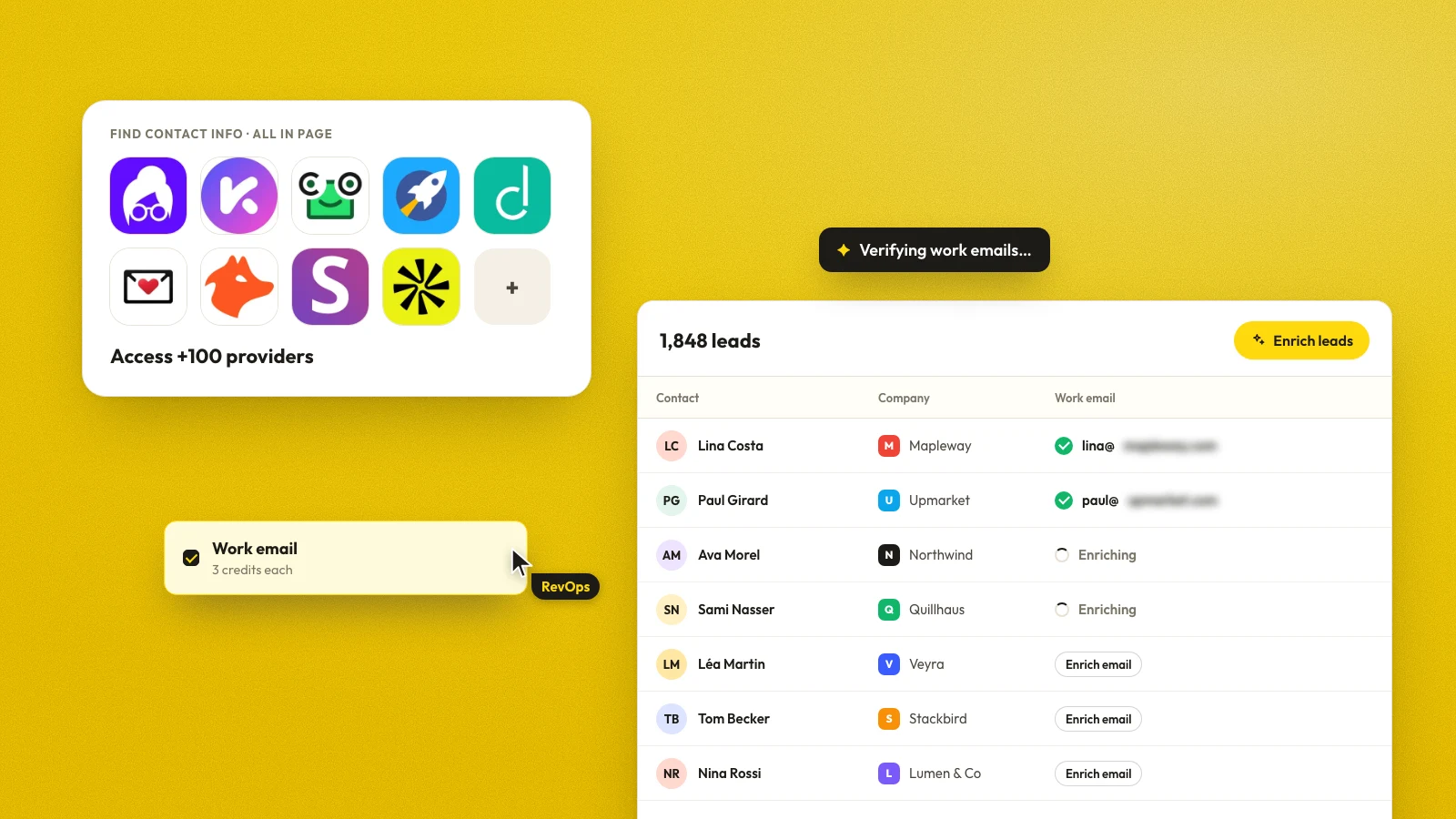
Pipecorn is one example of this model. Its B2B data platform combines real-time sourcing, AI cleaning, verification, waterfall enrichment across more than 100 providers, and delivery into CRM or sales-engagement workflows. Use those product capabilities as workflow components, not as a substitute for defining your own evidence standards and suppression rules.
The important design choice is on-demand verification. A nightly batch may be useful for maintenance, but a contact captured five minutes before a high-priority sequence deserves a check at the point of capture. That timing makes the verification result part of the outbound decision instead of a historical label attached after the fact.
Building Verification Into Your Outbound Stack as a Habit
A verified list isn't a permanent asset. It's a temporary statement about what your team knows at a particular time, using a particular method. People change roles, companies update domains, numbers get reassigned, and providers revise their records.
Ask every data vendor three pressure-test questions:
- How fresh is the result at the moment of capture? A recent verification timestamp is more useful than an undated status field.
- What happens when the first check fails? Look for a documented waterfall, suppression path, or human-review queue.
- How is consent provenance stored beside the record? A contact status without lawful-basis or consent context leaves a material gap.
A lightweight operating cadence keeps the process practical:
- High-priority accounts: re-check records close to sequence launch and after meaningful account or personnel changes.
- SDR team: review bounce and failed-call outcomes every week, then feed patterns back into sourcing rules.
- RevOps and privacy: reconcile data practices with governance records and retention requirements on a recurring schedule.
- Every campaign: require verification status, timestamp, and disposition before a contact becomes sequence-ready.
Playbook check: No timestamp, no method, no provenance, no send.
Make verification a default workflow trigger for new records, not an emergency response after deliverability drops. Start by mapping the fields your SDRs use, define the statuses they can act on, and create a suppression path for uncertainty.
Pipecorn combines real-time contact sourcing, email and mobile verification, AI cleaning, and waterfall enrichment across more than 100 providers, with CRM and sales-engagement integrations for operational handoff. Visit Pipecorn to see how you can make trustworthy contact data part of every outbound workflow.