
What Is Sales Leadership: A Practical Guide for VPs
Explore what is sales leadership, discover core responsibilities, coaching, forecasting, and practical strategies to build high-performing B2B sales teams.

Article summary
- Sales leadership is the operating discipline that connects commercial strategy to the daily behaviors, decisions and controls that create qualified pipeline. A manager supervises sellers; a leader designs the system.
- The core responsibilities: align strategy with the accounts the team can win, run a coaching cadence that changes behavior, inspect pipeline evidence rather than labels, and protect forecast discipline.
- Before asking for more activity, find the real bottleneck: rep execution, manager capability, territory design, pipeline quality or data integrity.
- Coaching and data quality belong in the same conversation. Verify the input (fit, role, contact, job status) before judging the outreach.
- Track outcome, funnel, data and management metrics, and give each one an owner and a response.
Want to go further? Ask
 ChatGPT
 Claude
 Perplexity
 Grok
GrokOn this page
- 01Defining Sales Leadership Beyond Motivation
- 02The Evolution and Impact of Sales Leadership
- 03Core Responsibilities of Effective Sales Leaders
- 04Managing Activity Versus Building Systems
- 05Coaching and Data Quality in Modern Selling
- 06Key Performance Indicators for Sales Leadership
- 07Building a High-Performing Sales Team
What should a sales representative do when a buyer already knows the product basics, has compared vendors with AI, and still isn't ready to make a decision? That question exposes the gap in conventional definitions of sales leadership. Motivation, quotas, and pipeline reviews matter, but they don't explain how a leader turns unreliable data, uneven coaching, and inconsistent execution into repeatable revenue performance.
The plan after a missed quarter:
more energy, more calls, more belief.

Defining Sales Leadership Beyond Motivation
Sales leadership isn't primarily about delivering energetic speeches or pushing sellers to make more calls. It is the operating discipline that connects commercial strategy to the daily behaviors, decisions, and controls that create qualified pipeline. A sales manager supervises individual sellers. A sales leader designs the system in which sellers, managers, data, process, and customer decisions interact.
The distinction changes what leaders inspect. A motivational manager asks whether representatives are working hard enough. A systems-oriented leader asks whether the ideal customer profile is specific, whether territories support fair execution, whether contact records are usable, whether qualification rules are consistent, and whether coaching changes observable behavior.
The leader as a control system
A useful control system has standards, inputs, feedback, and corrective action. In sales, the standards include ICP definitions, qualification stages, CRM requirements, messaging principles, and escalation paths. The inputs include account data, buying signals, rep activity, opportunity evidence, and customer conversations.
The feedback loop appears in weekly one-to-ones, call reviews, opportunity inspections, and forecast meetings. Corrective action might mean changing territory design, replacing invalid contacts, narrowing a segment, retraining discovery, or removing an opportunity that lacks a credible buying process.
The relevant question isn't whether a leader appears charismatic. It's whether the team can execute the strategy consistently without depending on one person's memory or energy.
A strong sales leader also works closely with operations. The sales operations analyst can expose gaps between what the CRM reports and what the field experiences firsthand. That partnership prevents leadership from treating bad data as bad selling.
The Evolution and Impact of Sales Leadership
Why did sales leadership become a distinct function in the first place? Because once companies had to sell at industrial scale, individual selling skill stopped being enough. In the late nineteenth and early twentieth centuries, firms such as National Cash Register, Eastman Kodak, Coca-Cola, Westinghouse, and Carnegie Steel built formal sales methods alongside the operating discipline used in mass production. By the 1920s, sales management had become a strategic function rather than an informal extension of a single rep's effort (history of the American salesman).
The underlying problem has not changed. The complexity has. A rep still owns the conversation, but leadership owns the system around it: which accounts get attention, what evidence counts as real progress, how discovery gets inspected, and whether forecast stages reflect an actual buying process or just rep optimism.
That matters even more now that buyer information is everywhere and much of it is generated, summarized, or recycled by AI tools. Access to information no longer gives a leader much advantage. Confidence in that information does. Strong sales leadership shifts from feeding reps more facts to building standards for data quality, message discipline, opportunity proof, and inspection cadence so teams can act on information without polluting the pipeline.
Sales has carried organizational weight for a long time. Approximately one-quarter of the chief executives of the 200 largest U.S. industrial companies in 1917 had spent part or all of their careers in sales. In 2000, about 16 million people worked in sales occupations in the United States, representing roughly 12% of the employed workforce. The point is straightforward: companies needed a repeatable way to coordinate markets, people, and execution at scale, so sales leadership became strategic.
Leadership as a multiplier
Sales leaders influence results through people, process, and operating rules. They set expectations, hire and develop reps, define inspection rhythms, allocate accounts, and decide which behaviors get reinforced. Those decisions shape revenue quality before they show up in quarter-end numbers.
The management effect is measurable. Research on sales-manager effectiveness found that high-skill managers produced 29% higher revenue performance, 47% higher employee-satisfaction scores, and 16% higher customer-satisfaction scores than low-skill managers. The revenue effect held regardless of the individual skills of the salespeople being managed (sales management as a source of competitive advantage).
Good leadership will not fix a bad market or a weak offer. It does multiply the return on a sound strategy. That is why an effective outbound sales strategy needs clean account selection, consistent coaching, and pipeline controls behind it, not just a list, a sequence, and hope.
Core Responsibilities of Effective Sales Leaders
A sales leader converts a revenue target into coordinated execution across people, process, strategy, and measurement. The role includes setting targets, designing sales strategy, hiring and developing representatives, managing territories, coaching performance, maintaining pipeline health, and forecasting revenue (sales manager responsibilities).
Those responsibilities become useful only when translated into operating habits.
Align strategy with the accounts the team can win
The first responsibility is to define where the team should spend scarce attention. An ICP should specify company characteristics, relevant roles, triggering events, exclusion criteria, and the business problem that makes a conversation timely. A vague target such as “mid-market technology companies” gives representatives too much room to interpret and managers too little ability to diagnose.
Leadership should connect segmentation to routing, messaging, qualification, and capacity. If the team targets companies without the relevant use case, higher activity won't solve the problem. If the segment is valid but contact data is incomplete, the issue sits in data operations rather than rep motivation.
Build a coaching cadence that changes behavior
Coaching needs a recurring place on the calendar and a clear performance hypothesis. A manager might review a discovery call, identify that the representative accepts surface-level answers, practice a deeper question sequence, and inspect the next calls for evidence of changed behavior.
The intervention should stay narrow. One seller may need to improve objection handling, while another needs better opportunity planning. Treating both as a generic “motivation” problem produces noise instead of development.
Inspect pipeline evidence, not just pipeline labels
An opportunity shouldn't be considered healthy because it has a close date and a probability field. Managers should ask who is involved in the decision, what problem is being funded, what the next customer action is, and which risk could prevent progression. These questions make pipeline review a decision forum rather than a CRM status ritual.
Protect forecast discipline
Forecasting requires defined stages, consistent evidence, and timely escalation. A leader should separate a representative's confidence from the facts supporting the deal, then compare forecast categories with customer actions and documented next steps.
The rep: "This one closes this month."
The manager, looking at a close date already pushed twice:

The lead qualification process should support this discipline by making the handoff from target account to qualified opportunity explicit. Without that boundary, teams confuse interest, activity, and genuine buying intent.
Managing Activity Versus Building Systems
Call counts and email totals are easy to display, which makes them tempting management tools. They also create bad incentives when leaders treat volume as proof of progress. A representative can complete a large amount of activity against invalid contacts, poorly chosen accounts, or a message that doesn't match the buyer's problem.
The implication is uncomfortable for leaders who rely on dashboards. Poor results can come from several different bottlenecks, and each requires a different response:
- Rep execution: The account is suitable and reachable, but discovery, messaging, follow-up, or objection handling is weak.
- Manager capability: The manager notices the problem but can't diagnose it, demonstrate the skill, or follow up consistently.
- Territory design: Accounts are distributed unevenly, or the assigned segment doesn't match the team's capacity and expertise.
- Pipeline quality: Opportunities lack verified buying processes, economic relevance, or a credible next step.
- Data integrity: Contact records are outdated, role information is wrong, or important stakeholders are missing.
Diagnostic rule: Before asking for more activity, identify whether the team has a targeting problem, a data problem, a skill problem, or a management problem.
A systems leader pairs outcome metrics with system checks. The manager might compare meeting conversion with contact validity, or inspect whether low connect rates cluster around a particular data source. The goal isn't to excuse weak execution. It's to assign the correct owner to the constraint.
That is where outbound sales automation can help as an operating layer, but automation won't repair unclear ICP rules or poor coaching. It should reduce repetitive work and expose exceptions, while managers remain responsible for judgment, prioritization, and development.
Coaching and Data Quality in Modern Selling
An SDR can follow the right sequence and still fail if the contact record is wrong. A manager can deliver excellent feedback and still see no improvement if the rep can't reach the buying group. Coaching and data quality therefore belong in the same operating conversation.
Consider a common workflow. An SDR receives a list of accounts, finds a contact with a relevant title, and writes a message tied to a business trigger. The manager reviews the message and recommends a sharper hypothesis. The campaign still underperforms because the person changed roles, the number is invalid, or the contact doesn't influence the problem. The coaching was reasonable, but the system supplied poor inputs.
The SDR team after a week of dialing numbers that no longer work,
meeting the old contact list:

From information provider to confidence builder
Buyer behavior makes this distinction more important. Gartner's 2025 survey of 645 B2B buyers found that 45% used generative AI during vendor or product research, 70% preferred a fully digital self-service buying experience, and 69% still wanted sales representatives to validate AI-generated insights (Gartner's B2B buyer survey).
Buyers still use representatives to validate information, select suppliers, secure internal support, and finalize purchases. Sales leaders should respond by changing the job, rather than just adding automation. Representatives need training in interpretation, risk reduction, stakeholder alignment, and decision confidence. They shouldn't spend most of their time repeating information buyers can find independently.
A practical coaching loop
A manager can connect data quality and coaching through a simple sequence:
- Verify the input. Check the account fit, role, contact method, recent job status, and relevant trigger before judging the outreach.
- Review the behavior. Inspect the message, call, discovery question, follow-up, or handoff that shaped the result.
- Choose one intervention. Practice a new opening, rewrite the hypothesis, rehearse an objection response, or change the stakeholder plan.
- Measure the funnel effect. Track the relevant movement, such as verified-contact coverage, connect rate, meeting conversion, stage progression, or pipeline creation.
- Inspect again. Decide whether the behavior changed and whether the data or targeting constraint remains.
The data quality standards should make these checks explicit. A clean record isn't merely a database preference. It gives managers a fair basis for evaluating seller judgment and gives representatives a credible chance to execute.
Key Performance Indicators for Sales Leadership
Revenue is an essential outcome, but it arrives too late to diagnose most leadership failures. A sales leader needs a measurement set that distinguishes commercial results from the health of the system producing those results.
Forecasting and forward-pipeline management should be treated as connected but separate mechanics. Forecasting focuses mainly on late-stage opportunities and revenue likely to close in the current period. Forward-pipeline management asks whether enough future opportunities are being created and advanced to support later periods (forecasting and pipeline management).
A forecast can look complete while remaining operationally weak if opportunities lack verified buying processes, credible next actions, or evidence that the customer is progressing. Leaders should inspect both the current number and the conditions behind the next number.
| Metric Type | Examples | What It Reveals |
|---|---|---|
| Outcome metrics | Conversion, revenue, retention, forecast accuracy | Whether the commercial system is producing business results |
| Funnel metrics | Connect rate, meeting conversion, stage progression, pipeline creation | Where execution slows or loses quality |
| Data metrics | Contact validity, account coverage, speed after job changes | Whether representatives have usable inputs |
| Management metrics | Coaching consistency, opportunity-review quality, follow-up completion | Whether leaders are reinforcing the required behaviors |
Use metrics to trigger decisions
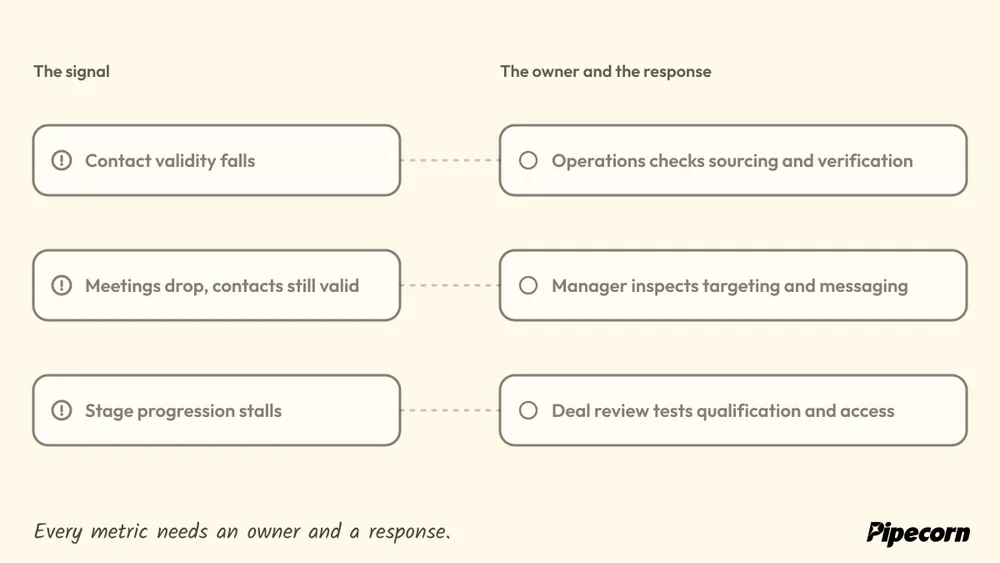
Each metric should have an owner and a response. If contact validity falls, operations should investigate sourcing and verification. If meeting conversion declines while contact validity remains stable, the manager should inspect targeting and messaging. If stage progression stalls, deal reviews should examine qualification and stakeholder access rather than demand more prospecting.
Teams comparing broader key revenue metrics for data teams should preserve this distinction between outcomes and operating signals. A dashboard becomes useful when it tells a leader what to change, not when it merely contains more fields.
A leadership KPI is valuable only when a manager can connect movement in the number to a specific decision, behavior, or system intervention.
Forecast accuracy deserves special care. Leaders should require defined stage criteria, customer-confirmed next steps, known risks, and a documented buying process. Forward-pipeline reviews should examine account coverage and opportunity creation separately from committed deals. That separation prevents late-stage optimism from hiding a future pipeline gap.
Building a High-Performing Sales Team
A high-performing team isn't built by hiring aggressive personalities and giving them a dashboard. It emerges when strategic alignment, reliable data, repeatable coaching, and disciplined measurement reinforce one another.
The practical sequence starts with operating clarity. Leaders define the ICP, qualification rules, account ownership, CRM stages, and evidence required for each progression. Representatives then know what good execution looks like, managers can coach against shared standards, and RevOps can distinguish a process failure from a seller failure.
Install the management rhythm
A workable cadence might include:
- One-to-ones: Review performance evidence, remove obstacles, and choose one development priority.
- Call reviews: Examine real conversations for discovery quality, relevance, listening, and next-step control.
- Role-play: Practice a specific behavior before the representative uses it with prospects.
- Deal strategy: Test stakeholder access, business impact, timing, risks, and mutual actions.
- Pipeline inspection: Separate current-period commitments from future pipeline creation.
The order matters less than the consistency and the connection to observable behavior. Salesforce describes effective management through recurring one-to-ones, call reviews, role-play, skill development, deal strategy, onboarding, and feedback tied to seller performance (effective sales managers).
Develop managers as operators
Frontline managers need their own coaching. A VP should inspect whether managers hold the agreed cadence, prepare for one-to-ones, document interventions, and follow up on assigned experiments. If managers only report numbers upward, representatives receive inspection without development.
The strongest teams also make data quality part of enablement. Reps learn how to assess contact confidence, interpret intent signals, and recognize when a buyer needs validation rather than another product explanation. Leaders can use guidance on building high-performance sales teams as a useful comparison point, but the operating test remains practical: can the team produce qualified pipeline without depending on heroic individual effort?
A sales leader's final responsibility is to keep the system honest. Strategy must shape targeting. Data must support execution. Coaching must change behavior. Pipeline reviews must expose risk. Forecasts must reflect evidence. When those parts work together, leadership stops being a motivational layer and becomes the mechanism that makes revenue performance repeatable.
Pipecorn helps B2B outbound teams organize ICP-based prospecting, clean and verify contact data, enrich records across multiple sources, and route qualified contacts into CRM and sales engagement workflows. Visit Pipecorn to build a more reliable data and pipeline system for the coaching and execution standards described above.